



Internal Audit
CRX | GRC Intelligence and Agentic AI across audit, risk, and compliance | Read more
March 31, 2026 • 30 min read
Key Takeaway: A modern HR audit covers seven functional areas and now includes algorithmic hiring tools, pay equity, and remote workforce compliance. The 2024 IIA Global Internal Audit Standards, EU AI Act, and June 7, 2026 EU Pay Transparency Directive deadline push practitioners toward continuous, risk-based assurance. Annual point-in-time reviews no longer satisfy regulators or the audit committee.
The HR audit has shifted from an annual compliance exercise into a continuous risk function, driven by the EU AI Act, the June 7, 2026 EU Pay Transparency Directive transposition deadline, and the 2024 IIA Standards (effective January 9, 2025). Practitioners now have to evidence pay equity, audit automated employment decision tools (AEDTs), and integrate HRIS data governance — work that fragmented documentation and reactive processes can no longer cover.
This guide walks through how to conduct an HR audit, the seven functional areas to scope, and how Optro centralizes records, evidence, and workflows across the audit lifecycle.
An HR audit is a systematic examination of HR policies, practices, documentation, and systems to confirm legal compliance and operational effectiveness. Unlike a standard compliance check, a thorough HR audit evaluates both what exists on paper and what happens in practice.
The scope of the audit typically covers:
For example, if an employee files a discrimination lawsuit, likely causes include weak hiring practices or gaps in equal-opportunity standards. An audit can identify and resolve those issues before they escalate and helps you build strategies to reduce the underlying risk.
HR audits can be conducted by:
The timing of HR audits varies based on organizational needs and risk profile:
HR audits work best when they are proactive, conducted before problems surface rather than in response to them.
A complete HR audit scopes seven functional areas. Use these as the backbone of your audit checklist:
Westlaw's Practical Law HR Audit Toolkit specifically flags handbook maintenance, lawful hiring practices, I-9/immigration compliance, and workplace policies as anchor scoping items within these areas.
HR audits surface blind spots that can create compliance, financial, and reputational exposure. Three reasons HR, audit, and compliance teams invest in this process:
As employment regulations keep evolving, more organizations are exposed to non-compliance. Without regular HR audits, compliance gaps can go undetected for years, resulting in penalties, lawsuits, and regulatory actions.
The U.S. Equal Employment Opportunity Commission (EEOC) processed 88,531 new charges in FY 2024 (up 9% year over year) and 88,201 in FY 2025, with the agency reporting record EEOC enforcement results. For example, one retailer paid $1 million in settlements due to discriminatory practices in its Bessemer, Alabama, distribution center. The retailer required job applicants to disclose family medical histories and used that information to exclude individuals with disabilities from employment.
Regular HR audits catch these issues before they damage hiring processes and trigger litigation.
Many organizations treat compliance as a separate function from operations. They create redundant processes that consume resources while still leaving gaps in coverage. This disjointed approach introduces administrative burden, drives errors, and blocks the integration of compliance into HR workflows.
For example, in 2023, the United Parcel Service (UPS) was ordered to pay $150,000 to an employee. The employee had diabetes and requested occasional breaks to check his blood sugar. The accommodation would have cost the company almost nothing, but instead, they fired the employee. The court found that UPS violated the Americans with Disabilities Act (ADA), which led to the fine. They also had to implement mandatory training and policy changes, leading to operational disruptions.
When you build compliance into your workflows, you can spot where reasonable accommodations are missing or where employee needs are not being met.
Compliance incidents become public almost immediately. Once an organization has dealt with such issues, regulatory authorities and prospective employees apply additional scrutiny in future hiring and reporting cycles.
Schuff Steel, a steel fabrication company, paid $500,000 for violating Title VII of the Civil Rights Act in 2023. Management was harassing Black and Latino employees and retaliating against those who complained. The company sustained severe reputational damage and had to implement company-wide anti-discrimination policies as part of the resolution.
Auditing your HR processes lets you address bottlenecks internally and externally. It also signals your commitment to ethical employment practices, builds employee trust through fair treatment, and over time gives you a competitive edge in recruitment and retention.
Several internal events trigger an HR audit:
With continuous compliance monitoring in place, you no longer wait for specific triggers. Your platform of choice should generate the evidence you need and feed your compliance filings.
HR audits generally fall into three categories: HR compliance audits, operational audits, and strategic audits.
Compliance audits review the organization against legal requirements such as the Americans with Disabilities Act (ADA), the Family and Medical Leave Act (FMLA), and internal policies. Common audits — I-9 file compliance, tax reporting, wage and hour — are typically tested with HR audit checklists. For I-9 specifically, sample current and terminated employee files to verify Form I-9 completion within three business days of hire, retention for three years post-hire or one year post-termination (whichever is later), E-Verify use where mandated, and reverification of work authorization for expiring documents.
Operational audits review daily HR processes such as compensation and benefits administration, performance evaluations, and safety practices. Operational audits examine:
Much of an organization's strategy starts with its HR strategy. Strategic audits take a forward-looking perspective to confirm HR practices support long-term business objectives and the effectiveness of the talent-management strategy.
Management objectives — filling key positions, non-discriminatory hiring practices, developing and training current staff, and succession planning — represent core risks across every organization.
Algorithmic hiring is the highest-velocity new risk area for HR auditors. After the EEOC's AI guidance was withdrawn in January 2025, practitioners are working without federal direction, which makes independent frameworks the defensible baseline.
Audit AEDTs against four anchors:
Maintain an enterprise AI inventory mapping every tool used across the HR lifecycle. According to the EY 2025 Work Reimagined Survey, 88% of employees use AI at work but only 28% of organizations achieve transformational results — the gap is largely a data governance and talent strategy issue auditors should evidence.
Pay equity audits in 2026 must demonstrably evidence equal pay for equal work. The EU pay transparency directive transposition deadline of June 7, 2026 requires reportable wage-gap analytics and employee disclosure rights across all member states. In the U.S., Washington's SHB 1905 (effective July 1, 2025) expanded wage equity protections, and most leading organizations are standardizing pay transparency and salary-history bans across all jurisdictions as a single baseline.
Integrate payroll data into your GRC platform for quarterly automated gap analysis rather than point-in-time reviews — that's the only way to meet the June 2026 deadline without manual scrambling.
Practitioners frequently confuse these three terms. They have distinct scopes, methodologies, and governance requirements:
Attribute | HR self-assessment | HR compliance audit | Full HR audit |
|---|---|---|---|
Scope | Informal pulse check on known issues | Legal and regulatory conformance (I-9, FLSA, ADA, FMLA, EEO) | All seven functional areas plus strategy |
Methodology | No standardized framework | Documented checklist against regulations | IIA Standards or SHRM toolkit methodology |
Owner | HR team self-review | Internal audit, compliance, or external counsel | Internal audit or independent external party |
Output | Internal notes | Compliance findings and remediation plan | Auditable evidence, remediation tracking, board reporting |
Independence | None | Partial | Required under 2024 IIA Standards |
A full HR audit improves your organization's bottom line and risk profile — fewer compliance violations, better retention, defensible documentation in legal disputes, and HR's elevation into a strategic partner role.
Tech tip: Platforms like Optro centralize and track controls, documentation, and workflows across the audit lifecycle — turning compliance into an ongoing exercise.
Here's how to perform an HR audit within your organization:
Start by securing leadership buy-in to gain authority and access to resources. Identify an executive sponsor and cross-functional team members from relevant departments. Explain the project's purpose in their language — exactly why the audit is needed and how it supports compliance objectives.
Next, define the audit's objectives and use them to establish scope. A function-specific audit, for instance, might focus on a single area like payroll processes. From there, build a realistic timeline with checkpoints and a stakeholder communication plan. Common challenges include:
Document what you need before starting the audit.
Compile applicable regulations (federal, state, local) and review industry-specific requirements. Then, gather all relevant internal policies and procedures and map regulations to specific HR processes and controls.
Where new regulations apply, define clear audit protocols for each requirement. Common pain points include:
These issues usually trace back to the absence of a centralized policy repository. A connected risk platform like Optro removes that bottleneck.
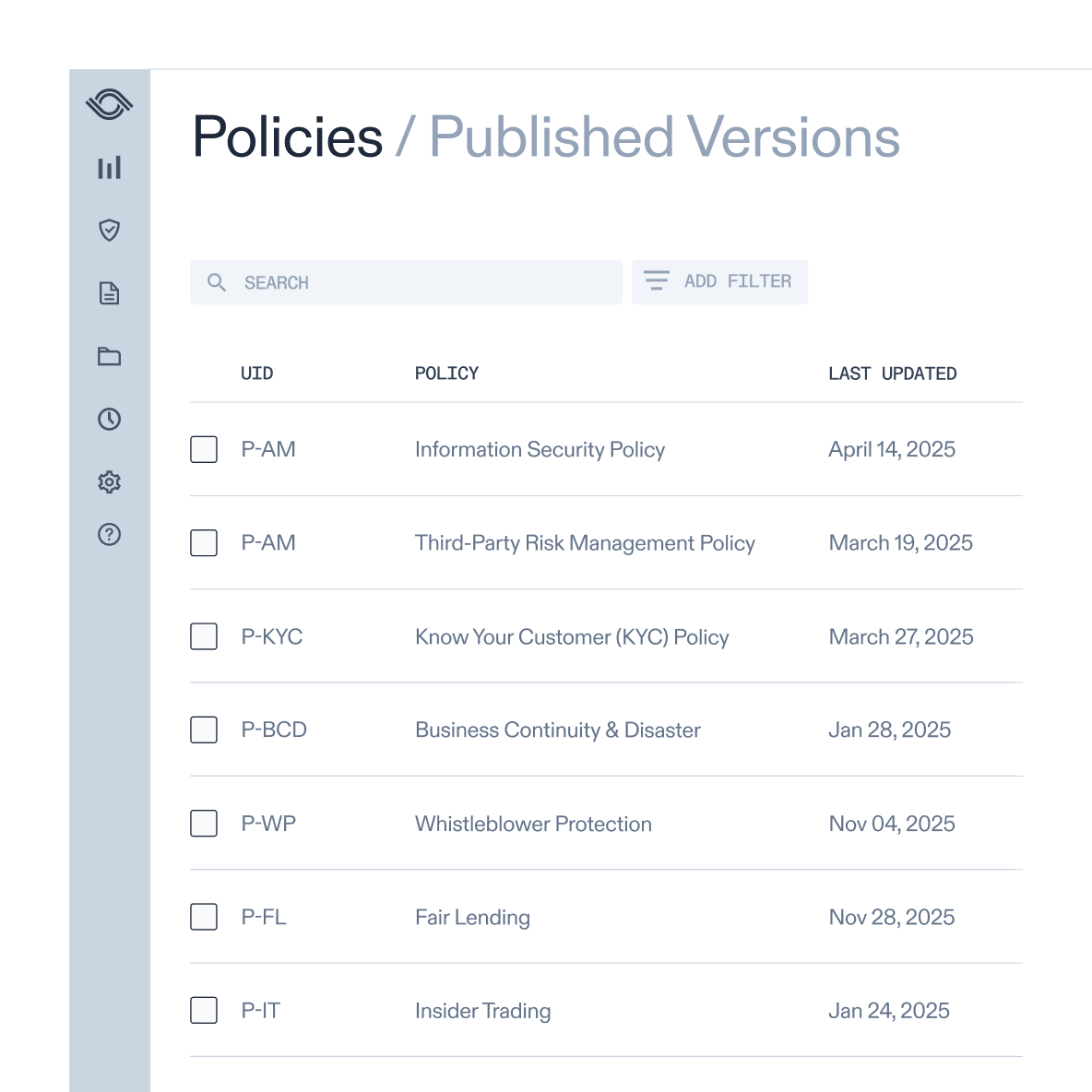
Track policy documents for HR compliance. Source: Optro. 2025.
Focus your assessment on high-risk areas, including:
Use multiple assessment methods — document sampling, process walk-throughs, and employee interviews — for a complete picture.
For example, employee records may show all safety certifications in place, but every one is overdue for renewal. That signals either a recordkeeping failure or the absence of a renewal-reminder system tied to named owners.
Categorize findings by risk level and area. Document specific compliance gaps with supporting evidence and identify root causes rather than symptoms.
For example, if you find an employee filed a wage dispute, understand why. Were timesheets not recorded properly? Did approvals stall between teams?
Develop remediation initiatives with assigned owners and timelines. Build training to address recurring gaps and establish monitoring mechanisms to prevent recurrence.
Do not try to solve every issue at once. Prioritize the highest-risk findings — anything that could trigger six- or seven-figure penalties (I-9 documentation gaps, ADA accommodation denials, FLSA misclassification, AEDT bias) — and treat the audit as an ongoing program rather than a one-time fix.
A follow-up plan transitions the engagement from point-in-time assessment to continuous compliance management. Run regular status checks against each compliance item and report on the HR metrics that match your risk profile.
A platform like Optro embeds this into your operating model. Because evidence collection is automated and risks are surfaced based on configured controls, findings, or user-defined assessments, you can run daily checks against potential issues. Track additional metrics such as:
These metrics show how well your remediation process works — and where to iterate.
Seven baseline best practices for an audit-defensible HR program:
Here are a few ways Optro automates and improves the HR audit process:
Optro creates a single source of truth for all compliance-related materials. The platform maintains all policies, procedures, and supporting documentation in one secure environment.
You can also access documents with version control that tracks document history and changes over time. This lets you locate the documents you need to stay compliant and see what has changed since you last reviewed them.
Real-time updates push policy changes to affected stakeholders automatically.
"What Optro allowed us to do is bring everything into one place. We now have a system not only from a control documentation standpoint that documents what our controls are, who our control owners are, who the exec owner is, but also tracking that through to issues — they become significantly easier now, the way we manage it." (Jonathon Hawes, Head of Internal Controls, IVC Evidensia)
If your current compliance audits sit across siloed teams with limited communication, Optro consolidates the work. We offer role-based access that gives the right permissions to the right stakeholders, with no one accessing files they do not need.
To keep compliance from getting lost in departmental handoffs:
Customizable templates let you configure audit workflows to match your specific processes. Regulatory framework mapping aligns audit activities with specific laws and regulations, while risk-based prioritization focuses effort on the highest-risk areas.
Scalable processes let you adjust depth and frequency based on risk profile. Automating testing schedules turns compliance checks into routine, repeatable activities over time.
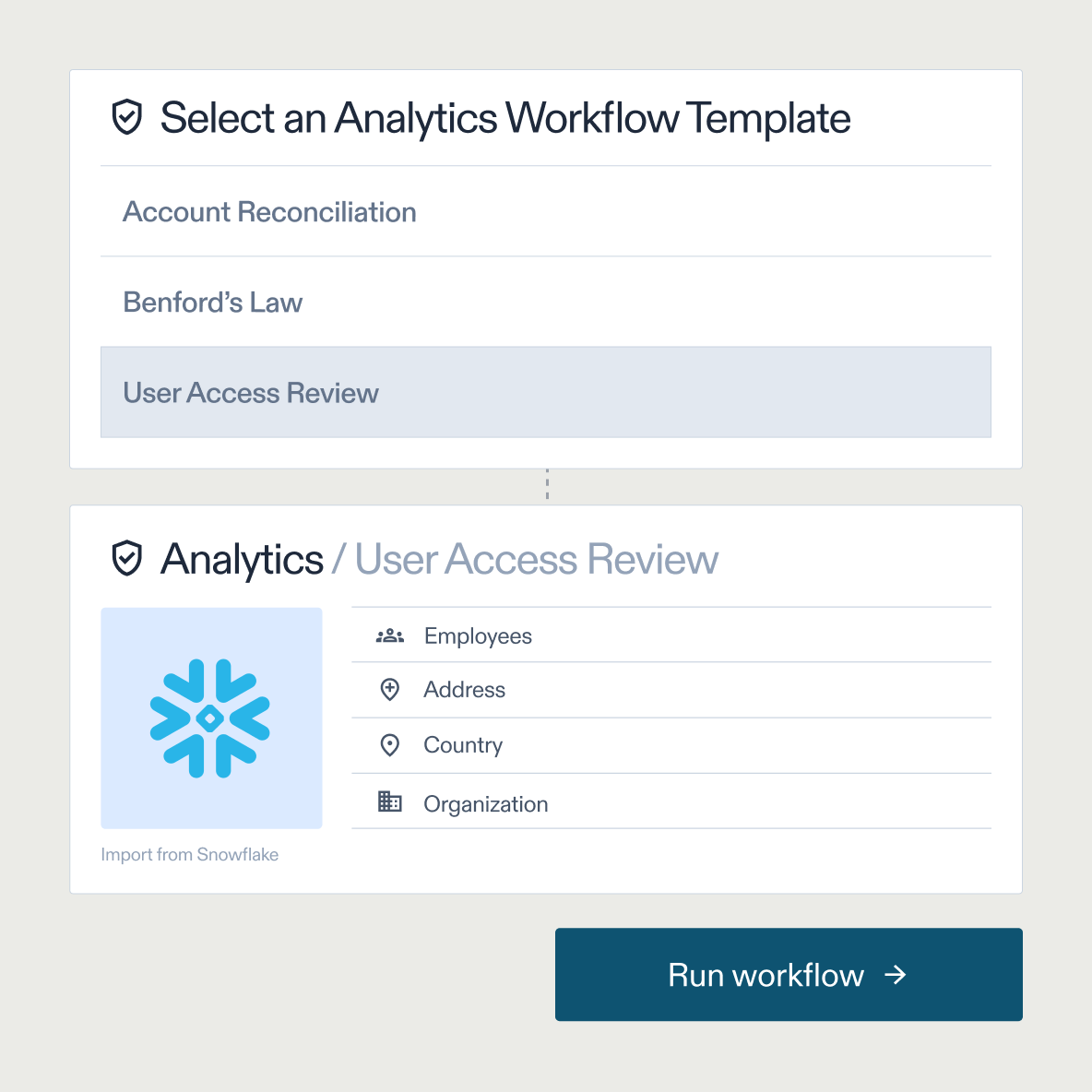
Configure your own workflows for HR compliance. Source: Optro. 2025.
This flexibility lets you right-size the audit process based on immediate needs and short-term objectives.
Centralized issue tracking maintains all findings in one system with clear ownership. Automated notifications alert stakeholders about approaching deadlines.
With "always-on" monitoring, you also have the data to conduct root cause analysis and identify problematic patterns across audits. As a result, you can sharpen your action plan and make better decisions after each engagement.
"The internal audit group needs to be accountable to our business goals. My team and I are committed to actively following up on our recommendations and findings. If there's something that has to be done, it won't get lost in a spreadsheet or an email. Even more, records of the information are kept, which also helps with historical knowledge." (Lisa Hughes, Internal Audit Manager at TriNet)
HR leaders no longer need to choose between compliance readiness and operational agility. Switching to "always-on compliance" surfaces blind spots before they become a problem for the organization.
Optro supports that shift. Instead of annual compliance checks that capture snapshots in time, you maintain continuous oversight across all your HR processes.
The platform centralizes documentation, automates routine compliance workflows, and provides real-time visibility into potential issues before they escalate. That frees you to focus on employee experience and get ahead of inefficiencies before they compound.
Request a demo with us today to standardize your HR audit process through streamlined workflows and automated documentation.
Most organizations run a comprehensive HR audit annually, with higher-risk functions like payroll, I-9, and AEDT bias reviewed quarterly or continuously. The 2024 IIA Global Internal Audit Standards (effective January 9, 2025) push practitioners toward risk-based, continuous assurance rather than a fixed annual cycle. Regulatory triggers — EU AI Act enforcement, the June 7, 2026 EU Pay Transparency Directive deadline, or NYC Local Law 144's one-year audit recency rule for AEDTs — should override the default calendar.
A complete HR audit covers seven functional areas: staffing and recruitment, compensation and benefits, training and development, employee relations, performance management, health and safety, and compliance and documentation (including I-9, handbooks, and recordkeeping). Westlaw's Practical Law HR Audit Toolkit specifically flags handbook maintenance, lawful hiring practices, I-9/immigration compliance, and workplace policies as anchor scoping items.
For compliance and risk-grade assurance, the audit should be led by internal audit or an independent external party, not by the HR team being audited — independence is required under the 2024 IIA Global Internal Audit Standards. HR can run interim self-assessments, but findings that feed board reporting, ESG disclosures under ISO 30414:2025, or legal-defense documentation require an independent function with cross-functional input from legal, compliance, and IT/data governance.
An HR compliance audit is a subset focused on legal and regulatory conformance (I-9, FLSA, ADA, FMLA, EEO, pay transparency). A full HR audit also evaluates operational efficiency and strategic alignment with talent management. Self-assessments are informal, internally scoped pulse checks with no standardized methodology, whereas a formal HR audit follows a documented framework (IIA Standards or SHRM toolkit methodology), uses independent testers, and produces auditable evidence.
Audit AEDTs against four anchors: NYC Local Law 144 (independent bias audit within the past year, public summary posted), the EU AI Act risk classification (high-risk recruitment tools face full conformity obligations under the August 2, 2026 general application date), ISO/IEC 42001 for AI management system controls, and the NIST AI RMF 1.0 for technical risk evaluation. Maintain an enterprise AI inventory across sourcing, screening, and performance management, since federal EEOC AI guidance was withdrawn in January 2025.
Pay equity audits in 2026 must demonstrably evidence equal pay for equal work. The EU Pay Transparency Directive transposition deadline of June 7, 2026 requires reportable wage-gap analytics and employee disclosure rights, and Washington's SHB 1905 (effective July 1, 2025) expanded U.S. protections. Most leading organizations standardize pay transparency and salary-history bans across all jurisdictions as a single baseline, integrating payroll data into the GRC platform for quarterly automated gap analysis.
Anchor the program in four standards: the 2024 IIA Global Internal Audit Standards (effective January 9, 2025) for audit methodology; ISO 30414:2025 for human capital metrics, ESG alignment, and AI/ethics disclosures; ISO/IEC 42001 for AI management system controls in HR tools; and NIST AI RMF 1.0 for AI risk evaluation. For employment law specifics, layer in SHRM's HR audit toolkit and Westlaw Practical Law's HR Audit Toolkit as procedural references.