




Internal Audit
CRX | GRC Intelligence and Agentic AI across audit, risk, and compliance | Read more
March 30, 2026 • 23 min read

Annette He
Key Takeaway: Operational audit is the internal audit engagement type focused on the 4Es — efficiency, effectiveness, economy, and ethics — rather than financial reporting accuracy. The 2025 IIA Global Internal Audit Standards (effective January 9, 2025) now require explicit linkage between the audit plan and enterprise risk, reshaping how scoping, fieldwork, and follow-up are documented.
Operational audit goes beyond financial checks and balances to evaluate how efficiently and effectively a company runs its operations, systems, and processes. Under the 2025 IIA Global Standards, operational audits are framed as forward-looking, systematic reviews tied to the organization's risk profile — not retrospective compliance checks.
An operational audit is a systematic, future-oriented review of a company's operations, systems, and processes against the 4Es: efficiency, effectiveness, economy, and ethics. Unlike a financial audit, which focuses on financial statements, an operational audit assesses how well the business is run and whether resources are being used appropriately.
The purpose of an operational audit is to identify areas where improvements can be made to streamline processes or implement more effective organizational activities. It examines internal policies, procedures, and controls to provide insights into how well a company is managing its resources and whether it is operating in compliance with relevant laws and regulations.
The process of conducting an operational audit involves several steps. First, the internal audit team or external auditor defines the scope and objectives of the audit, taking into account the company's specific needs and goals. Then, the auditor collects and analyzes data, reviews relevant documentation, and conducts interviews with key stakeholders. This information is used to identify gaps or deficiencies in the company's operations and to make recommendations for improvement.
Internal audit is the broader assurance function — a department and discipline covering financial, compliance, IT, and operational reviews. Operational audit is a specific type of internal audit engagement, distinguished by its objective to review the 4Es rather than validate historical financial statements or test compliance against a single regulation.
Dimension | Internal audit | Operational audit |
|---|---|---|
Scope | Financial, compliance, IT, and operational reviews | Efficiency, effectiveness, economy, and ethics of operations |
Orientation | Mix of retrospective and forward-looking | Future-oriented, improvement-focused |
Primary deliverable | Assurance over controls, risk, and governance | Recommendations to improve how the business operates |
Authority | IIA Global Internal Audit Standards (2025) | A type of engagement within the internal audit function |
For a deeper comparison of audit types, see our explainer on internal vs external audit.
Operational audits cover several components that together provide a comprehensive evaluation of how a company runs.
Evaluation of internal controls. Internal controls are the policies, procedures, and systems put in place by management to ensure the integrity of operations and protect company assets. The auditor assesses the effectiveness of these internal audit controls, identifying weaknesses or deficiencies that could expose the company to risks or fraud. This work helps strengthen risk management practices and safeguard assets.
Audit program. The audit program outlines the procedures and workflow followed during the engagement. The auditor develops a program tailored to the specific needs and goals of the company, ensuring that all in-scope areas are examined. The program serves as a roadmap, guiding data collection, documentation review, and communication of operational improvements to stakeholders.
Human resources processes. The auditor evaluates recruitment, training, performance management, and employee relations to confirm the company has the right people and skills in place to support its operations.
Management oversight. The auditor assesses how management oversees and directs day-to-day activities, including whether there are clear goals, monitored performance, and measurable accountability.
Compliance reviews. Operational audits often include compliance work that confirms the company is operating in line with relevant laws and regulations. The auditor reviews policies, procedures, and practices to surface non-compliance and help maintain a strong ethical and legal framework.
Risk-based scoping. Increasingly, operational audits begin with risk-based auditing — an inherent risk assessment across operational, financial, compliance, and strategic categories, then an overlay of the current control environment to identify residual risk hotspots. Audit hours are then allocated proportional to residual risk — a documentation expectation reinforced by the 2025 IIA Global Internal Audit Standards.
Operational audits help businesses optimize operations, manage risk, and make better decisions. By evaluating internal controls and process design, audit findings highlight where work can be streamlined, leading to cost savings and increased productivity. Operational audits also surface inefficiencies in resource allocation and opportunities for automation or technology adoption.
Operational audits also play a role in risk mitigation. By assessing compliance with relevant laws and regulations, businesses confirm they are operating within legal boundaries and reduce the risk of fines or legal action. Findings can also identify vulnerabilities, such as weak internal controls or inadequate risk management practices, allowing businesses to strengthen operations and protect their assets. Regulator data corroborates the link between structured audit work and outcomes: the PCAOB documented audit quality improvements in its 2024 inspection cycle, with a decrease in Part I.A deficiency rates.
Operational audits take different forms depending on scope and objectives. Here are seven common types:
By understanding the different types, audit functions can tailor the engagement approach to specific risk areas — whether that is hardening IT systems, improving financial controls, or evaluating marketing strategies.
The six steps below align with the four recognized phases of operational auditing: Planning, Fieldwork, Reporting, and Follow-up.
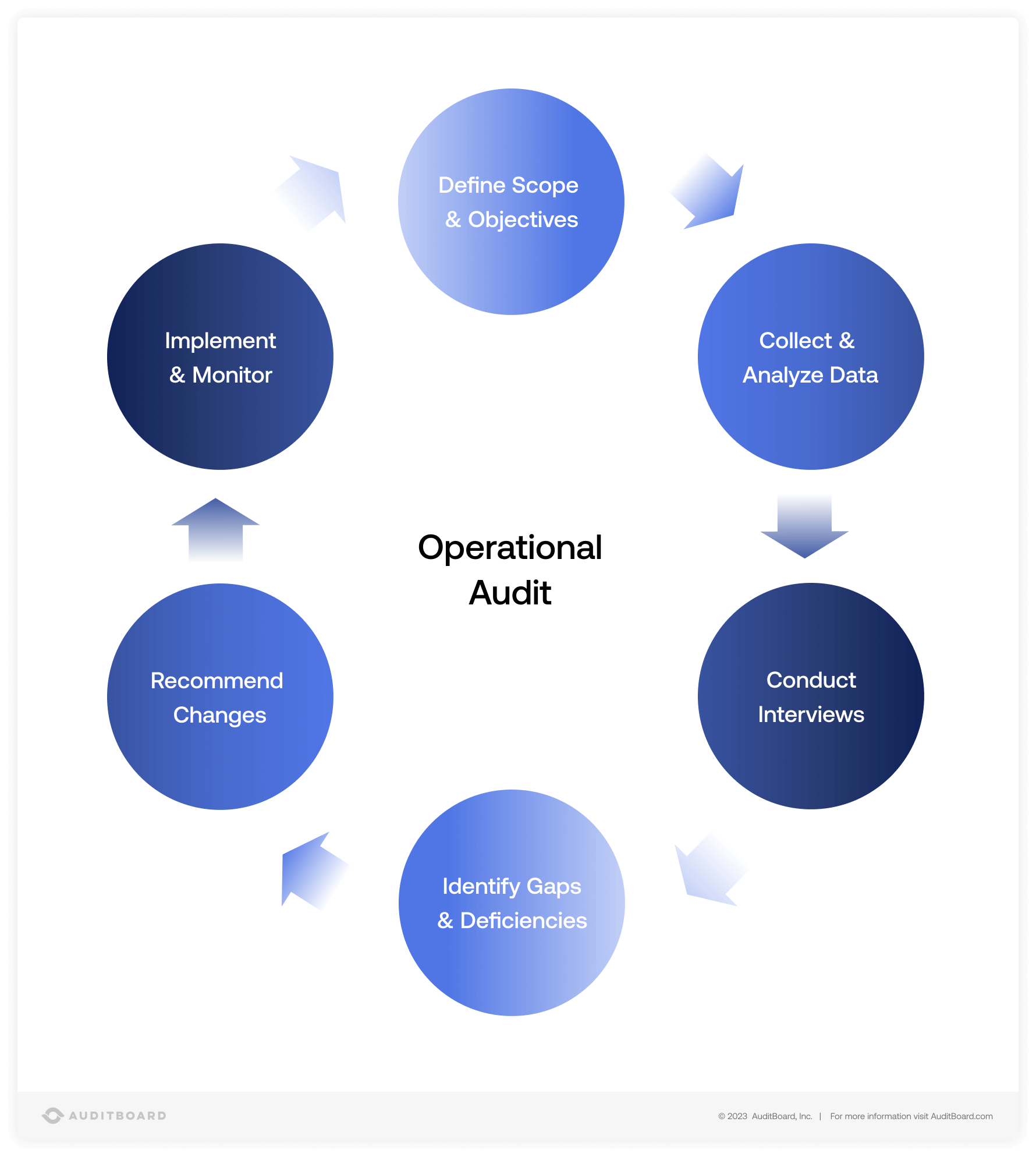
Step 1: Define the scope and objectives (Planning)
Clearly define the scope and objectives of the audit. Consider the specific needs and goals of the company, and outline which areas are in scope. This pre-audit step keeps the engagement focused and ensures the right data is collected. Document the rationale so scope decisions are defensible under the 2025 IIA Global Internal Audit Standards. For a deeper view of the planning phase, see our guide to audit planning.
Step 2: Collect and analyze data (Fieldwork)
Gather relevant data and documentation, including financial statements, operational reports, policies, procedures, and other artifacts. Analyze the data for patterns, trends, and areas of concern. Per the 2025 IIA Pulse Survey, roughly 40% of CAEs now use GenAI for activities like document review and control testing — useful where defensible, but still subject to the PCAOB's AS 1105/2301 amendments (effective December 15, 2025) governing technology-assisted analysis.
Step 3: Conduct interviews (Fieldwork)
Interview key stakeholders to understand the operations, systems, and processes in detail. Interviews surface context that data alone does not show. Come prepared with a list of questions and actively listen to responses.
Step 4: Identify gaps and deficiencies (Fieldwork)
Based on data analysis and interviews, identify any gaps or deficiencies in the company's operations. Look for areas where improvements can be made to enhance efficiency, effectiveness, and overall performance. These gaps form the foundation for recommendations.
Step 5: Make recommendations (Reporting)
Develop actionable recommendations that are specific, measurable, achievable, relevant, and time-bound (SMART). Pair each recommendation with a named accountable owner and a target date, and communicate the reasoning to stakeholders. Agree on a timeline to implement action plans.
Step 6: Implement and monitor (Follow-up)
Work with stakeholders to implement recommended changes and measure their impact over time. Include scheduled validation testing rather than relying on management self-attestation, and escalate unresolved findings to the audit committee per the 2025 IIA Standards governance requirements. Schedule time with internal audit team members to reflect on what is working and refine the approach.
Operational audits face several recurring challenges. Below are the most common, with strategies to address them.
Inaccurate or incomplete data. Many businesses contend with data management gaps that produce incomplete or unreliable information. Address this by establishing clear data collection and documentation procedures, and by implementing automated systems and standardized processes to maintain accuracy and consistency.
Resistance to change. Audit findings often surface areas needing improvement, which can be met with resistance from employees and management. Involve stakeholders early in the audit process and communicate the purpose and benefits of the work. A culture of continuous improvement, paired with training and support, helps reduce resistance.
Resource constraints. Per the 2025 IIA North American Pulse Survey, 19% of internal audit functions reported lower budgets in 2025 than the prior year — a clear signal of the resource constraints facing the profession. Narrow scope using a strict risk-based filter — audit the top-quartile residual-risk processes — and use continuous monitoring and data analytics to replace sample testing where possible. Co-source specialist work (IT, ESG, AI) rather than building permanent capability.
Recommendations not implemented. Following through on recommendations can stall due to competing priorities or unclear accountability. Create a plan for implementation, assign responsibility to specific individuals, and establish monitoring and reporting mechanisms. Regular follow-ups and audit-committee-visible tracking help confirm that changes land and that their effectiveness is assessed.
Real-world audit findings can provide valuable insights into how this process drives positive change and enhances business performance. A few illustrative cases:
Manufacturing — supply chain and inventory. A manufacturing firm conducted an operational audit to identify inefficiencies in its production process. The audit revealed bottlenecks in the supply chain and opportunities to streamline inventory management. Implementing the recommendations reduced production costs, optimized inventory levels, and improved overall operational efficiency.
Retail — customer service operations. A retail company audited its customer service processes and found long waiting times, ineffective communication channels, and inadequate training for representatives. Implementing the recommendations improved response times, customer communication, and satisfaction, leading to improved sales and retention.
Technology — IT infrastructure and security. A technology company evaluated its IT infrastructure and data security measures. The audit identified vulnerabilities in network security, backup protocols, and disaster recovery plans. Acting on the findings strengthened data protection, reduced cyberattack exposure, and improved the availability and integrity of critical systems.
Public-sector audits show the stakes when controls are weak. The SBA's FY2025 financial audit (reported March 2026) identified four material weaknesses and one significant deficiency, and the Mountain Line FY2024 audit (filed January 2026) flagged two material weaknesses in internal controls — both surfaced through systematic operational and financial review.
Use these tips to tighten the audit process and increase its value:
Operational audit is a tool businesses use to optimize internal processes, manage risk, and achieve their goals. By evaluating operations, systems, and processes against the 4Es, operational auditors provide insights and recommendations that drive measurable change — from reducing production costs to improving customer service to strengthening data security.
Through the step-by-step guide above, businesses can map the work to the four recognized phases (Planning, Fieldwork, Reporting, Follow-up), align with the 2025 IIA Global Internal Audit Standards, and bring discipline to follow-up so recommendations are actually implemented. By involving key stakeholders, applying operational audit software, and prioritizing findings, audit functions can stretch capacity without sacrificing depth — a critical capability given current budget pressures and rising impact expectations.
Internal audit is the broader assurance function — a department and discipline covering financial, compliance, IT, and operational reviews. Operational audit is a specific type of internal audit engagement focused on the 4Es (efficiency, effectiveness, economy, ethics) rather than financial reporting accuracy. Per the IIA, operational audits are distinguished by a forward-looking objective to improve how the business operates.
Operational audits follow four recognized phases: Planning (scoping, risk assessment, objective-setting), Fieldwork (data collection, testing, interviews, control walkthroughs), Reporting (findings, recommendations, management response), and Follow-up (verifying remediation and tracking action plans). These phases align with the IIA Global Internal Audit Standards effective January 9, 2025, which codify governance and performance expectations across each stage.
The 4Es are efficiency, effectiveness, economy, and ethics — the evaluation lenses that distinguish operational audit from financial or compliance audits. Efficiency measures input-to-output ratios, effectiveness measures whether objectives are achieved, economy measures resource cost-appropriateness, and ethics evaluates conduct, culture, and integrity of operations.
Roughly 40% of CAEs now use GenAI in audit activities (2025 IIA North American Pulse), primarily for risk assessment, document review, control testing, and workpaper drafting. Practitioners should ground deployment in COSO's 2024 supplemental guidance on internal controls for generative AI, and align technology-assisted analysis with the PCAOB's AS 1105 and AS 2301 amendments (adopted June 12, 2024, effective December 15, 2025).
The IIA Global Internal Audit Standards became effective January 9, 2025, replacing the prior IPPF structure with five domains and adding a new "Applying the Global Internal Audit Standards" section. For operational audit practitioners, the biggest practical shifts are stronger requirements around board and audit committee engagement, methodology documentation, and demonstrable linkage between the audit plan and enterprise risk — meaning charters, planning memos, and reporting templates likely need updating.
Common examples include supply chain and inventory audits (identifying bottlenecks and excess working capital), customer service operations audits (waiting times, channel effectiveness, training gaps), IT operations and cybersecurity audits (network resilience, backup, disaster recovery), and procurement or HR process audits. Real-world findings illustrate the stakes: the SBA's FY2025 audit (reported March 2026) identified four material weaknesses and one significant deficiency, and the Mountain Line FY2024 audit (filed January 2026) flagged two material weaknesses in internal controls.
Implementation discipline starts in the reporting phase: every recommendation should be SMART, paired with a named accountable owner, a target date, and an audit-committee-visible tracking mechanism. The follow-up phase should include scheduled validation testing — not just management self-attestation — and unresolved findings should escalate via the audit committee per the 2025 IIA Global Internal Audit Standards governance requirements.

Annette has been a part of the Client Advisory Services group as an Implementation Manager for OpsAudit for more than three years. She previously comes from EY working in the Assurance practice, and has engaged with clients in the Los Angeles area focusing on Retail and Consumer Products as well as Technology industries. She is an active CPA in the state of California.