




GRC
CPE Week | Join us for our second annual CPE Feast, November 30 to December 3 | Register here about this announcement
November 20, 2026 • 17 min read
A GRC software RFP usually starts with a clear trigger: an acquisition has multiplied the control environment, teams are managing risk and compliance across disconnected spreadsheets and tools, or leadership wants a unified view of risk that the current setup cannot provide.
A strong RFP turns that problem into requirements vendors can answer consistently and your team can score objectively.
This guide provides a practical structure you can adapt to your own RFP, including functional and nonfunctional requirements, vendor questions designed to cut through marketing claims, and a scoring model you can agree on before responses arrive.
Consolidating after an acquisition? Answering an executive mandate for integrated risk management?
Optro holds risk, controls, audit, and compliance in one system of record, so a scripted demo can move a single record from an audit finding to the risk register without anyone re-keying it.
A request for proposal (RFP) sets out what the organization needs from GRC software and asks every vendor to answer against the same requirements and evaluation criteria. Written well, it forces specific answers instead of marketing claims, and it leaves a record of how the decision was reached that holds up with the audit committee or the board.
The RFP captures what can be answered in writing and verified against evidence: architecture, framework content, integration coverage, security posture, and pricing. The demo tests what only a live system shows, such as how a record moves between domains, or how long a configuration change takes.
A strong response names the mechanism, identifies what is native versus configured versus services work, and attaches an artifact. A weak response restates the requirement back to you with a confirmation. The questions work best when restating the requirement visibly fails to answer them.
Most weak RFPs fail here rather than in the requirements list. Skip the inventory and the requirements end up describing the tools the organization already owns, which hands the advantage to whichever vendor most resembles the incumbent.
The first list is every system holding risk, control, audit, policy, or vendor data:
The second records where the same data is re-keyed by a human, and which reports are assembled by hand each quarter.
The second list turns an unclear consolidation objective into a measurable standard for vendor assessment. "Eliminate manual reentry between the control library and the audit workpaper" is testable. "Improve efficiency" is not. Documenting the target state beside the current one is the same groundwork from which a GRC framework build starts.
Each function gets a line of its own: the outcome it needs from the system, and the data it owns.
The exec sponsors are scoring the outcome, which is whether the organization can see its risk posture without waiting on a quarterly assembly job.
Phase one needs an explicit boundary, because an RFP that asks for everything at once invites responses that promise everything at once.
The scope statement also must say whether the engagement covers software only or includes implementation, and the dates belong in the document: issue date, question window close, response deadline, demo window, and decision date.
The structure below works as a starting point, adapted to the organization's own needs. Sections 5 to 8 carry most of the weight.
Each question below requests the vendor to explain a workflow, identify a mechanism, or provide evidence instead of self-rating, and none should be answerable by just one supplier. If only one vendor can meet a requirement, review whether it reflects a genuine business need or unnecessarily favors a particular supplier.
Each domain is also worth testing for how it shares data with the others, which is usually where platforms separate from portfolios. The OCEG GRC Capability Model (Red Book 3.5) is worth structuring these sections against.
Domain | Requirement statement | Sample vendor questions |
|---|---|---|
Unified platform and single source of truth | Risk, control, audit, compliance, policy, and vendor records share one data model, with a change in one domain visible in the others. | Describe how a control tested by internal audit becomes visible to compliance and risk without reentry. What is the underlying object model, and how are relationships among risks, controls, and entities maintained? Which capabilities share one data store, and which are separate products or acquisitions? |
Risk management and assessment | Enterprise, operational, and cyber risk in one register, with methodology, scoring, appetite thresholds, and aggregation you can configure yourself. | How are taxonomies and scoring methodologies configured, and what happens to historical assessments when a methodology changes mid-cycle? Describe how risks aggregate from a business unit to the enterprise view. How does the system link a cyber risk to its mitigating controls and the issues that reveal failure? |
Controls, testing, and assurance | One control library serving multiple frameworks and audit programs, with testing workflow, evidence capture, issue tracking, and remediation in the same system. | Describe how a single control can be tested once and relied on by several frameworks or audits. What is automated in your testing workflow — evidence collection, sampling, population completeness, exception identification — and what still requires a human step? How are issues routed, aged, escalated, and closed? |
Compliance frameworks and regulatory change | Preloaded framework content with cross-framework mapping, plus a mechanism for tracking regulatory change and assessing its impact on existing controls. | Which frameworks ship preloaded, and how is that content maintained when a framework is revised? Describe how a control maps across frameworks, and what happens when a framework version changes. How does the system identify a regulatory change relevant to our footprint and route an impact assessment? |
Third-party risk and business continuity | A vendor inventory with tiering, assessment workflow, continuous monitoring, and an explicit link between third-party dependencies and the processes they support. | How are vendors tiered, and what drives reassessment frequency? Describe how a questionnaire response, a security rating, and an internal control finding about the same vendor are reconciled in one record. How does the system connect a critical vendor to the recovery objectives that depend on it? |
AI governance | An inventory of AI systems and AI-enabled vendors, an intake and approval workflow for new AI tools, use-case risk assessment, and auditable evidence of AI controls. | How does the system inventory AI in use, including AI embedded in third-party software? Describe the intake and approval workflow for a business unit requesting a new AI tool.How do you support assessment against published AI frameworks, and how is that evidence produced for an audit? |
The AI governance row is the one most templates omit, and published references keep it comparable: The NIST AI Risk Management Framework, released in January 2023 and now under revision, organizes the work around Govern, Map, Measure, and Manage, and ISO/IEC 42001:2023 is a standard you can ask about directly.
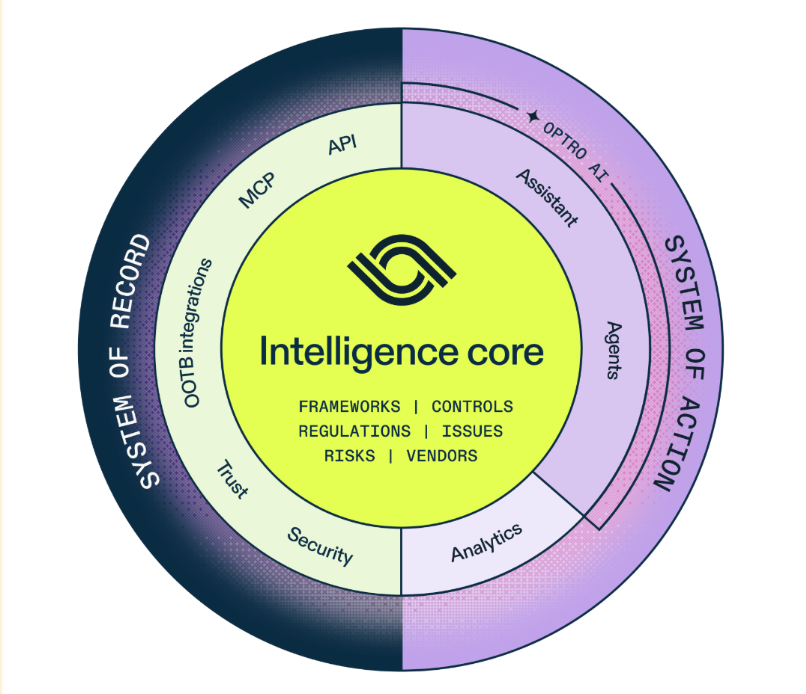
Optro (formerly AuditBoard) is a GRC Intelligence platform that brings GRC data, taxonomy, and business context together with integrations and APIs, and ships a preloaded library of 30+ frameworks, including SOC 2, ISO 27001, and GDPR.
The domains above map to RiskOversight, Cyber Risk Management, Controls Management, Autonomous Testing, OpsAudit, CrossComply, RegComply, TPRM, Business Continuity Management, and AI Governance.
Nonfunctional requirements are just as important as features when evaluating GRC software, yet they often receive less attention in RFPs.
A platform may offer all the capabilities your organization needs, but complex integrations, limited configuration options, or ongoing reliance on professional services can increase costs and make adoption more difficult. Make sure your RFP addresses these requirements in detail.
The systems from the current inventory (ERP, ITSM, identity provider, HRIS, cloud security tools, ticketing) each need an answer on whether the integration is native, runs on vendor middleware, or is professional services billed separately.
Data migration belongs in its own requirement, including who handles it and what it costs.
This maps directly to what the sponsors are scoring, and the complaint that usually starts a GRC evaluation is that reporting is slow, manually assembled, or inconsistent between functions.
Export formats matter here too, since a committee pack that can only leave the system as a screenshot only half meets the requirement.
Hosting and data residency, certifications and independent audit reports, role-based access, audit logging, SSO and provisioning, and the line between configuration and customization all belong here.
That last distinction matters most, because changes an administrator can make independently cost less than customizations that need professional services.
Customer effort is the line implementation plans tend to leave out, and GRC implementation covers what realistic phasing looks like.
The scoring model is agreed upon and weighted before the first response arrives. Otherwise, the committee risks adjusting the criteria based on vendor responses, which can undermine the fairness and objectivity of the evaluation.
Each requirements category carries a percentage weight, ratified in writing by the sponsors. Weights should reflect the trigger that started the process.
An organization consolidating after an acquisition weights unified data model and integration highest, while one replacing a single audit tool weights audit workflow higher.
A flat weighting across ten categories tells a vendor the organization has not set a priority. Published weights also tell them where to spend their response effort.
A 0-to-5 scale anchored to demonstrated capability, configuration requirements, and integration keeps scorers consistent. The anchors below can be adapted.
Two independent scorers per section, with the rationale recorded alongside the number, is what makes a score defensible three months later.
Analyst reports, such as Forrester Wave: Governance, Risk, and Compliance Platforms, Q2 2026, help assemble a longlist, but borrowing an analyst's criteria wholesale produces a document that scores the market rather than your organization.
Three or four scenarios drawn from the organization's real work, sent to every shortlisted vendor in advance, let each one be scored on the same run.
An unscripted demo lets every vendor present the path it has rehearsed, which measures presentation quality. A scripted scenario measures the product instead. If you’re still working on creating a longlist, our roundup of the best GRC tools is a starting point.
Four failures account for most RFPs that produce an unusable result.
A requirements document written before AI systems entered the control environment leaves the newest category of risk unscored. Failing to address AI governance could leave important risks and controls outside the evaluation.
Requirements lifted verbatim from a vendor's own materials leave you comparing one supplier against itself, and the decision record cannot be defended. A requirement written from the outcome the organization needs can be answered by more than one credible vendor, which is the test worth applying.
Evaluation criteria and their weights are agreed before anyone reads a response, then applied consistently through the selection.
The cost of skipping the script lands at implementation, when the workflow nobody was asked to demonstrate turns out to need services work. A rehearsed demo hides exactly the gaps a scored scenario would have surfaced.
A well-structured GRC software RFP helps you compare vendors consistently, verify their capabilities, and document the reasons behind your final decision.
See how Optro supports connected GRC workflows across risk, controls, audit, and compliance.
Optro's GRC Intelligence platform holds risk, controls, audit, and compliance as connected records, so a scripted scenario can move one record across two domains without anyone reentering it.