


GRC
CRX | GRC Intelligence and Agentic AI across audit, risk, and compliance | Read more
October 21, 2026 • 15 min read
Someone on the board asks where your GRC program stands. You know the team has moved past spreadsheets. You know audit, risk, and compliance are doing real work. But you don't have a structured answer that maps capabilities to a defined scale.
A GRC maturity model provides that structure. It evaluates governance, risk, and compliance capabilities across progressive stages — from ad hoc, reactive processes to integrated, predictive risk management — so leaders can benchmark where the program stands today and identify where to invest next.
This article walks through what a GRC maturity model looks like, how to run a self-assessment, and how to build a roadmap that advances your program stage by stage. The focus is on CROs, GRC managers, and risk leaders who need to demonstrate program value with evidence, not instinct.
Can you show the board exactly where your GRC program stands and what it needs next?
Optro connects risk, audit, and compliance on a single platform, giving your team the cross-functional visibility to benchmark maturity accurately and advance it.
A GRC maturity model is a structured framework that evaluates an organization's governance, risk, and compliance capabilities across progressive stages. Those stages typically range from informal and reactive to integrated and predictive.
The practical value is straightforward. Boards and regulators want evidence that risk management is maturing, not just maintaining. A maturity model gives leaders a common language for that conversation, one that translates operational detail into a benchmark executives can act on.
Compliance checklists confirm you've done the required work. They don't tell you whether the program is getting better, faster, or more efficient at what it does.
Maturity measurement answers a different question: How capable is the program at identifying, managing, and responding to risk across the organization? That’s an important distinction when leadership evaluates whether to fund the next stage of GRC strategy investment.
Without a maturity framework, GRC investment decisions default to whoever makes the loudest case for the budget. A staged model ties each investment to a defined capability gap and a measurable outcome.
Stage 2 investment might mean centralizing risk registers. Stage 4 investment might mean cross-functional data integration. The model makes the sequence legible and defensible to stakeholders outside the risk function.
The typical five-stage progression moves from fragmented, reactive processes to a state where predictive analytics and continuous monitoring drive strategic decisions. Each stage builds on the one before it.
The OCEG GRC Capability Model provides the foundational framework most maturity assessments reference. OCEG's own GRC Maturity Model maps these capabilities to defined levels of organizational readiness.
Here is what each stage looks like in practice.
Stage 1 — Ad hoc. Processes are informal, siloed, and reactive. Risk identification happens in response to incidents, not as a structured activity. Documentation is inconsistent. Individual teams may be doing good work, but nothing connects them.
Stage 2 — Managed. Basic processes are defined, but inconsistently applied. Risk registers exist. Audit schedules are in place. However, each function — risk, audit, compliance — operates its own tools, its own data, and its own reporting cadence. The work is real, but the picture is fragmented.
Most organizations that have moved past spreadsheets sit somewhere in Stage 2. The problem is that "managed" feels like progress until you try to produce a unified risk report.
Stage 3 — Defined. Standardized processes, roles, and tools are in place across teams. Risk taxonomy is consistent. Control frameworks are mapped to obligations. Reporting follows a shared cadence.
This is the stage where cross-functional agreement becomes the bottleneck. Technology helps, but the real work is getting audit, risk, and compliance to operate from the same definitions and the same data.
Stage 4 — Integrated. Cross-functional data flows connect risk, audit, and compliance into a unified view. A control tested by internal audit maps directly to the risk it mitigates and the regulatory obligation it satisfies. Evidence collected once serves multiple frameworks.
Stage 5 — Optimized. Predictive analytics, continuous monitoring, and proactive risk management drive strategic decisions. The GRC program is identifying what's likely to happen next.
Organizations at Stage 4 and Stage 5 need a platform that breaks down silos between audit, risk, compliance, and infosec — a connected system of action where cross-functional data flows replace manual reconciliation. That's the shift from managing compliance in parallel tracks to running it as one integrated program.
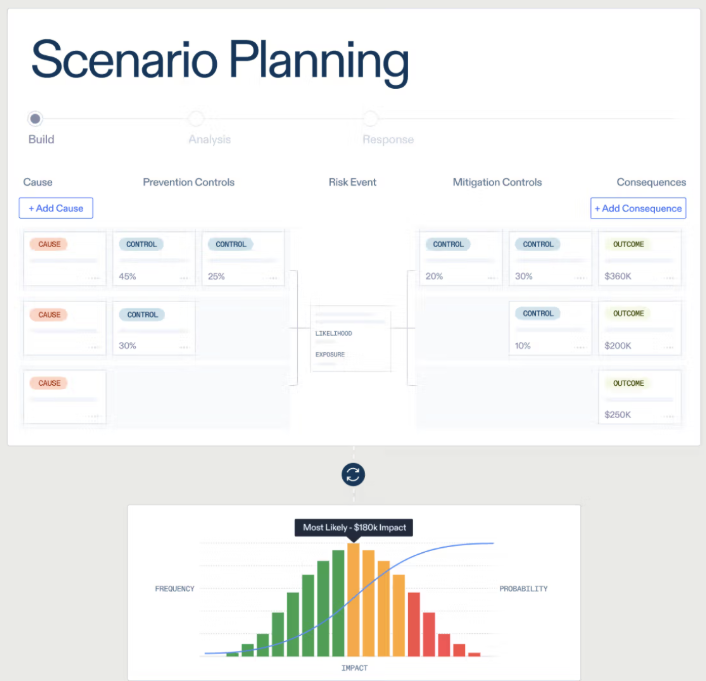
A self-assessment serves two purposes. First, it surfaces the specific capability gaps your program needs to close. Second, it produces a visual output, like a heatmap or scorecard, that communicates program status to leadership in a format that drives investment decisions.
The process is straightforward, and the key is to be honest about where processes actually work versus where they exist on paper.
Assess capabilities across six dimensions. Each one maps to a core function of the GRC program.
Score each dimension on the five-stage scale. Be specific. "We have a risk register" is Stage 2. "Our risk register feeds directly into audit planning and compliance monitoring" is Stage 4.
The gap between your current and target scores across each dimension helps determine your roadmap priorities.
Benchmarking against industry peers adds context. OCEG periodically publishes a GRC Maturity Survey — most recently in 2025 — with aggregate data on where organizations across industries sit on the maturity spectrum. Access requires an OCEG account.
The assessment output is the input for your roadmap. Prioritize the dimensions with the largest gaps between the current and target state. Don't try to advance every dimension simultaneously.
When risk, audit, and compliance data live in one connected system rather than scattered across spreadsheets and disconnected tools, the assessment reflects reality instead of approximation.
A risk platform — one where audit findings, compliance status, and risk data live together — makes it possible to score each dimension against reality rather than assumptions.
The roadmap is the actionable output of the maturity assessment. It translates gap analysis into sequenced initiatives with defined milestones, owners, and success criteria.
The principle is straightforward: quick wins build momentum for longer-term structural changes. Start with the work that removes the most friction, then sequence the harder cross-functional initiatives behind early proof points.
Centralizing risk registers into a single platform eliminates the version-control problem immediately. Automating evidence collection removes one of the highest-friction manual tasks in audit prep.
Standardizing control taxonomies across functions, even before systems are fully integrated, creates the shared language that Stage 3 requires.
Cross-functional data integration, predictive risk modeling, and continuous monitoring are Stage 4 and Stage 5 capabilities. They require investment in both technology and organizational alignment.
Define milestones for each stage transition. Assign ownership across risk, audit, and compliance functions — maturity doesn't advance when a single team drives it.
Each milestone should have a measurable outcome: a reduction in manual hours, an improvement in time-to-report, or an increase in cross-functional data utilization.
At Stage 2, the priority is to replace spreadsheets and consolidate operational audit workflows into a structured platform. At Stage 3, the priority is standardization — shared control libraries, consistent risk taxonomy, and unified reporting.
At Stages 4 and 5, the priority shifts to connected data and predictive capabilities. For example, Optro's connected-risk platform supports the full maturity journey, from replacing spreadsheets at Stage 2 to enabling cross-functional risk intelligence at Stage 5.
MDA, an international space company working with government and commercial agencies worldwide, ran audit, risk, and compliance through spreadsheets, shared folders, and email.
After deploying Optro's CrossComply, OpsAudit, and RiskOversight modules, the internal audit team estimated roughly a 25% efficiency gain on the processes it ran before, with evidence collected once and reused across CMMC, NIST, ISO 27001, and SOX.
Sustained maturity requires measurement that goes beyond the initial assessment — not just whether teams are busy, but whether the program is actually getting more capable.
Four metrics matter most:
Sustaining those gains depends on connected data and cross-functional collaboration. Point solutions that recreate silos at a higher tier don't sustain maturity — they just move the fragmentation problem up one level.
Ready to move your GRC program past spreadsheets and siloed tools?
Optro connects risk, audit, and compliance on one platform — so your team benchmarks maturity accurately and advances it from a single source of truth.