



AI governance
CRX | GRC Intelligence and Agentic AI across audit, risk, and compliance | Read more
October 21, 2026 • 13 min read
GDPR was not written with machine learning in mind. Its core requirements — data minimization, purpose limitation, transparency, and automated decision-making safeguards — nonetheless apply directly to how organizations build, deploy, and procure AI systems.
The result is operational confusion.
AI governance mandates are arriving alongside existing GDPR obligations, and the overlap between them is outpacing most programs' ability to absorb them. Compliance teams are not sure whether AI governance belongs with the privacy office, IT compliance, or somewhere new.
If you manage IT compliance or risk and compliance, you are likely navigating both sides simultaneously. New regulations like the EU AI Act layer additional requirements on top of GDPR. Vendor AI assessments introduce questions your existing due diligence frameworks were never designed to answer.
This article maps the zones where GDPR and AI governance requirements converge, how to build a unified compliance approach, and where the EU AI Act adds obligations beyond what GDPR already requires.
GDPR’s foundational principles were designed for traditional data processing. Lawful basis, data minimization, purpose limitation, transparency, and the Article 22 rights around automated decision-making all predate the current wave of enterprise AI adoption.
That no longer matters in practice. AI systems that train on, process, or generate personal data trigger every one of those obligations. The regulatory boundary between “data protection” and “AI governance” is dissolving because the technology has moved squarely into GDPR’s scope — the rules themselves have not changed.
The EDPB’s Opinion 28/2024 made this convergence explicit. Adopted on 17 December 2024, it clarified that GDPR obligations apply throughout the AI lifecycle, from data collection for training through model deployment and ongoing use.
Five GDPR principles carry direct implications for AI governance implementation. Lawful basis requires organizations to establish and document a valid legal ground for using personal data in AI training. Data minimization demands that only the personal data necessary for the stated purpose enter training datasets.
Purpose limitation restricts repurposing personal data collected for one objective to train AI models serving a different one. Transparency obligations require organizations to inform data subjects when their data feeds AI systems. Article 22 gives individuals the right not to be subject to solely automated decisions with legal or similarly significant effects.
The opinion addressed several questions that compliance teams had been working through without clear guidance. It established that an AI model qualifies as anonymous only where both the likelihood of extracting personal data about training subjects and the likelihood of obtaining it from queries are “insignificant” — assessed case by case, and a threshold most enterprise AI deployments will not meet.
Controllers cannot assume that legitimate interest under Article 6(1)(f) applies to AI training without completing the assessment. The EDPB applies a three-step test:
Most consequentially, the opinion confirmed that unlawful processing of training data can trigger corrective measures against the resulting model. Available measures include fines, processing restrictions, dataset erasure, and, where erasure of the data is not possible, erasure of the model itself.
These overlapping obligations show up in five operational areas where compliance teams are already doing double work.
Organizations must establish and document a valid legal basis for using personal data in AI training. This is GDPR Article 6 applied to a context it was not originally designed for, but the obligation is no less binding.
The challenge is practical. Training datasets often contain personal data collected under consent or legitimate interest for purposes unrelated to AI model development. Repurposing that data requires a fresh legal basis assessment, and the EDPB’s opinion raised the bar for relying on legitimate interest alone.
AI processing likely to result in a high risk to individuals’ rights triggers a mandatory data protection impact assessment under GDPR Article 35 — a separate test from the AI Act’s high-risk classification, though the two often coincide. AI governance frameworks require their own risk assessments. The overlap between the two is substantial.
Both evaluate the same processing activities, assess similar risks, and require documented mitigation measures. Running them as parallel exercises doubles the work without improving outcomes.
Compliance teams that manage controls across both frameworks benefit from shared assessment templates, common evidence repositories, and unified risk scoring.
GDPR’s right to meaningful information about automated decisions maps directly to AI explainability requirements. Articles 13 and 14 require organizations to inform data subjects about the existence of automated decision-making, including profiling, along with meaningful information about the logic involved.
Article 22 adds another layer. Data subjects have the right not to be subject to solely automated decisions producing legal or similarly significant effects, subject to limited exceptions.
For AI systems that influence hiring, credit, insurance, or access to services, this creates specific obligations around human oversight and contestability.
Vendor AI models processing personal data require compliant data processing agreements under GDPR Article 28. AI governance adds requirements around model transparency, training data provenance, and risk assessment documentation that standard DPAs were never built to cover.
Third-party risk management programs need to integrate AI-specific questions into vendor due diligence. Standard security questionnaires were not built to ask the questions that matter for AI:
Optro brings these overlapping obligations onto one platform.
Its connected architecture links AI governance workflows with compliance tracking, so teams assess each requirement once and maintain a single source of truth across both programs instead of duplicating work across separate tools.
Running parallel compliance tracks for GDPR and AI governance is the default in most organizations, and it is unsustainable. The overlap between the two programs means teams assess the same processing activities twice, maintain duplicate evidence, and report to different stakeholders on fundamentally the same risk.
The alternative is integration: build workflows where GDPR assessments and AI governance reviews share a common control framework, a shared evidence base, and a unified reporting structure.
The operational model requires shared visibility. The privacy office and the AI governance function both need a single view of which AI systems process personal data, what legal basis applies, what risk assessments have been completed, and what vendor due diligence is in place.
Start with a joint inventory. Map every AI system that processes personal data and document the GDPR and AI governance requirements that apply to each. That register becomes the foundation for integrated assessments, coordinated evidence collection, and consolidated reporting.
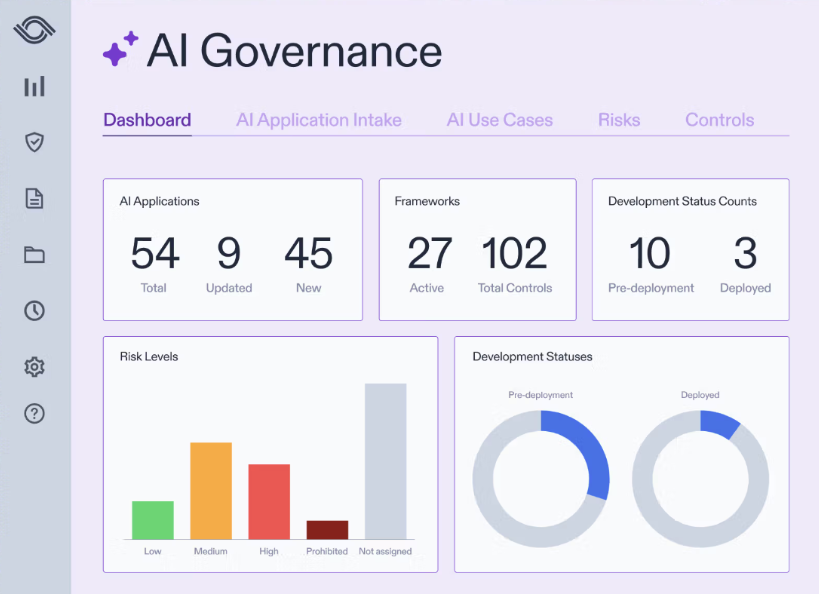
A connected GRC platform closes the operational fragmentation. When framework obligations and AI-specific risk assessments live on the same platform, teams stop maintaining separate spreadsheets and start working from a shared picture of compliance posture.
Optro’s CrossComply and AI Governance modules connect on the same platform for this reason. Compliance teams track framework obligations alongside AI-specific risk assessments, share evidence across both programs, and report on GDPR and AI governance compliance from a single view.

Four KPIs tell you whether your unified approach is working.
Track the percentage of AI systems with a documented GDPR legal basis. Measure DPIA completion rates for high-risk AI processing. Monitor time to respond to data subject requests involving AI systems. Assess vendor AI assessment coverage across your third-party portfolio.
The organizations that handle this well share a pattern: they stop treating GDPR and AI governance as separate compliance tracks and start running them as one program with shared controls, shared evidence, and a single view of risk. That integration pays off immediately in less duplicated work — and it pays off again every time a new regulation lands, because the foundation is already connected.
The GDPR-AI overlap will only deepen as the EU AI Act takes full effect. Teams that build that connected foundation now will adapt faster than those still running parallel programs when the next enforcement wave arrives.
New AI regulations and vendor AI assessments straining your compliance program?
Optro brings GDPR compliance tracking and AI governance together — giving your team real-time visibility across both programs and audit-ready evidence in one place.