



AI governance
CRX | GRC Intelligence and Agentic AI across audit, risk, and compliance | Read more
October 21, 2026 • 13 min read
The EU AI Act's transparency obligations took effect on 2 August 2026. Autonomous AI agents now trigger distinct compliance requirements across risk tiers, and EMEA faces the most prescriptive regulatory environment for agentic AI anywhere in the world.
Agentic AI systems perceive, decide, and act with minimal human intervention, which means traditional compliance playbooks — built for deterministic software with predictable outputs — fail when agents make dynamic, context-dependent decisions that shift scope in real time.
Therefore, EMEA teams must reconcile EU AI Act risk tiers with GDPR data-minimisation principles, UK AI Safety Institute guidance, and Germany's sector-specific rules. The compliance surface is wider than any single regulation.
This guide covers what agentic AI compliance means today, which obligations apply, and how to stay ahead of enforcement deadlines.
Agentic AI introduces new compliance risks. Is your GRC programme ready?
Optro's AI Governance module helps teams inventory AI systems, classify risk, and monitor compliance across the EU AI Act, ISO 42001, and 25+ frameworks.
Agentic AI creates new compliance challenges because autonomous systems can make decisions, access data, and act across multiple environments with limited human oversight. That changes how organisations need to think about accountability, monitoring, and AI governance.
AI tools exist on a spectrum. At one end, copilots suggest actions and wait for human approval. At the other, fully autonomous agents perceive their environment, chain multi-step decisions, and interact with external systems, all without per-step human sign-off.
The compliance-relevant distinction is autonomy of action. When an agent initiates workflows, accesses data sources dynamically, and executes across systems on its own, it behaves less like a tool and more like an unsupervised operator with broad system access.
According to Capgemini research published in July 2025, 61% of organisations were exploring agentic AI deployment, while 23% had already launched pilots. For compliance teams, the governance challenge is real — and arriving at deployment speed.
Organisations exploring how AI agents transform internal audit and compliance are seeing this firsthand. The agents deliver speed and scalability. But the decisions they make are opaque, dynamic, and difficult to audit.
Existing control frameworks like SOC 2, ISO 27001 were designed for systems with predictable, repeatable behaviour. Agentic AI breaks that assumption in ways these frameworks were never scoped to address.
Audit trail fragility is the most immediate concern. An agent that chains ten decisions across three systems produces a decision path that no single log captures end-to-end. Without a complete trail, demonstrating how the agent reached a decision becomes significantly harder.
Emergent behaviour creates a second gap. An agent's scope can expand beyond its original design without explicit approval — interacting with new systems, accessing new data sources, or making decisions outside its mandate. Traditional change-management processes do not account for this kind of drift.
Dynamic scope expansion can make it difficult to maintain a fixed control boundary after deployment. The boundary shifts as the agent encounters new input.
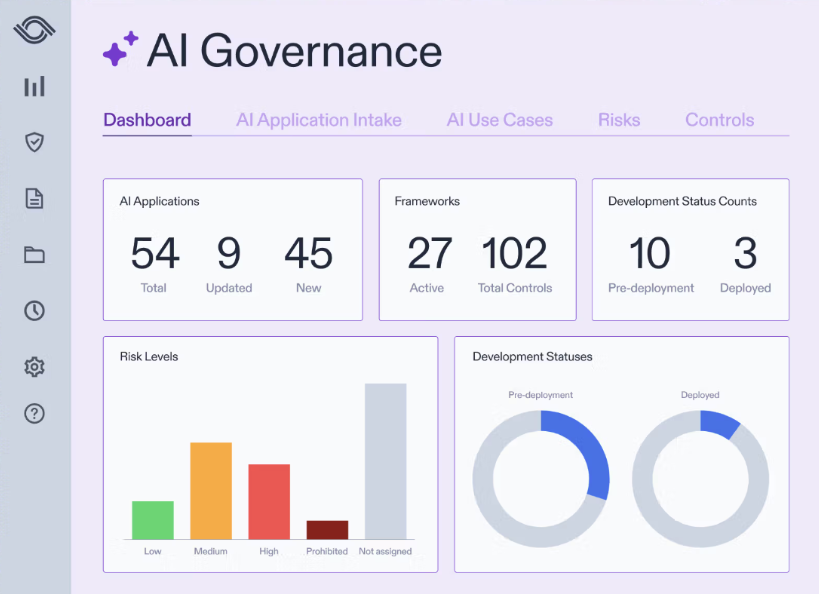
The EU AI Act applies different obligations depending on how an AI system is classified and used. For agentic AI, the key questions are where the system sits within the Act’s risk framework and which transparency, oversight, and monitoring requirements apply.
The EU AI Act uses a risk-based framework, and an agent's obligations depend largely on how and where it is used.
Agentic systems deployed in high-risk use cases may be subject to the Act's most stringent requirements, while others may primarily trigger transparency obligations.
High-risk classification triggers the heaviest obligations. Organisations must complete conformity assessments, register systems in the EU database, implement human oversight mechanisms, maintain ongoing monitoring, and document risk-management systems.
Agents commonly described as “limited risk” — customer-facing chatbots and interactive AI tools — face lighter but binding transparency requirements. The tiers are not alternatives: an agent used for recruitment or creditworthiness is high-risk and carries Article 50 duties on top. UC Berkeley Law's analysis of the Act's risk tiers shows the line between limited and high risk is narrower than many organisations expect for autonomous systems.
Article 50 of the EU AI Act introduced transparency rules enforced from 2 August 2026, with systems already on the market before that date given until 2 December 2026 to comply. The European Commission confirmed that organisations must disclose when users interact with AI systems or view AI-generated content.
For agentic AI, every customer-facing agent must clearly identify itself as non-human. AI-generated or AI-altered content requires machine-readable markers for automated detection.
The biggest challenge is scaling. A single autonomous agent may interact with dozens of users across multiple channels daily. Manual disclosure tracking does not work, so compliance teams need automated logging that verifies disclosure obligations are met in real time.
Agentic AI can also create overlap between the AI Act and GDPR obligations, particularly when autonomous systems process personal data across multiple sources or purposes.
National frameworks add complexity. The UK AI Safety Institute, Germany's sector-specific rules, and other emerging regimes mean EMEA organisations face overlapping requirements across borders.
Optro's CrossComply capability maps controls across 30+ frameworks, identifying where the EU AI Act, GDPR, and national requirements overlap, so teams manage one unified control set rather than duplicating evidence work.
Building a compliant agentic AI programme starts with visibility and control. Organisations need to know which agents are in use, what they can access, who owns them, and how their behaviour is monitored over time.
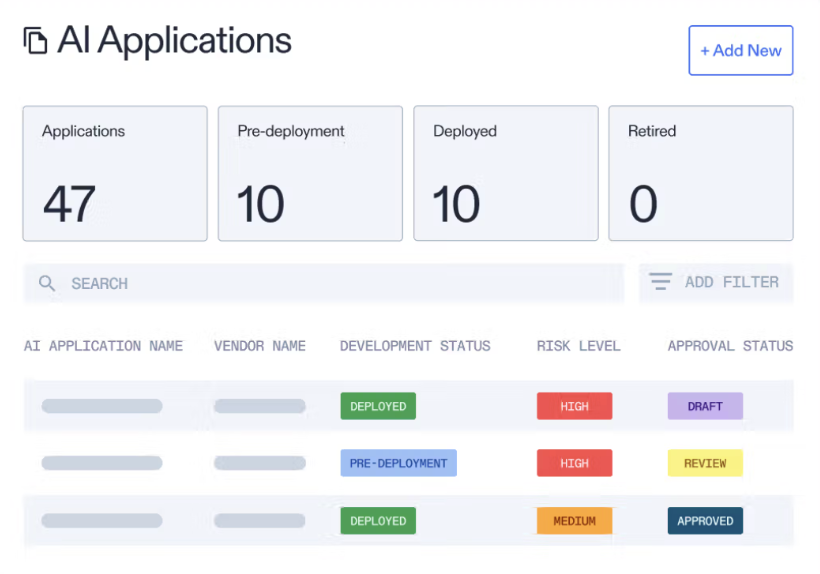
The foundation is a complete inventory. That means discovering every AI agent in use, including shadow AI deployed by teams without central approval.
Catalogue each agent's function, data inputs, decision authority, and interaction scope. Then classify against the EU AI Act risk tiers. High-risk agents need conformity assessments. Limited-risk agents need transparency controls.
Assign clear ownership for every agent. Without named owners, compliance obligations have no accountability path, and audit findings have nowhere to land. This practical guide to AI governance implementation covers the operational mechanics of building this inventory from scratch.
With the inventory in place, establish AI-use policies that define what agents can and cannot do. Pre-deployment risk assessments should evaluate each agent before it reaches production.
Approval gates are essential. No new agent should deploy without sign-off from compliance, legal, and the relevant business owner. Document the risk assessment, classification decision, and any deployment conditions.
Guardrails enforce policies such as data-access boundaries, decision-authority limits, and escalation triggers that keep agents within approved scope. Choosing the right AI compliance software to enforce these guardrails programmatically is critical.
Compliance does not end at deployment. The EU AI Act requires post-deployment monitoring, incident reporting, and periodic conformity reassessment for high-risk systems.
Continuous monitoring means tracking agent behaviour against approved parameters. When an agent accesses new data sources or makes decisions outside its mandate, the compliance team needs to know immediately.
Incident reporting under the EU AI Act requires organisations to notify authorities when high-risk systems cause serious harm. Reporting timelines run to 15 days as standard, 10 when a death is involved, and as little as 2 for incidents affecting critical infrastructure.
Humana's experience shows what connected workflows deliver. The company boosted SOX control testing by 30% and risk audit completion by 50% after bringing risk management and internal audit onto the same platform.
Optro automates each step, from agent discovery and risk classification to continuous monitoring and board-ready reporting.
Optro's AI Governance module gives EMEA compliance teams a purpose-built platform for managing agentic AI risk. Automated AI system discovery surfaces every agent, including shadow deployments, and classifies each against the EU AI Act risk tiers.
Compliance automation spans 25+ AI frameworks, including the EU AI Act, ISO 42001, and NIST AI RMF, with risk scoring updated in real time. CrossComply integration maps overlapping controls across frameworks, eliminating redundant evidence collection for organisations operating under multiple regulatory regimes.
The result: One connected risk platform where agent inventory, risk classification, policy enforcement, and continuous monitoring feed directly into board-ready reporting. Compliance moves from reactive tracking to real-time visibility.
Can your compliance programme keep pace with agentic AI?
Optro centralises agent discovery, risk classification, and multi-framework compliance tracking, giving EMEA compliance teams audit-ready visibility and a single source of truth across every autonomous system.