




GRC
CRX | October 13-15, 2026 | Up to 17 CPEs | In-person & virtual options available | Register Now!
June 30, 2026 • 17 min read

Elli Sullivan
AI adoption didn’t wait for governance to catch up. Models moved into production, and decisions began to scale. Only then did boards and regulators begin asking the uncomfortable questions.
Who approved this? What risks did we assess? Where’s the evidence?
External frameworks for AI governance exist, and many organizations have created their own internal controls. But most organizations still don’t know how to implement AI governance in practice.
That’s the real gap that this guide addresses.
Here’s a breakdown of how to build AI governance as a repeatable, auditable program that scales across risk, compliance, and internal audit without slowing your business down.
AI risk has moved out of the hypothetical realm and into a strict reality of regulatory scrutiny, board-level accountability, and decisions that now carry real legal and financial consequences.
This means that expectations have changed. Leaders now need to demonstrate oversight, not just describe it.
Yet while adoption is racing ahead, provable governance is lagging behind. According to EY’s 2025 survey, 72% of companies have rolled out AI across the organization, yet only around a third have implemented practical governance protocols.
That gap is why AI governance has shifted from ethics committees into GRC, infosec, and internal audit. The risk now sits squarely with the functions regulators expect to manage evidence, controls, and accountability — when governance doesn’t reach the operational level, failures show up quickly.
Here’s how those failures manifest in practice:
AI governance frameworks and principles only describe what responsible AI should look like. Implementation is about how those expectations show up in real work. That means embedding governance directly into the workflows where you propose, build, deploy, and change AI systems.
After all, policies on their own rarely fail because they’re wrong. They fail because no one owns them at decision time. Without defined accountability, enforceable controls, and evidence of review, governance becomes aspirational rather than operational. Teams may intend to manage AI risk, but they can’t consistently prove how the organization made decisions or why.
Equally, AI governance behaves differently from traditional IT compliance, model risk management, or data governance. AI algorithms evolve quickly, draw on complex training data, and influence human decision-making in ways static controls can’t handle.
In this sense, AI governance implementation means designing governance that moves with the AI lifecycle, so it captures oversight as models and use cases change — rather than relying on one-time approvals that go stale.
AI systems evolve. Use cases expand. Models retrain. Risk shifts quietly.
In this respect, effective AI governance implementation isn’t a one-and-done approval moment. It only works when it follows the AI lifecycle. Governance has to move with that reality, or it stops working.
Here’s how you implement governance as a living system across the AI lifecycle.
At the design and intake stage, you’re deciding whether an AI use case should exist at all.
To do this well, you need a structured intake process to ensure clarity early by asking the following questions:
Risk scoping at this stage should assess data privacy, ethical considerations, and explainability, as well as whether the use case may qualify as high-risk under emerging AI regulations like the EU AI Act.
Most importantly, assign a clear business owner. Without ownership at intake, governance breaks down everywhere else.
Once deployed, governance shifts from approval to control. This stage focuses on enforcing guardrails, such as policies and controls, and on observing how AI systems behave in real-world conditions.
Controls should scale with risk. The greater the AI system's impact, the more oversight it needs. In practice, that means building in human review, validating that the model behaves as you expect, and keeping a clear view of the outputs that shape real business decisions.
And remember, AI usage rarely stays static. Generative AI and AI-powered tools are expanding rapidly, especially on third-party platforms. To manage third-party AI effectively, you need to track where models run, how they handle training data, and whether vendors can withstand audit and regulatory scrutiny.
A foundational step in implementing an AI governance program is identifying a framework or regulation to align with. This gives your program structure, a common language for risk, and a defensible baseline for audit and regulatory scrutiny.
Common starting points include NIST AI RMF, ISO 42001, and the EU AI Act. The right choice depends on your industry, geography, and regulatory exposure, but the goal is the same: a consistent standard to assess use cases against, categorize risk, and identify where controls are needed. Alignment to a framework also signals to regulators, auditors, and internal stakeholders that your governance program is structured and intentional, not ad hoc.
To keep governance effective over time, you need to revisit AI policies, risks, controls, and the AI systems themselves every time something actually changes, such as a new data source being added or a vendor update on how their system works. This is why ongoing monitoring is so important. Continuously monitoring systems gives you early signals when behavior, outputs, or usage start to drift, so reviews happen before issues escalate.
Just as important is knowing when to stop. Retiring and decommissioning models prevent outdated or unsupported systems from quietly influencing decisions long after anyone is paying attention.
The core components of an AI governance program - intake, framework alignment, policies, and continuous monitoring - only hold up if there's a clear operating model sitting on top of them. AI governance works when responsibility is explicit, and decision-making follows a repeatable rhythm.
This operating model keeps ownership clear, reviews focused, and evidence easy to produce when scrutiny arrives.
A practical operating model assigns clear responsibility for decisions, risk ownership, and oversight, so governance doesn’t rely on informal agreements or assumed approvals. Each role below plays a distinct part in keeping AI use controlled, defensible, and auditable.
AI governance needs defined checkpoints that align with how AI systems actually change, not just annual review cycles. These decision points ensure risk assessments stay current and governance keeps pace as models, data, and use cases evolve.
Even organizations that take AI risk seriously tend to stumble in the same places. The issues show up in day-to-day execution, usually long before regulators or auditors get involved — and they compound quickly.
Here are some of the most common challenges and how to address them.
This problem shows up when different teams use AI without a shared view of what exists across the organization. AI tools often enter through vendors, internal projects, or embedded features, but no one keeps a single, up-to-date list of who’s using what.
As Optro’s From blueprint to reality report shows, 92% of leaders believe they have good visibility into AI use, yet a meaningful portion don’t carry out formal risk assessments. That confidence becomes a risk in itself.
As the report puts it, “When companies assume they have control, they’re less likely to invest in proactive auditing, centralized model inventories, or employee education. And when vulnerabilities surface, they’re often caught off guard, leading to downstream consequences.”
To avoid this, you need a centralized AI inventory that clearly lists each system in use, who owns it, where it operates, and whether it’s had a review.
Many teams rely on spreadsheets, email threads, or one-off documents to manage AI risk reviews and approvals. That approach might work for a pilot, but it breaks the moment AI use scales. This is because manual tracking creates gaps, leads to inconsistent reviews, and often results in missing evidence.
To fix this, you need to embed risk assessments, approvals, and ownership directly into workflows so reviews happen as part of normal operations, not as an afterthought.
Another common failure is tooling fragmentation. Organizations adopt AI governance solutions in isolation, disconnected from existing GRC processes. Optro’s From blueprint to reality report shows that this isn’t a tooling shortage — fewer than 15% cite lack of tools as the core problem.
The real issue is integration. Governance works when AI risk flows through the same systems that manage controls, issues, and audits, not when it lives in a parallel universe.
Optro’s From blueprint to reality report shows that only around a quarter of organizations have fully implemented AI governance, while 75% are still sitting on draft policies.
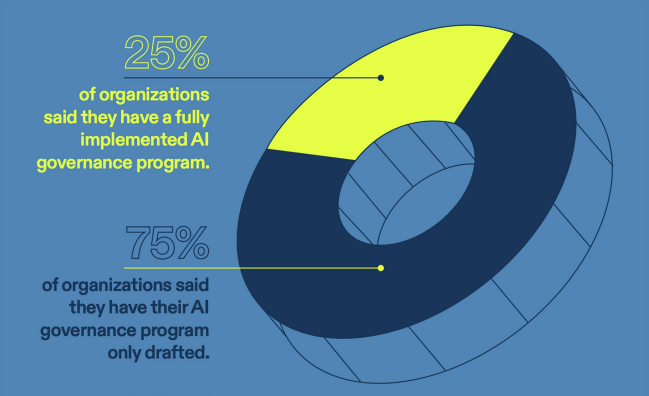
This is a problem. When you spend too much time worrying about policy language, you often fail to plan how those rules will actually apply in daily work. And while policies remain in draft or approval cycles, your organization continues to use AI with little or no consistent control.
To move forward, you need to shift focus from perfect wording to practical execution by defining how your AI governance program will trigger real reviews, decisions, and controls in day-to-day AI use.
All of these issues converge during audits.
Scattered or missing evidence leaves you reconstructing decisions, chasing emails, reconciling spreadsheets, and explaining gaps instead of demonstrating control.
Centralized GRC and AI governance tools change that dynamic.
MDA found this out when they moved from shared drives and manual tracking to Optro. With a single system of record, audit teams gained instant access to approvals, documentation, and review history in one place. Audits became about 25% more efficient, and they could demonstrate oversight with confidence.
As AI applications continue to evolve, governance has to keep pace with constant advancements in how AI models are built, used, and scaled.
Sustainable AI governance focuses on how AI deployment actually affects decision-making processes, with clear human oversight built in from the start. That means moving beyond static governance policies to design governance strategies that support regulatory compliance through repeatable reviews, documented decisions, and regular audits.
When compliance requirements are embedded into daily operations, governance becomes easier to maintain and harder to break.
If you’re ready to move from drafting AI policies to governance that holds up in practice, request a demo to see how Optro helps teams operationalize AI governance across risk, compliance, and audit.

Elli Sullivan is a Senior Product Marketing Manager at Optro, driving strategic market execution, with nearly a decade of experience in IT audit, risk, and compliance. Her career is grounded in security and compliance from her time at KPMG as part of the IT Advisory team, focused on evaluating IT controls and risks. She transitioned into the GRC technology space, where she served as a subject matter expert, developing platform content and resources aligned to best practices across various company sizes and industries, while driving content and strategy initiatives in partnership with product, customer success, and marketing teams. Her multidisciplinary background across IT audit, GRC, and product marketing enables her to help organizations understand and adopt technology solutions that strengthen their GRC programs.