




GRC
CRX | GRC Intelligence and Agentic AI across audit, risk, and compliance | Read more
July 20, 2026 • 17 min read

Guru Sethupathy
Quick answer: A responsible AI policy is a formal framework that governs how your organization develops, procures, and deploys AI systems. It aligns your artificial intelligence systems with ethical principles, legal obligations, and stakeholder expectations, translating abstract AI ethics into enforceable controls across the entire AI lifecycle.
Integrating artificial intelligence systems into daily operations unlocks massive productivity gains, accelerates product development, and shifts market dynamics. Rapid adoption also introduces complex vulnerabilities. Developing artificial intelligence technology without boundaries leaves organizations exposed to algorithmic bias, privacy violations, and regulatory penalties.
Organizations need a structured approach to manage these vulnerabilities. Mid-to-senior compliance officers, innovation leaders, and procurement professionals must collaborate to establish clear guardrails. These guardrails ensure that rapid AI deployment maintains strict alignment with ethical obligations and emerging laws.
Creating a responsible AI policy solves this challenge. This formal document establishes the precise rules of engagement for artificial intelligence within your business. By implementing a responsible AI policy, organizations transform ambiguous ethical considerations for AI into concrete, auditable workflows that satisfy emerging regulations and earn stakeholder trust.
A responsible AI policy serves as the operational rulebook for how a business interacts with artificial intelligence. This living document articulates the specific principles, controls, roles, and accountability mechanisms required for every stage of the AI lifecycle. It dictates exactly how product managers develop models, how procurement gatekeepers evaluate AI vendors, and how employees interact with generative tools.
Top technology companies have already published public frameworks guiding their development. Microsoft’s responsible AI principles, for instance, focus on fairness, reliability, and safety. Google’s AI policies emphasize social benefit and privacy. However, a responsible AI policy is not just a public relations statement. For mid-market and enterprise companies, it operates as an internal control mechanism that requires continuous updating as artificial intelligence technology evolves.
A responsible AI policy is the organizational backbone that turns AI ethics principles into enforceable practice across the AI lifecycle.
Understanding the distinction between these three concepts ensures your organization builds a functional compliance program.
Organizations operating without a responsible AI policy face escalating regulatory, reputational, and commercial risks. Regulatory bodies across the globe are aggressively policing AI adoption. The EU AI Act imposes strict documentation requirements and massive fines for non-compliance. State-level laws in the U.S. now restrict algorithmic decision-making in employment and housing.
Recent AI ethics developments frequently highlight high-profile model failures. Algorithmic bias lawsuits and data leaks generate negative AI ethics news, damaging brand reputation permanently. Furthermore, enterprise procurement teams heavily scrutinize vendors. If your organization sells AI-powered software, procurement gatekeepers will demand proof of your ethical AI practices before signing a contract. Having a documented policy demonstrates proactive AI risk management, accelerating deal cycles.
Without a responsible AI policy, organizations face escalating regulatory, reputational, and commercial risk as AI adoption scales.
Implementing a documented policy provides distinct advantages for specific stakeholders across the organization:
Every responsible AI policy must anchor itself to widely accepted ethical principles. Establishing these core principles ensures your artificial intelligence systems remain aligned with human rights and safety standards. Top industry players, including Microsoft AI, Google, IBM, and AWS, consistently frame their policies around these foundational elements.
To prove adherence to these principles, organizations often rely on transparency tools like model card reports. Model cards provide standardized documentation detailing a model's intended use, performance limitations, and bias testing results. By enforcing these ethical AI considerations, organizations build stakeholder trust.
Every effective, responsible AI policy is built on a shared foundation of fairness, transparency, accountability, privacy, safety, and human oversight.
Organizations should structure their policy around these six critical pillars:
Drafting the policy requires moving beyond abstract values into practical, operational requirements. A comprehensive responsible AI policy acts as a manual for your compliance and engineering teams. Missing any single component creates a governance blind spot, leaving the organization vulnerable to rogue AI deployments.
This section serves as a responsible AI policy best practices guide. Organizations can use these components as a responsible AI policy template to evaluate their current internal documentation or structure a completely new framework.
A complete responsible AI policy covers scope, roles, risk tiers, data, development, vendors, monitoring, and review — missing any one component creates a governance blind spot.
Ensure your policy includes the following documented sections:
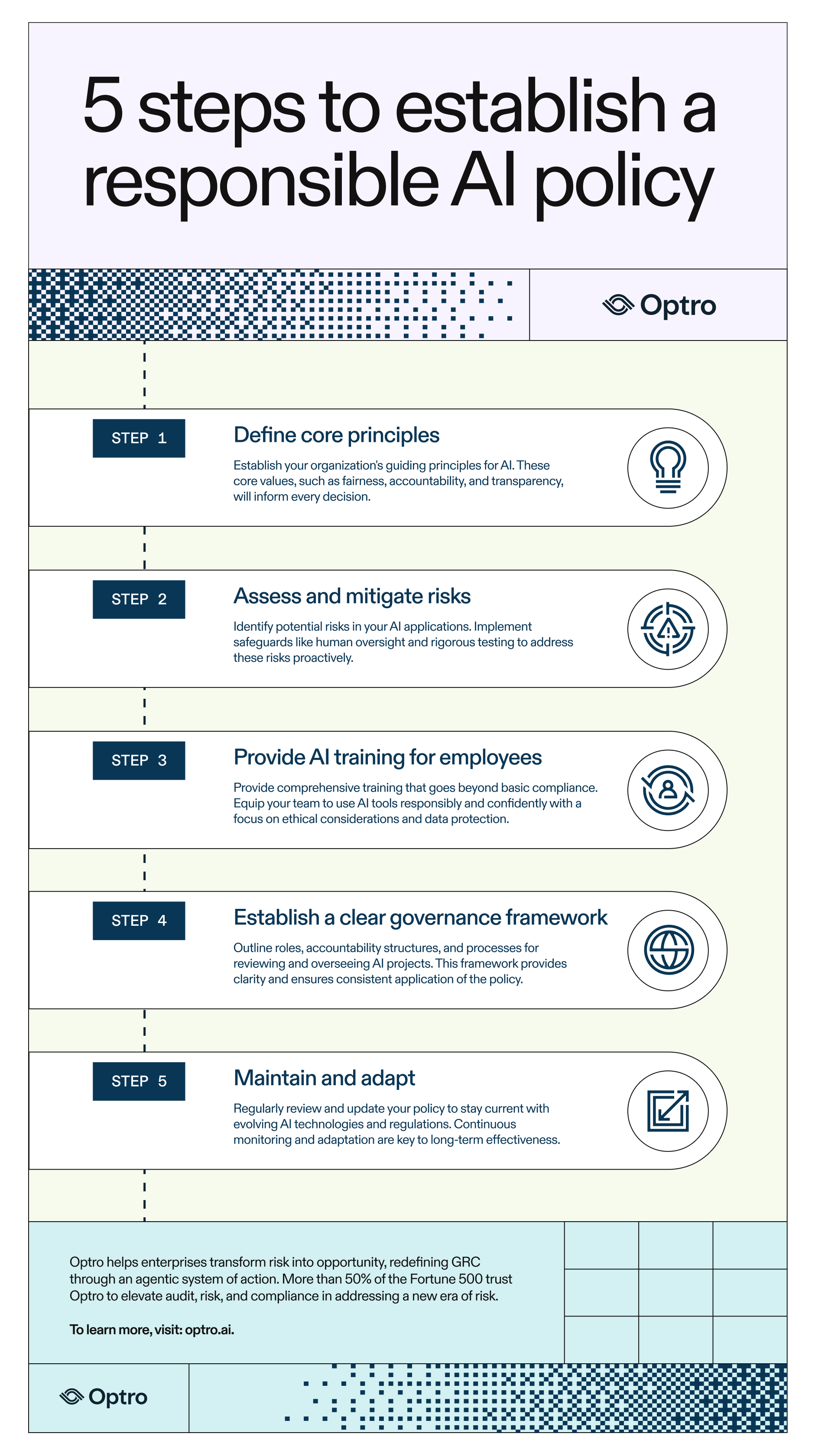
Drafting a responsible AI policy is only the first phase. Implementation determines whether the policy actively reduces risk or sits ignored in a shared drive. Effective rollout requires cross-functional coordination, a clear understanding of current AI usage, and a phased approach to enforcement.
Choose a platform that operationalizes these requirements. Optro provides the necessary infrastructure to track your AI inventory, assign risk tiers, and collect automated evidence. If you want to streamline your implementation phase, leverage the NIST AI RMF checklist to map your internal controls to recognized standards immediately.
Successful implementation depends less on the policy document itself and more on cross-functional ownership, phased rollout, and continuous monitoring.
Follow this structured process to deploy your policy effectively:
A standalone internal policy lacks authority if it ignores global regulatory frameworks. Aligning your responsible AI policy with established standards proves to regulators, enterprise buyers, and auditors that your organization takes AI risk management seriously.
Aligning your responsible AI policy with the EU AI Act, NIST AI RMF, and ISO 42001 transforms it from an internal document into a defensible compliance asset.
Documenting a responsible AI policy is critical, but manually managing spreadsheets, model cards, and risk assessments will quickly overwhelm your compliance and engineering teams. Organizations require dedicated software to operationalize responsible AI policies effectively.
Optro is the AI governance platform that acts as the connective tissue between your written policy, governance controls, compliance evidence, and regulatory alignment. Optro translates abstract AI ethics principles into enforceable, auditable governance controls across the entire AI lifecycle.
By centralizing policy management, risk assessments, and model documentation in one platform, Optro replaces fragmented spreadsheets and ad-hoc review processes. This empowers organizations to demonstrate regulatory compliance and vendor trust to procurement teams, auditors, and customers without slowing down innovation.
Optro turns your responsible AI policy from a static PDF into a live governance program that scales with your AI adoption.
To learn exactly how to build this infrastructure, watch the on-demand webinar: Foundations for AI governance.

Guru Sethupathy is the VP of AI Governance at Optro. Previously, he was the founder and CEO of FairNow (now part of Optro), a governance platform that simplifies AI governance through automation and intelligent and precise compliance guidance, helping customers manage risks and build trust and adoption in their AI investments. Prior to founding FairNow, Guru served as an SVP at Capital One, where he led teams in building AI technologies and solutions while managing risk and governance.