



AI governance
CRX | October 13-15, 2026 | Up to 17 CPEs | In-person & virtual options available | Register Now!
August 27, 2026 • 12 min read

Natalie Dytrych
As AI moves from static models to autonomous agents, the risk surface shifts from what AI says to what AI does. Agentic AI governance is the required evolution for modern GRC, moving beyond policy documents to a real-time System of Action. This roadmap outlines how to govern the authority, access, and real-world execution of autonomous agents using the NIST AI RMF and ISO/IEC 42001, providing the structural guardrails needed to innovate at machine speed without losing control.
At its core, governing AI agents is the structured management of delegated authority, access, and runtime behavior in autonomous AI agents. While legacy governance primarily centers on model outputs, ensuring responses are accurate, agentic governance functions as a System of Action focused on execution risk. It defines what an agent is empowered to do in the real world.
This discipline is the connective tissue between security and authority; while security defends the perimeter, governance defines the mandate. To be effective, organizations must deploy a System of Action that scales with their agents. For instance, our NIST AI RMF guide illustrates how these principles provide the foundation for governing autonomous systems at scale.
Key Point: Agentic AI governance transforms GRC from a passive record-keeper into an active System of Action that governs the real-world authority and execution of autonomous agents in real time.
The adoption curve for agentic systems is steep; McKinsey suggests agentic AI could unlock $2.6–$4.4 trillion in annual value. However, governance maturity lags dangerously behind. Gartner estimates that more than 40% of agentic AI initiatives could fail by 2027 due to weak risk controls. Most existing programs were built for static outputs, creating a gap that only a dedicated agentic AI governance framework can close. As organizations move from pilots to production, they face unprecedented AI risk velocity, in which autonomous failures occur at machine speed.
Key Point: In the age of agentic AI, the gap between innovation and governance is a material liability. A System of Action is no longer optional—it is the prerequisite for autonomous deployment.
To navigate agentic AI governance challenges, teams should adopt the OWASP Top 10 for Agentic Applications (2026) taxonomy (ASI01–ASI10). This provides a shared reference for risks that most legacy guides overlook.
Autonomy does not transfer accountability. The deploying organization retains primary responsibility for permissions and authority granted. Model providers and integrators play roles, but operational ownership—monitoring and intervention—must be defined before deployment. For instance, in highly regulated sectors, as seen in AI governance and regulatory compliance in finance, shutdown authority is a non-negotiable requirement.
Knowing how to implement agentic AI governance is critical for moving beyond theory into practice. Follow these eight steps to secure your agent deployments:
A robust agentic AI governance framework crosswalks several global standards. The NIST AI RMF has introduced an Agentic Profile, while ISO/IEC 42001 and the EU AI Act set baseline human-oversight expectations. Notably, Singapore’s IMDA Model AI Governance Framework (Jan 2026) is the first to require verifiable digital identities for agents.
Successful teams design governance in rather than bolting it on. Key best practices include scaling oversight to autonomy level and automating evidence collection. Conversely, common pitfalls include having no named kill switch or ignoring shadow AI and purpose creep, where unsanctioned agents silently expand their access.
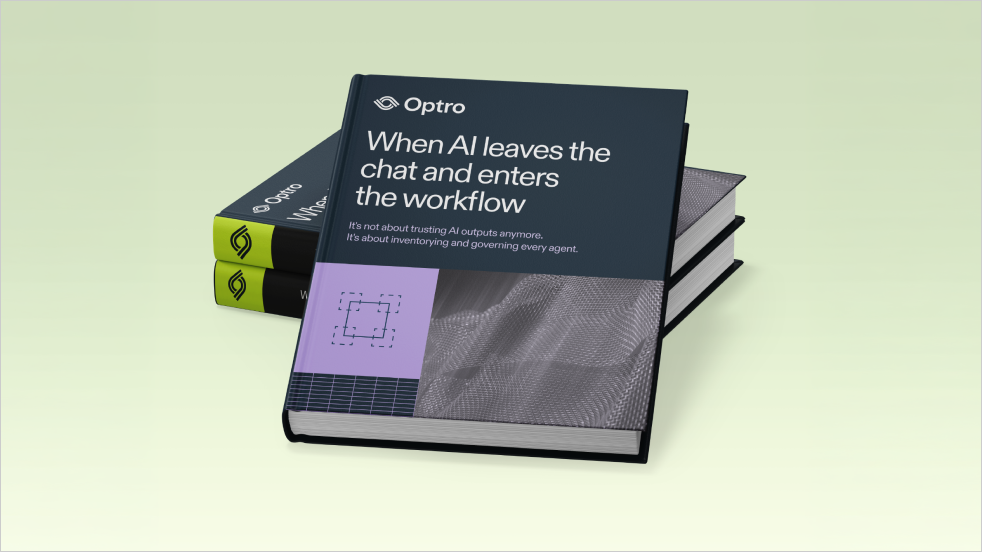
Optro’s AI Governance module is the industry’s leading System of Action, unifying policies and agent inventories into a single, proactive command center. Don’t let your governance maturity lag behind your innovation. Optro streamlines compliance across 25+ frameworks, allowing leaders like Dayforce and Cielo to automate evidence and achieve certification in record time. Ready to take command? Download the agentic AI report today or request a tailored demo to see our System of Action in motion.
Agentic AI governance is the structured management of the authority, access, and actions of autonomous AI agents that plan and execute tasks on behalf of an organization. It sets boundaries on what agents can access and do at runtime, extending trustworthy AI principles beyond model outputs to real-world execution.
Implementation starts with defining each agent’s scope and authority, then mapping identity and access on a least-privilege basis, running a pre-deployment impact assessment, establishing runtime controls, logging every action, setting human oversight thresholds, planning incident response, and monitoring continuously for behavioral drift.
The right solution depends on whether a team needs security-first runtime protection, enterprise lifecycle tooling, or compliance-first governance that maps to existing risk frameworks. Look for a platform that enforces least-privilege agent identity, provides audit-ready logging, and crosswalks directly to NIST AI RMF, ISO/IEC 42001, and the OWASP Top 10 for Agentic Applications.
Enterprise agent adoption is accelerating — agentic AI could unlock trillions of dollars in value — while governance maturity lags behind. Most existing AI governance programs were designed for model outputs, not autonomous execution, leaving a gap that agentic AI governance is built to close.
Successful teams design governance in rather than bolting it on. Key best practices include scaling oversight to autonomy level and automating evidence collection. Conversely, common pitfalls include having no named kill switch or ignoring shadow AI and purpose creep, where unsanctioned agents silently expand their access.
Optro’s AI Governance module is the industry’s leading System of Action, unifying policies and agent inventories into a single, proactive command center. Don’t let your governance maturity lag behind your innovation. Optro streamlines compliance across 25+ frameworks, allowing leaders like Dayforce and Cielo to automate evidence and achieve certification in record time. Ready to take command? Download the agentic AI report today or request a tailored demo to see our System of Action in motion.
Agentic AI governance is the structured management of the authority, access, and actions of autonomous AI agents that plan and execute tasks on behalf of an organization. It sets boundaries on what agents can access and do at runtime, extending trustworthy AI principles beyond model outputs to real-world execution.
Implementation starts with defining each agent’s scope and authority, then mapping identity and access on a least-privilege basis, running a pre-deployment impact assessment, establishing runtime controls, logging every action, setting human oversight thresholds, planning incident response, and monitoring continuously for behavioral drift.
The right solution depends on whether a team needs security-first runtime protection, enterprise lifecycle tooling, or compliance-first governance that maps to existing risk frameworks. Look for a platform that enforces least-privilege agent identity, provides audit-ready logging, and crosswalks directly to NIST AI RMF, ISO/IEC 42001, and the OWASP Top 10 for Agentic Applications.
Enterprise agent adoption is accelerating — agentic AI could unlock trillions of dollars in value — while governance maturity lags behind. Most existing AI governance programs were designed for model outputs, not autonomous execution, leaving a gap that agentic AI governance is built to close.
Natalie Dytrych is a Senior Product Marketing Manager for Regulatory Compliance at Optro. She has 8 years of experience helping financial institutions navigate complex regulatory compliance and risk challenges, most recently as a Senior Manager at PwC.