

Risk
CRX | GRC Intelligence and Agentic AI across audit, risk, and compliance | Read more
October 21, 2026 • 15 min read
A ransomware attack locks critical systems at 2 a.m. A key vendor goes dark mid-quarter. A regional disaster takes an entire facility offline. In every case, the question is the same: can operations continue?
Most organizations believe the answer is yes. Optro's "When business continuity fails" research report tells a different story: 92% of leaders say they are confident in their recovery capabilities, yet only 39% actually met their recovery-time objectives during their most significant disruption. Confidence without a tested plan is a liability.
A business continuity plan is a documented strategy that defines how an organization will sustain critical operations during and after a disruption. It covers people, processes, technology, and third-party dependencies — mapping what must keep running, what can tolerate downtime, and how recovery happens.
Standards and regulations like ISO 22301 and DORA now require documented, tested continuity programs. Third-party ecosystems keep expanding. AI-driven operations introduce new failure modes.
This article covers the core components of an effective BCP, a step-by-step process for building one, and how Optro (formerly AuditBoard) connects continuity planning to your broader risk and compliance program.
Is your recovery confidence high, while actual performance falls short?
Optro unifies business impact analysis, continuity plans, and tabletop exercises within a connected risk platform — so your recovery targets hold up when disruption hits, not just in planning sessions.
A business continuity plan is a formal document that outlines how an organization will maintain essential functions during and after a disruption. It addresses four domains: people, processes, technology, and third-party relationships.
Most BCP failures trace back to fragmentation — plans that live in isolation from the risk, compliance, and audit data that should inform them. Optro's analysis of why business continuity programs break down identified this disconnection as the primary structural gap.
ISO 22301, the international standard for business continuity management systems, provides the framework most organizations benchmark against. But the standard defines requirements, not architecture. How a BCP connects to the rest of your risk program determines whether it works under pressure.
The two terms are often used interchangeably, but shouldn’t be.
A business continuity plan (BCP) covers the full scope of sustaining operations: people, facilities, communications, vendor relationships, and decision-making authority. A disaster recovery plan (DRP) is a subset focused specifically on restoring IT infrastructure, applications, and data.
Both are essential. The BCP is the strategic umbrella. The DRP is one component within it, addressing the technology recovery that supports broader operational continuity.
Organizations that treat DRP as their entire continuity strategy discover the gap during an actual disruption, when people, processes, and vendor dependencies fall outside the DRP’s scope.
The gap between continuity confidence and actual recovery performance is the defining risk in business continuity planning.
Organizations invest in plans, governance structures, and recovery targets. Then a disruption reveals what the plan missed.
When recovery targets fail, the cost compounds fast. Optro's research report on business continuity failures found that 40% of organizations that missed recovery targets experienced losses exceeding $1 million.
Financial losses are the most visible consequence. But reputational damage, regulatory penalties, and customer attrition often exceed the direct operational cost of the disruption itself.
The common thread in most failure cases is not the absence of a plan. It is the absence of current, tested, connected planning. Static BCPs built in isolation from live risk data degrade slowly until the moment they are needed.
ISO 22301 establishes the international standard for business continuity management systems, requiring documented recovery strategies, regular testing, and management review.
DORA, the EU's Digital Operational Resilience Act, is a parallel regime for financial entities and has been applicable since January 2025, mandating ICT-related incident management and third-party risk oversight.
Industry-specific mandates add further pressure. The Business Continuity Institute frames continuity as a core organizational capability. For risk and compliance managers, the regulatory landscape has shifted from encouraging BCPs to requiring them.
Organizations that treat business continuity as a documentation exercise face audit findings, regulatory action, and operational failure without the governance record to demonstrate due diligence.
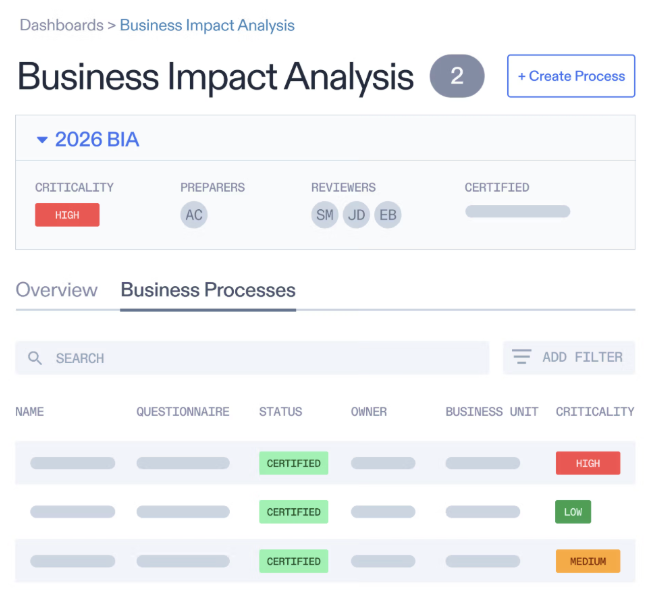
An effective BCP is built on three interconnected foundations:
The BIA is the foundation of every business continuity plan. It identifies critical processes, quantifies the financial and operational impact of their disruption, and sets recovery-time and recovery-point objectives.
A thorough BIA answers three questions:
Most organizations underestimate the dependency-mapping step. A process may appear self-contained until the BIA reveals upstream vendor dependencies or shared infrastructure connecting it to other workflows.
Optro's business continuity management platform offers configurable BIA questionnaires with dynamic scoring that surface these hidden interdependencies.
Once the BIA identifies what matters most, risk assessment determines what could disrupt it. This means mapping processes to IT systems, vendors, physical locations, and upstream risks, then assessing the likelihood and impact for each threat.
Fragmentation is the top reason continuity programs break down at this stage. When risk assessments live in spreadsheets, vendor data sits in procurement, and IT dependencies are tracked separately, no one has a single source of truth. Enterprise risk management programs that connect these data sources outperform siloed approaches.
Humana's risk management transformation illustrates the principle. After consolidating internal audit and risk management onto Optro's connected platform, the organization achieved a 30% increase in SOX controls tested and a 50% increase in risk audits. Cross-functional visibility makes dependency mapping actionable.
Recovery strategies translate BIA findings into actionable procedures. Each critical process needs defined recovery-time objectives, recovery-point objectives, workaround procedures, communication protocols, and role assignments.
The documentation itself is important. Plans stored as static PDFs degrade the moment a process changes, a vendor is replaced, or an RTO is revised. Living documentation — plans that update as assessments change — separates functional continuity programs from compliance artifacts.
Effective operational risk management requires plan documentation that reflects the current state, not last quarter's assumptions. Approval workflows, version control, and stakeholder notifications keep plans aligned with actual operations.
Building a BCP is iterative. The five steps below follow a logical sequence, but each feeds back into the others as new information surfaces.
Start with a complete inventory of business processes, mapped to the IT systems, vendors, and personnel that support them. A business process library provides a searchable foundation — you cannot protect what you have not documented.
Prioritize by revenue impact, regulatory obligation, and customer dependency. Not everything is critical. The exercise of distinguishing the essential from the important is where most organizations see their real risk landscape.
For each critical process, quantify the impact of disruption over time. Define maximum tolerable downtime, set recovery-time objectives, and establish recovery-point objectives for data-loss tolerance.
Capture dependencies at every level: internal systems, external vendors, shared infrastructure, and upstream data feeds. Dynamic scoring helps prioritize where static checklists fall short, accounting for how disruption impacts based on timing, season, and concurrent events.
Each critical process needs a defined recovery path. This includes alternate work locations, backup systems, manual workaround procedures, and communication chains.
Recovery strategies should account for multiple types of disruption. A cyberattack demands different procedures than a natural disaster, even for the same process. Address the most likely scenarios first, then expand to high-impact, low-probability events.
A BCP stored on a shared drive as a static PDF is already outdated. Plans should be living documents that update automatically when assessments change, RTOs are revised, or vendor relationships shift.
Approval workflows ensure plan changes are reviewed. Version control maintains an audit trail. Automated distribution ensures every stakeholder has the current version — not the one from last year's exercise.
Tabletop exercises and scenario simulations validate whether recovery strategies work in practice. They reveal gaps that documentation reviews alone cannot surface.
Link exercises directly to specific plans, track identified gaps, and feed findings back into the BIA and recovery strategies. The exercise cycle — test, identify gaps, remediate, retest — is what turns a document into a capability.
Optro centralizes the entire continuity lifecycle — business impact analysis, plan creation, tabletop exercises, and reporting — within a connected risk platform, eliminating the fragmentation that causes most continuity programs to fail.
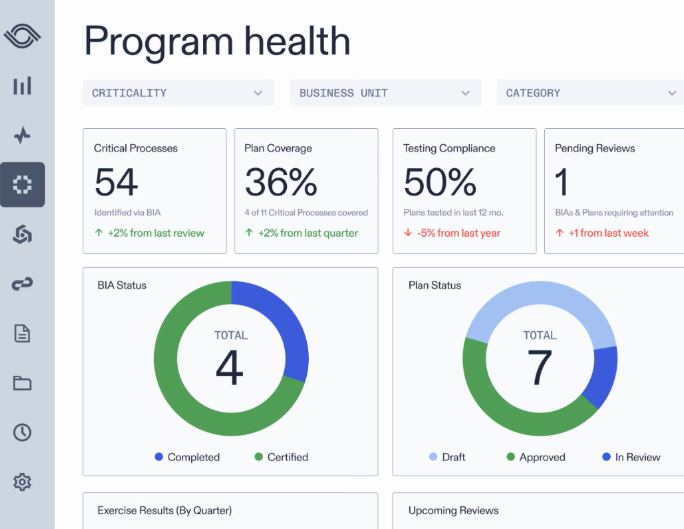
Configurable BIA templates with dynamic scoring surface hidden dependencies. Auto-populating continuity plans stay current as assessments change, with built-in approval workflows and version control. Tabletop exercises link directly to plans with bow-tie analysis and gap tracking, so findings translate into remediation rather than sitting in a debrief document.
RiskOversight extends continuity planning into predictive risk capabilities and scenario planning, connecting your BCP to the broader enterprise risk program. Board-ready dashboards give leadership real-time visibility into program health and compliance status, turning continuity management from a back-office function into a strategic asset.
Most business continuity plans fail because they are disconnected from the risk data that matters most.
Optro unifies continuity planning, impact analysis, and tabletop exercises within your GRC platform — so your plans stay current, and your recovery targets stay within reach.