

Risk
CRX | GRC Intelligence and Agentic AI across audit, risk, and compliance | Read more
October 21, 2026 • 14 min read
Having a business continuity plan and proving it works under pressure are two different problems. ISO 22301 is the international standard that requires organizations to build, test, and maintain a certified management system around continuity, not just document one.
When continuity planning lives in static documents, disconnected from the risk assessments and control frameworks that should inform it, the result is plans that look complete on paper but have never been tested against the dependencies they’re intended to protect.
This article looks at what ISO 22301 requires, how it strengthens broader risk programs, the essential components of an effective BCM framework, and how to embed it into day-to-day operations.
ISO 22301 is the international standard for business continuity management systems. Published by the International Organization for Standardization (current edition: ISO 22301:2019), it provides a framework for organizations to anticipate, prepare for, respond to, and adapt to disruptive incidents.
The standard matters now more than ever. Boards and regulators have moved past asking whether an organization has a disaster recovery plan. They want evidence of ongoing operational resilience: documented processes, tested scenarios, and measurable recovery capabilities.
That shift is what makes ISO 22301 different from a checklist exercise. It demands a management system with leadership commitment, defined scope, regular testing, and continual improvement.
Disaster recovery focuses on restoring IT systems after an incident. ISO 22301 operates at a broader level. It addresses the entire organization's ability to continue delivering products and services during and after disruption, covering people, processes, technology, and supply chains.
The distinction is practical. A disaster recovery plan might restore a data center in four hours. A BCMS asks whether the people who need that data center can actually use it, whether alternative processes are in place during the outage, and whether customers were notified.
ISO 22301 is sector-agnostic. Financial services, healthcare, manufacturing, technology, and government are all in scope; any organization that needs to maintain operations through disruption can implement it. Certification is voluntary but increasingly expected.
Regulated industries often treat it as a baseline. The BCI Horizon Scan Report 2025 reinforces what practitioners already see: cyber-attacks remain the top anticipated risk for the year ahead, and stakeholders want proof of preparedness across the disruption landscape.
A structured BCMS does more than protect against disruption. It generates risk intelligence that traditional risk management approaches miss.
Business impact analyses, a core ISO 22301 requirement, force organizations to map dependencies across processes, systems, vendors, and personnel. That mapping surfaces single points of failure and concentration risks that a standard risk register, populated top-down by risk owners, often overlooks.
When those findings stay locked in a standalone BCM tool, their value is limited. When they flow into the same platform as enterprise risk assessments and audit plans, leadership gets a unified view of organizational resilience.
The BIA is where BCM and ERM intersect most directly. Every critical process identified in a BIA carries dependencies: technology, personnel, third parties, and facilities. Each dependency is a potential risk.
Mature programs feed BIA outputs directly into the enterprise risk register. A critical vendor dependency identified during continuity planning is recorded as a third-party risk entry. A single point of failure in a payment-processing workflow poses an operational risk with a quantified impact.
Continuity exercises do double duty. They validate whether recovery procedures work, and they stress-test the controls that the risk management process depends on.
A tabletop exercise that reveals a communication breakdown during a simulated cyber incident also reveals a control gap. That finding belongs in the risk register and the audit plan, not just the BCM after-action report.
Risk committees and boards increasingly expect continuity metrics alongside enterprise risk dashboards. Exercise completion rates, recovery time performance, and BIA currency belong in the same reporting cadence as risk appetite utilization and control effectiveness scores.
Connected reporting eliminates the quarterly scramble to reconstruct continuity posture from a different system. It gives leadership real-time visibility into whether the organization's resilience matches its risk profile.
ISO 22301 defines a set of interconnected building blocks. Each one feeds the next: a business impact analysis informs continuity strategies, which shape exercise scenarios, which generate findings that cycle back into risk assessments.
Understanding these components as a system, rather than a compliance checklist, is what separates organizations that achieve certification from those that achieve operational resilience.
The BIA identifies which processes are critical, how quickly they must be restored, and what resources they depend on. It produces two key outputs: maximum tolerable periods of disruption and recovery time objectives for each critical process.
Risk assessment, run in parallel, identifies threats and vulnerabilities that could cause those disruptions. Together, BIA and risk assessment answer two questions: what matters most, and what is most likely to go wrong.
With critical processes identified and risks assessed, the next step is defining how the organization will maintain or restore operations. Continuity strategies address the gap between current capability and required recovery performance.
Strategies might include alternative work locations, technology failover arrangements, reciprocal agreements with third parties, or cross-trained personnel. Each strategy should map directly to a BIA-identified dependency.
Recovery procedures translate strategies into actionable, step-by-step instructions. They need to be specific enough that someone unfamiliar with the process can execute them under pressure.
Plans that are never tested are assumptions. ISO 22301 requires organizations to conduct exercises at planned intervals and use the results to improve the BCMS.
Effective exercise programs escalate in complexity: desktop reviews, tabletop discussions, functional simulations, and full-scale exercises. Each type validates different aspects of the framework.
Continual improvement closes the loop. Exercise findings, incident learnings, audit results, and changes in the organization's risk profile all feed back into the BCMS, updating BIAs, refining strategies, and improving procedures.
Implementation starts with a gap assessment. Map your current BCM activities against the seven ISO 22301 clause areas (context of the organization, leadership, planning, support, operation, performance evaluation, and improvement) and identify where you fall short.
Prioritize based on your BIA. The processes with the highest business impact and the widest readiness gaps deserve attention first. Trying to build a complete BCMS across every process simultaneously is the most common cause of stalled implementations.
Build cross-functional ownership rather than centralizing BCM in one team. Process owners should own their continuity plans. The BCM function provides the framework, the tools, and the oversight, not the plans themselves.
Optro provides a centralized platform where business continuity management activities connect to risk assessments, audit findings, and compliance obligations. Practitioners can manage continuity within the same system of action they use for broader GRC, which eliminates the disconnected spreadsheets and point tools that create the readiness gap ISO 22301 is designed to close.
Toro was managing controls through spreadsheets and documentation scattered across SharePoint sites and network drives — a setup that could not keep pace with growing audit requirements or survive staff transitions.
After deploying CrossComply, SOXHUB, OpsAudit, and RiskOversight on Optro's connected platform, the team completed a full NIST 8183 mapping for their OT environment.
From there, they formalized enterprise risk management that had previously existed only informally, and gave leadership direct visibility into remediation status and accountability.
The result: the same team now covers significantly more ground — what Toro describes as being able to “go further with the same hours.”
Read The Toro Company’s full story.
Passing the certification audit confirms your BCMS meets the standard — what happens next determines whether it actually protects the business.
The KPIs that matter track operational maturity: exercise completion rates, mean time to activate continuity plans, percentage of critical processes with tested recovery procedures, and reduction in recovery time objectives over successive test cycles.
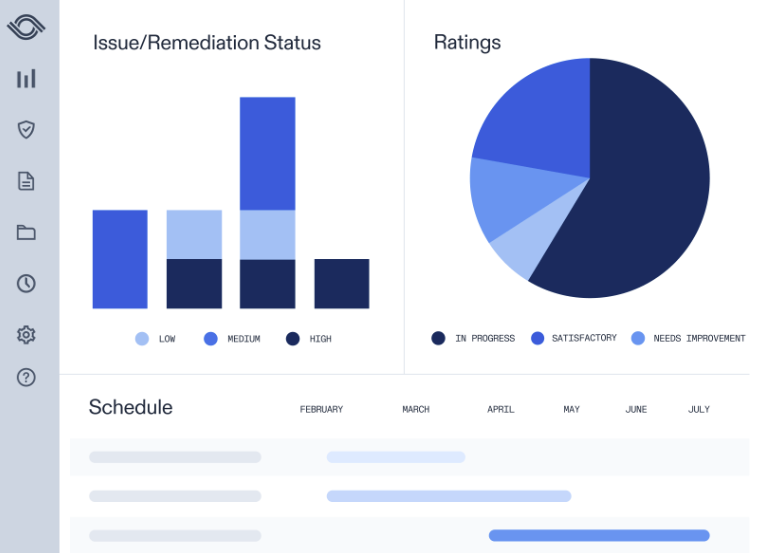
Connected data across risk, audit, and compliance functions gives leadership confidence that continuity plans reflect the organization's actual risk landscape rather than last year's assumptions. That confidence is what transforms BCM from a compliance obligation into a strategic capability.
Organizations that get this right share a common pattern: they treat ISO 22301 not as a standalone compliance project but as the operational backbone of a broader resilience program — one where continuity data informs risk decisions, audit findings sharpen recovery procedures, and every test cycle makes the next disruption less disruptive.
Is your continuity plan sitting in a binder that no one has tested?
Optro connects business continuity activities to risk assessments, audit plans, and compliance obligations on a single platform, so leadership gets real-time visibility into organizational resilience.