

Risk
CRX | GRC Intelligence and Agentic AI across audit, risk, and compliance | Read more
October 21, 2026 • 15 min read
Integrated risk management and governance, risk, and compliance show up in the same conversations, vendor pitches, and analyst reports. Sometimes the terms are treated as synonyms. Other times, one is positioned as the successor to the other, or as a competing philosophy entirely.
This can create internal confusion. How an organization defines its risk management approach shapes budget conversations, technology decisions, and cross-functional collaboration. A CRO framing a program around GRC fundamentals will make different platform and staffing choices than one building toward enterprise-wide risk intelligence.
The stakes rise when organizations hit a growth inflection: new business units, executive mandates for integrated risk visibility, or the realization that siloed tools cannot keep up with cross-functional complexity.
This article breaks down what each term actually means, where IRM and GRC overlap, where they diverge, and how to decide which framing serves your organization's next phase.
GRC coordinates governance, risk, and compliance as three linked disciplines — each with its own workflows, ownership, and reporting lines. IRM reorganizes the same work around a single enterprise-wide view of risk, making risk appetite (not the compliance calendar) the primary driver of priorities and resource allocation.
GRC is a structured approach to aligning three functions that historically operated in parallel. Governance sets policies and oversight structures. Risk management identifies and mitigates threats. Compliance ensures the organization meets regulatory and internal obligations.
In practice, GRC programs tend to organize around functional domains — internal audit, operational risk, IT compliance, regulatory compliance — with processes and tools dedicated to each. The OCEG GRC Capability Model formalized this as a discipline: coordinated rather than siloed, but still structured around distinct functional pillars.
The strength of this model is clarity. Each function has defined ownership, workflows, and reporting lines.
IRM starts from a different organizing principle. Instead of coordinating separate governance, risk, and compliance functions, it treats enterprise-wide risk visibility as the primary lens. Governance and compliance become supporting outputs of a unified risk view.
The term gained traction from 2018, when Gartner repositioned its analyst framework around integrated risk management and pushed organizations to think beyond compliance-first operating models. Gartner has since returned to GRC terminology, publishing a Magic Quadrant for GRC Tools in 2025. The argument is that risk should drive the program, not the other way around.
IRM does not eliminate governance or compliance; it reorders the hierarchy.
Risk appetite and enterprise-wide risk intelligence sit at the center, and compliance obligations flow from that risk picture instead of defining it.
The terminology debate can make these approaches sound more different than they are in practice. Most organizations that do GRC well are already doing parts of IRM, and most organizations pursuing IRM still need every capability GRC provides.
Both approaches aim to break down the silos that plague risk and compliance programs. They require cross-functional collaboration among audit, risk, compliance, and IT security teams and depend on reliable data flowing among those functions.
A mature GRC strategy and a mature IRM program look similar at the data layer: connected repositories, shared control libraries, and reporting that aggregates across functions. The infrastructure requirements converge even when the organizing philosophy differs.
The practical difference shows up in how the program is structured and what question it answers first.
GRC programs typically organize around compliance obligations and control frameworks. The core question is: are we meeting our obligations?
Risk management exists alongside compliance, but the compliance calendar and audit cycle set the operational rhythm.
IRM programs organize around risk appetite and enterprise-wide risk visibility. The core question: what are our most significant risks, and are we managing them within tolerance? Compliance becomes an output — evidence that risks are being governed — instead of the starting point.
On the ground, most risk and compliance leaders operate between these poles. They manage frameworks, run audits, and track compliance, and they want connected risk data that tells a board-ready story about enterprise risk posture.
That theory holds in practice. For example, Humana's audit and risk teams were each running their own processes with limited visibility into each other's work — a textbook case of the silo problem both GRC and IRM try to solve.
After consolidating onto Optro's connected platform, the team tested 30% more SOX controls, completed 50% more risk audits, and improved audit cycle efficiency by 20%, by giving every function access to the same data.
Read how Humana broke down silos across its lines of defense.
Optro supports both perspectives on a single platform. Teams that think in GRC terms manage frameworks, controls, and audits in connected modules. Teams adopting an IRM lens use the same connected data to drive enterprise risk management visibility and risk-first decision-making.
Framing this shift as an evolution, not a replacement, is the key insight. Organizations that have built mature compliance processes do not tear them down to adopt IRM. They build on that foundation and reorient around risk visibility as the organizing principle.
Most teams don't decide to adopt IRM because of a strategy offsite. They hit a wall that a function-by-function model can't solve:
Day-to-day risk work stays the same — what changes is how it's organized. Risk assessments become enterprise-scoped instead of function-scoped. Reporting aggregates risk data across audit, compliance, and operational risk into a single view, and the risk register becomes the primary artifact, with compliance status mapped as a dimension of risk instead of a standalone workstream.
Cross-functional collaboration shifts from periodic (quarterly risk committee meetings) to continuous (shared risk data updated in real time).
This is the part that trips people up. The GRC-to-IRM narrative can imply that governance and compliance lose importance, but they do not. Every IRM program still needs policy governance, regulatory compliance tracking, audit management, and control testing.
What changes is where those activities sit in the hierarchy. They become inputs to the enterprise risk picture instead of standalone programs measured on their own terms.
Optro's connected-risk platform supports organizations at any point in this evolution, from teams formalizing GRC fundamentals to teams building enterprise-wide risk intelligence with RiskOversight.
The platform question matters because most organizations do not land purely in one camp. They need a system of action that supports compliance-driven workflows and risk-first analytics without forcing a binary choice.
Four capabilities separate platforms that support a GRC-to-IRM evolution from those that lock organizations into one approach:
Optro provides a single platform where audit, risk, compliance, and IT security teams work from connected data.
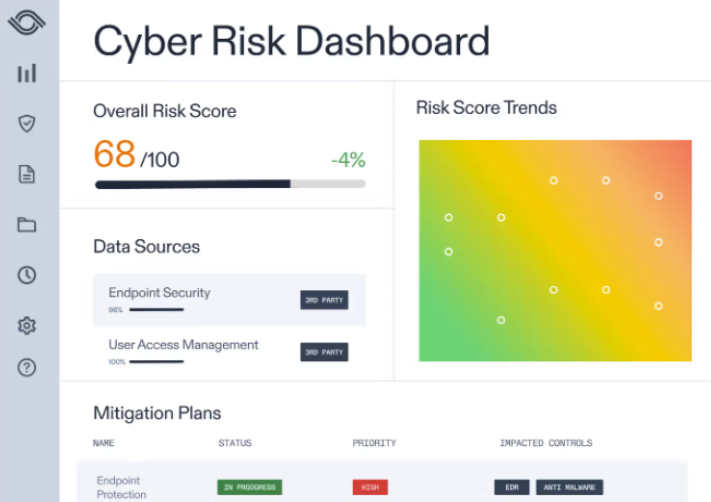
Teams running compliance-first programs use CrossComply and OpsAudit to manage frameworks, controls, and audit evidence, while teams building toward enterprise risk visibility use RiskOversight to aggregate risk data across functions and produce real-time reporting.
The architecture is designed so organizations do not choose between GRC and IRM at the technology layer. The platform supports both and the path between them.
Whether the program is framed as GRC, IRM, or a pragmatic blend of both, four KPIs signal that the approach is working:
The label matters less than the outcome: connected data, cross-functional collaboration, and a risk picture leadership actually trusts.
Still running risk, audit, and compliance as separate programs, or ready to connect them?
Optro brings risk, audit, compliance, and IT security onto one connected platform, so you get enterprise-wide visibility without choosing between GRC and IRM frameworks.