



Compliance
CPE Week | Join us for our second annual CPE Feast, November 30 to December 3 | Register here about this announcement
November 17, 2026 • 15 min read
The access review export lands in your inbox for the third time this year, from the same system and the same engineer, who is slower to answer each time because the request looks identical to the last two.
Two pressures put this on the agenda: audit cycle time, and stakeholder fatigue from repeated requests.
This article explains the mechanism behind that work. You’ll see how evidence is retrieved, timestamped, and attached to a control, and where it stops working.
Automated evidence collection is the practice of connecting a compliance platform to the systems that already hold the record of a control operating, retrieving that record on a defined schedule, and storing it with the metadata an auditor needs to rely on it.
The step that disappears is the request, while the judgment about whether the control worked stays with a person.
A control is the activity that reduces the risk. An artifact is the file showing it ran: an export, a log entry, a ticket. Evidence is the artifact plus the context that makes it believable: who produced it, when, and across what population.
Collection, testing, and continuous monitoring are three different activities. Collection obtains the artifact and proves where it came from, testing evaluates whether the control worked, and continuous monitoring watches for drift between tests. Collection feeds testing rather than replacing it.
Automated evidence collection takes place across five steps: a connector authenticates to a source system, queries a defined scope, retrieves the result, applies a collection timestamp, and writes the artifact against the control it supports.
Source systems fall into categories rather than brand names: cloud infrastructure, identity and access providers, vulnerability scanners, ticketing and change management tools, and HR systems. What they share is a queryable record generated by normal operation rather than by someone preparing for an audit.
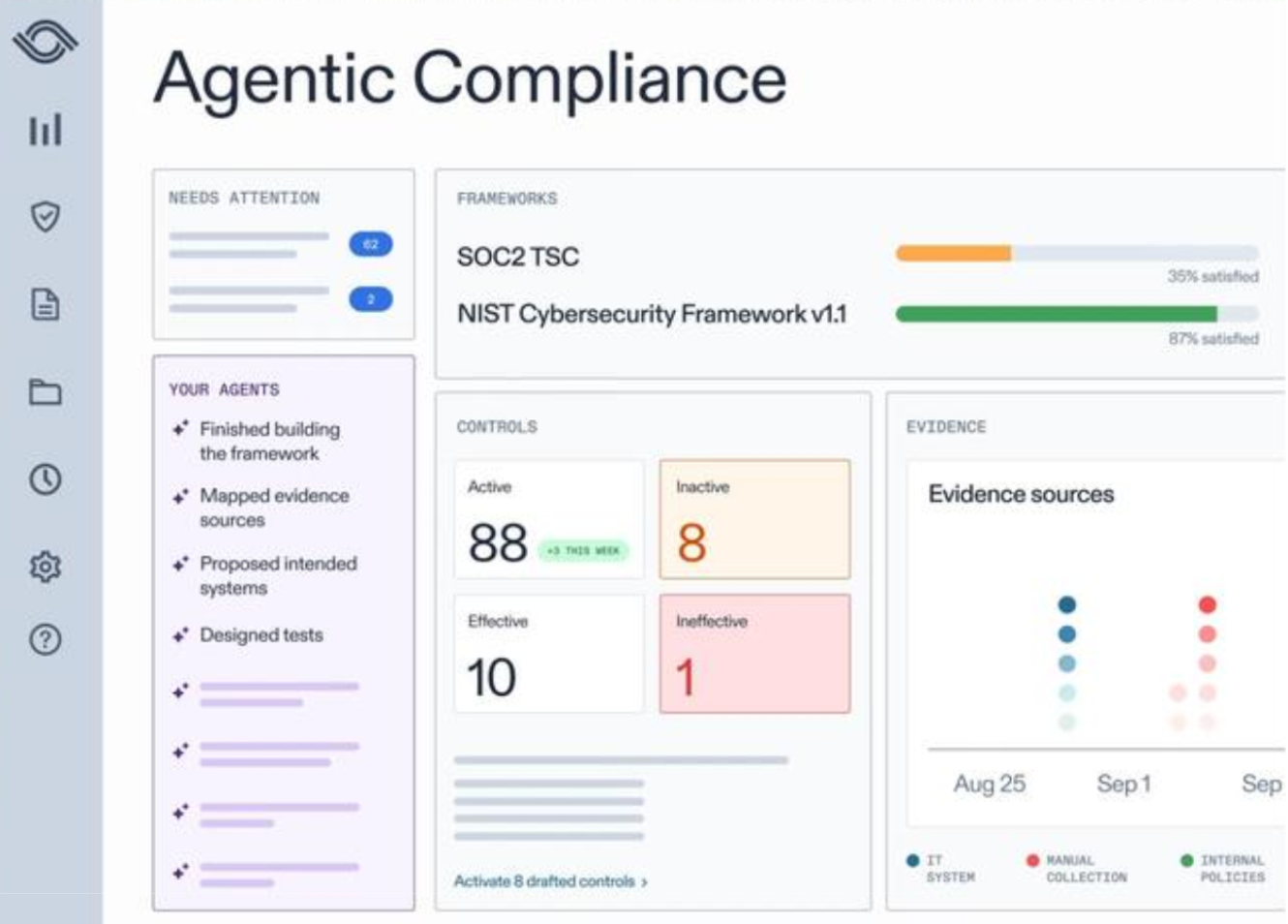
CrossComply, the compliance control module from Optro (formerly AuditBoard), describes automated evidence collection and control testing against mapped controls, so the artifact lands attached to the requirement it satisfies rather than in a shared folder.
A connector holds credentials for the source system and reads under a specific service account, and that account is part of the evidence. An auditor who cannot see which identity pulled the record has to take the export on trust.
Scope is easy to underspecify. A connector that queries production but misses three legacy accounts in a separate tenant produces an artifact that looks complete and is not.
Define the population first, covering every in-scope system, every account type, and every documented exception, then write the query against that definition. A connector pulling the wrong population produces evidence that fails review, and the failure usually surfaces months after collection started.
The artifact writes against the control, not into a folder named after the audit. That attachment is what lets one pull answer several requests, and it is how an auditor finds the evidence for a given control without being walked through a folder structure.
Four tests decide whether a piece of evidence survives review, and they apply to automated and manual evidence alike. Scheduled collection satisfies them as a by-product of how it works, while a screenshot taken by hand fails at least two of them by construction.
These four tests are easiest to answer when the artifact, the control it supports, and the collection record sit together in a single system of record.
Completeness asks whether the artifact covers everything in scope or a convenient slice of it. Manual collection tends toward the slice, because the person pulling it exports what the interface shows on the first screen.
A scoped query returns the full population every time it runs, including the records nobody thought to check. Sampling then becomes the auditor's decision rather than an accident of how the export was taken.
Provenance asks which system produced the artifact, under which account, and when. Immutability asks whether anyone can edit it after collection, and whether that edit is visible.
A spreadsheet emailed among three people satisfies neither test, while a timestamped pull written to a controlled repository satisfies both without anyone attesting to the chain by hand.
Period coverage asks whether the evidence spans the window under audit or only the day someone remembered to take a screenshot. Manual collection fails this test most often, and remediation is expensive because the window has usually closed by the time anyone notices.
SOC 2 is where the structural argument for automation is strongest, for a reason built into how a Type II report is written.
A Type II opinion covers an observation period. The auditor is testing whether the control operated throughout that window, not whether it was configured correctly on the day of fieldwork. Evidence gathered retrospectively, at the end of the window, cannot demonstrate operation across it.
Scheduled collection does demonstrate it. Each pull carries its own timestamp, and the sequence of pulls describes the period rather than a point inside it.
A screenshot taken in month 11 proves the configuration in month 11 and says nothing about months 1 through 10, which is the part the opinion covers. Teams compensate by collecting more screenshots closer together, which multiplies the requests without changing what the evidence proves.
The AICPA publishes its own crosswalk from the 2017 Trust Services Criteria to ISO 27001. It covers the Security, Availability, Processing Integrity, Confidentiality, and Privacy categories.
It is authoritative because it comes from the body that owns the criteria, which is reason enough to prefer it to a vendor's reproduction of the same mapping.
That traceability is what makes one piece of evidence worth collecting well. Optro's CrossComply describes the same principle as "Certify once and comply across multiple requirements." For teams further along and comparing products, that decision is covered in our guide to SOC 2 compliance software.
Three categories of control cannot be automated, and a program built on the assumption that they can will produce evidence that auditors reject.
Judgment controls include a management review, an approval that turned on reasoning rather than a rule, and a risk acceptance signed off by a named executive. The system can evidence that the review happened, who attended, and when it concluded.
It cannot evidence that the review was adequate. Adequacy is an assessment a person makes, and an auditor tests it by reading what the reviewer wrote and judging whether the conclusion follows.
Some controls leave no queryable trace: for example, physical access to a facility whose badge reader logs nothing, segregation of duties agreed outside the provisioning tool, or vendor processes you observe during a site visit instead of querying over an API.
There is no record to connect to, so the evidence is the observation itself, documented at the time it was made by the person who made it.
Older on-premises applications frequently have no API. The realistic outcome is a scheduled manual upload with the same metadata discipline applied by hand: named collector, collection date, defined population, stored against the control.
The target is an inventory showing which controls fall into which category, so manual effort goes where a person is genuinely needed. That inventory also tells you, before an audit opens, which requests are still going to land on a person.
Sequencing matters more than tooling here, and it starts with the controls themselves. Rank the controls by how much duplicate work each one creates, map before you connect, then set a cadence that matches how the control operates.
Build a list of in-scope controls ranked by how many separate evidence requests each one generates across all audits in a year. That list decides what to connect first, not the integrations catalogue.
The controls at the top are usually access reviews, change approvals, and vulnerability remediation, because duplication concentrates there and a single connector retires the most repeat requests.
If one control satisfies requirements in several frameworks, connecting it once retires several recurring requests. Mapping before connecting converts a single pull into multiframework coverage.
The Secure Controls Framework is a free, noncommercial starting point, published by the Secure Controls Framework Council, LLC under Creative Commons Attribution-NoDerivatives 4.0 International. The 2026.2 release carries 1,500+ controls across 34 domains, mapped to 200+ laws, regulations, and frameworks, and is offered as a spreadsheet or NIST OSCAL JSON.
For deciding which controls belong in scope at all, NIST SP 800-53B sets three security control baselines, one for each system impact level, plus a privacy baseline applied irrespective of impact level, with tailoring guidance to inform control selection.
Cadence should follow the control's operating frequency and the audit window, not the shortest interval the connector allows. A quarterly access review collected daily generates a pile of redundant artifacts and no additional assurance.
Which enterprise platform to run this on is a separate exercise, covered in our guides to compliance automation tools and cybersecurity compliance software.
Three measures tell you whether the program is improving:
The third is the most informative and the least tracked. Rework is where scope errors, missing period coverage, and weak provenance show up, after the fact.
Evidence that sits attached to the control it supports, in one system of record, is what shortens the next audit's request list and keeps the same engineer from answering the same question three times a year.
The same access review export, requested for the third audit this year?
Optro's CrossComply collects evidence against mapped controls and keeps each artifact attached to the requirement it satisfies, so one tested control stays audit-ready across every framework that asks for it.