


Compliance
CRX | October 13-15, 2026 | Up to 17 CPEs | In-person & virtual options available | Register Now!
July 6, 2026 • 25 min read

Elli Sullivan
This guide is for GRC, compliance, audit, and IT risk teams comparing compliance management software for 2026. It compares seven platforms, Optro, Vanta, Drata, ServiceNow GRC, MetricStream, Workiva, and LogicGate Risk Cloud, on framework coverage, automation, and integrations, then walks through the criteria and questions to use when shortlisting a tool.
Choosing the best compliance management software is a question of finding a solution that aligns with how your team actually manages compliance, i.e., handling multiple frameworks simultaneously, sharing control and ownership, responding to constant evidence requests, and maintaining readiness for audits.
Under ISO 37301:2021, a compliance management system (CMS) is the organizational framework of policies, processes, and controls an organization uses to identify, assess, and meet its legal, regulatory, and internal obligations, and to continually monitor and improve that program. Compliance management software is the tool that operationalizes a CMS, so it's worth judging platforms on how well they support that full cycle, not just individual features.
The challenging part is ensuring a good fit. As well as assessing features, you need to align workflows, ownership responsibilities, integrations, reporting schedules, and budgetary considerations with a tool your team can continue to use as your operations scale.
This guide compares the leading platforms, outlines what to prioritize, and the key questions to ask internally. We also share a simple evaluation matrix to help you make the best decision.
Here are the seven compliance management platforms we'll explore:
Compliance evidence collection and audit prep still manual and error-prone? Optro centralizes controls and evidence, supports cross-framework mapping and reuse, and automates workflows and testing for audit-ready reporting. Request a demo.
Use this high-level breakdown to see how each platform aligns across frameworks, integrations, and operating models.
Platform | Primary use case | Framework support | Key differentiators | Best for |
|---|---|---|---|---|
Optro | Automated, AI compliance, continuous compliance, Multi-framework compliance | 40+ frameworks including SOC 2, ISO 27001, ISO 42001, PCI DSS, HIPAA, GDPR, NIST, DORA | Continuous control monitoring, automated evidence collection, AI-powered cross-framework mapping and gap assessments | Organizations needing a holistic, connected GRC platform to scale and automate IT compliance across multiple frameworks. |
Vanta | Trust management, continuous compliance automation | 35+ frameworks including SOC 2, ISO 27001, HIPAA, GDPR | 1,200+ automated tests, continuous monitoring | Cloud-first teams prioritizing automated evidence collection |
Drata | Security and compliance automation, audit readiness | 20+ frameworks, including SOC 2, ISO 27001, HIPAA, GDPR, PCI DSS | Strong AWS integration, continuous control monitoring | Organizations with AWS-centric or cloud-native environments |
ServiceNow GRC | Enterprise GRC, IT risk, policy compliance | SOX, GDPR, ISO 27001, NIST, custom frameworks | Built on Now Platform, deep ITSM and SecOps integration | Large enterprises standardizing on ServiceNow |
MetricStream | Regulatory compliance, enterprise risk management | FFIEC, GLBA, FINRA, HIPAA, SOX, industry regulations | Regulatory library, MDOS modeling, AI-enabled insights | Highly regulated, multi-jurisdictional organizations |
Workiva | SOX compliance, financial reporting, ESG | SOX, internal audit, ERM, ESG frameworks | Real-time collaboration, data connectivity, and audit trails | Finance-led programs unifying SOX, ESG, and reporting |
LogicGate Risk Cloud | No-code GRC, third-party risk | 31+ security and privacy frameworks via Secure Control Framework | No-code workflows, Spark AI mapping, modular apps | Teams needing configurable, workflow-centric GRC |
Data accurate as of February 2026. Information is based on publicly available product documentation and vendor websites.
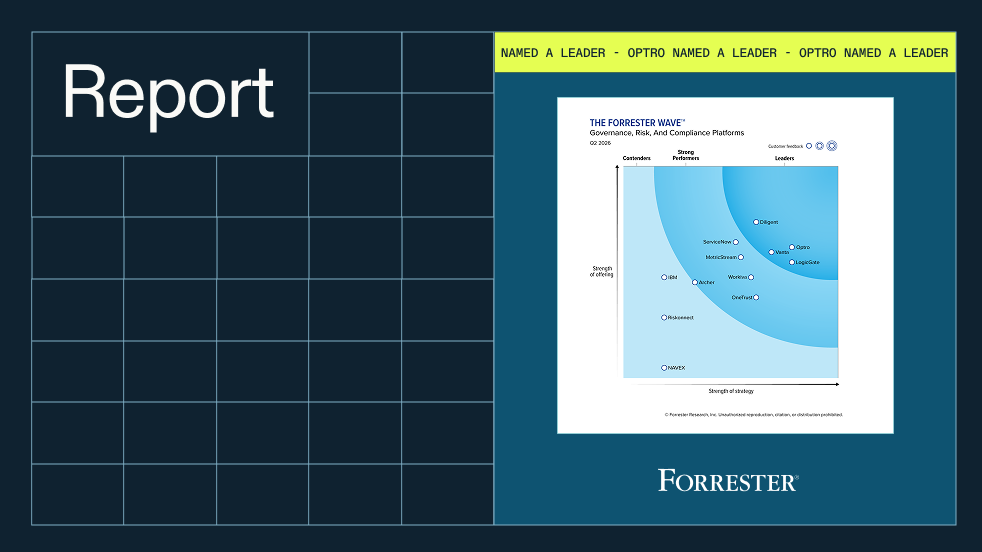
Optro is a GRC Intelligence Platform built for IT compliance, GRC, and risk teams managing multi-framework programs. It combines an enterprise-proven system of record with an agentic system of action, bringing together compliance management, internal audit, and risk workflows in a single environment that supports 40+ frameworks, including SOC 2, ISO 27001:2022, ISO 42001, PCI DSS, HIPAA, GDPR, NIST CSF 2.0, NIST AI RMF, and DORA. Optro was named a Leader in The Forrester Wave™: Governance, Risk, And Compliance Platforms, Q2 2026.
Teams use it to centralize their control library, automate evidence collection, map controls across frameworks to reduce duplicate testing, and report compliance status to executives and auditors. Because audit, risk, and compliance data share a common data model, updates in one area (a failed control, a new issue, a remediation task) flow through to the others without manual reconciliation. AI agents work alongside your team to flag risk and automate testing, while your team stays in control of decisions and remediation. Public companies using Optro agents to test controls have saved about 70% of their time in year one, and Optro is targeting up to an 87% reduction in fieldwork hours overall.
"The transparency that Optro gives to us and our business partners really helps us as an organization better manage risk." — Bambi Gifford, Manager of Internal Audit, U.S. Xpress
Compliance evidence collection and audit prep still manual and error-prone? Optro centralizes controls and evidence, supports cross-framework mapping and reuse, and automates workflows and testing for audit-ready reporting. Request a demo.
Vanta is a trust management and compliance automation platform focused on continuous monitoring and automated evidence collection. It supports common security and privacy frameworks such as SOC 2 and ISO 27001, and integrates with a large ecosystem to pull technical evidence. Teams often use Vanta to manage readiness workflows, track control status, and coordinate audits in cloud-first environments.
Vanta is a strong fit for cloud-first teams preparing for SOC 2 or ISO 27001 who want automated evidence collection and continuous monitoring with minimal manual effort, and are comfortable managing broader risk and governance workflows outside the platform.
Drata is a security and compliance automation platform centered on continuous control monitoring and evidence collection. It supports popular frameworks, including SOC 2 and ISO 27001, and integrates with cloud, identity, and development tools to surface control status and changes over time. Drata is commonly used to track readiness, manage evidence requests, and support audit preparation workflows.
Drata is a strong fit for cloud-native teams that want always-on technical control, monitoring, and automated evidence collection across their core stack.
ServiceNow GRC extends the Now Platform to support governance, risk, and compliance workflows in large organizations. It's typically used to connect control testing, attestations, issues, and policy workflows with ITSM/SecOps processes already running in ServiceNow. Programs that standardize compliance activities across many business units often use it to align reporting and operational execution.
ServiceNow GRC is a strong fit for large enterprises already standardized on the Now Platform who want compliance, risk, and ITSM workflows unified in a single engine across business units.
MetricStream is an enterprise GRC platform designed for organizations managing complex regulatory obligations across geographies and business lines. It's often used to map obligations to risks and controls, run assessments, manage issues, and support regulatory change processes. Teams typically deploy MetricStream as part of a broader, centralized GRC operating model with formal governance and reporting needs.
MetricStream is a strong fit for large enterprises in heavily regulated industries — banking, insurance, and pharmaceuticals — that manage complex, multi-jurisdictional obligations and operate a formal, dedicated GRC function.
Workiva is a cloud platform used for SOX, internal audit, ERM, and reporting-heavy compliance programs. Teams use it to coordinate workflows, maintain audit trails, and collaborate on documentation and reporting while connecting data from enterprise systems. Workiva is commonly adopted by finance-led or reporting-led programs that want structured workflows and traceability across stakeholders.
Workiva is a strong fit for finance-led programs that need structured workflows, traceability, and real-time data connectivity across SOX, internal audit, and ESG reporting.
LogicGate Risk Cloud is a no-code GRC platform for building and adapting workflows for compliance, risk, and third-party processes. Teams use it to configure assessments, approvals, and reporting without heavy development effort. It's commonly deployed where organizations want flexibility to tailor processes over time while maintaining centralized tracking and dashboards.
LogicGate Risk Cloud is a good fit if you value workflow flexibility, plan to tailor processes over time, and are comfortable defining those processes internally.
When evaluating tools, you need to prioritize support for the complete control lifecycle — documentation, testing, evidence, remediation, and reporting — across every framework you manage. The features listed below directly influence audit readiness, control reuse, and control owners' daily workload.
A control library that addresses SOC 2, ISO/IEC 27001:2022, NIST, HIPAA, SOX, and internal policies is essential. Your software should let you define controls, map them to requirements, assign ownership, schedule tests, and collect attestations.
Look for features such as clear ownership assignments, automated tasks, and dashboards that highlight overdue tests, and choose a platform supporting shared ownership, consistent testing, and accountability. A dedicated compliance workflow will reduce duplicate testing as your scope expands.
Strong platforms integrate with systems such as cloud providers, IAM, ticketing, and HR to regularly pull evidence. They should allow mapping of single evidence items to multiple controls and frameworks, maintain version history, and provide a clear audit trail. Scoped, read-only auditor access to evidence and test results can also streamline response times for requests.
Modern compliance platforms should support regulatory compliance through automated evidence collection, recurring control tests, alerts for control failures or requirement changes, and AI-assisted mapping of obligations to controls and policies. This helps teams move toward continuous compliance, reducing manual follow-up and keeping pace with changing regulatory requirements without rebuilding workflows every time the scope expands.
If you manage more than one framework, cross-framework mapping isn't optional. Your platform should help you see where a single control (such as MFA enforcement or change management) meets requirements across SOC 2, ISO/IEC 27001:2022, NIST CSF 2.0, and other standards, so you can test once and apply results everywhere relevant.
Pre-built mappings and the ability to extend them to custom frameworks are critical as new regulations are added over time.
Your software should support a consistent workflow for logging issues, rating impact and likelihood, recording risk-based exceptions, assigning owners, setting dates, and tracking remediation to closure—tied back to affected controls and risks so you can report meaningful impact.
Bi-directional integrations with tools like Jira or ServiceNow are especially valuable, since remediation tasks often live in engineering or IT queues while compliance teams still need visibility into status.
You'll want configurable dashboards for executives, operational leaders, and auditors, plus the ability to filter by framework, entity, process, and control owner. Prioritize native connectors and APIs for your cloud stack, identity systems, ticketing tools, CMDB, and existing risk registers.
Platforms such as Optro connect this data across a unified system of record and system of action, so you can maintain a single pane of risk across audit, compliance, and IT.
Before shortlisting platforms, align internally on your operating model—who owns controls, who tests them, how evidence is collected, and how often you report status to leadership. The questions below help you define requirements before you start demos.
To get fully aligned on the right fit, start by identifying which category your context fits into: Automation tool, connected risk platform, or enterprise GRC suite.
Once you've determined the appropriate category, assess vendors based on three key factors: Integrations, workflow ownership, and reporting depth.
Dimension | Examples | Better-suited tool types |
|---|---|---|
Organization size/maturity | Early-stage startup; mid-market with developing GRC program; global enterprise with legacy GRC investment | Vanta/Drata for lean early-stage teams; Optro for mid-market to enterprise with mid-to-high program maturity; Archer/IBM OpenPages for complex legacy environments |
Primary use case | First SOC 2 certification; multi-framework compliance; continuous monitoring at scale | Compliance automation tools for certifications; Optro or ServiceNow for multi-framework; MetricStream for regulated industries |
Integration needs | Cloud/IAM automation; ticketing and CMDB sync; ERP and HR data | Vanta/Drata for cloud/IAM depth; Optro or LogicGate for cross-domain; ServiceNow for ITSM-native environments |
Reporting & governance | Auditor portals; evidence trails; exec and board reporting cadence | Optro, Workiva, MetricStream for board-level and cross-program reporting |
Admin and implementation capacity | Small team, no dedicated GRC admin; mid-size team with defined ownership; large enterprise with dedicated GRC function | Vanta/Drata for minimal-admin setups; Optro for teams with defined ownership and phased rollout capacity; ServiceNow/MetricStream for enterprises with dedicated admin |
Ready to reduce audit prep and evidence chasing as the scope expands? See how Optro supports multi-framework compliance with centralized controls, mapped evidence, and automated workflows. Request a demo.
Compliance management software is a platform that centralizes the management of regulatory obligations, security and privacy frameworks, and internal policies. It brings together controls, testing workflows, evidence, issues, and reporting so you can coordinate multi-framework programs from one place. The best compliance management software lets you map requirements from standards like SOC 2, ISO 27001, HIPAA, GDPR, and SOX to specific controls, assign owners and testers, collect and version evidence, and show real-time status to leaders and auditors.
Compliance management software focuses on the mechanics of meeting requirements, such as controls, testing, evidence, exceptions, and audits. GRC software covers a wider set of use cases, including enterprise risk management, policy management, internal audit, ESG, and third-party risk, with compliance as one module among several. The key question for buyers is scope: whether you mainly need deep support for multi-framework compliance workflows, or whether you also want those workflows connected to enterprise risk and governance in one platform.
Your software should natively support the frameworks you're accountable for today and have a path for the ones you expect to add. Common needs include SOC 2, ISO/IEC 27001:2022, PCI DSS, HIPAA, GDPR, NIST CSF 2.0, and SOX. Financial institutions may also need FFIEC, GLBA, or FINRA, healthcare organizations often add HITRUST, and global organizations may need DORA or Cyber Essentials. Just as important as coverage is how well the platform supports cross-framework control mapping, so you can reuse controls, tests, and evidence across overlapping requirements.
Several developments reshape buyer requirements heading into 2026: the EU's NIS2 Directive, transposed by member states in October 2024, expands cybersecurity risk management and incident reporting obligations; the EU AI Act, in force since August 2024, phases in risk management and documentation duties for high-risk AI systems through 2028; and SEC cybersecurity disclosure rules require U.S. public companies to report material incidents and describe their governance over cybersecurity risk. Compliance management software should help track these obligations, map them to controls, and produce audit-ready evidence as each requirement phases in.
Focused compliance automation tools for a single framework can often be up and running in a few weeks, especially with out-of-the-box templates and standard integrations. Broader GRC or multi-framework platforms typically require a phased rollout over several months. Implementation moves faster when you come into the project with an agreed control library, defined testing procedures, and clear ownership.
According to IBM's Cost of a Data Breach Report (2024), organizations making extensive use of security AI and automation had an average breach cost of $3.84 million, compared to $5.72 million for organizations not using these technologies, and identified and contained breaches nearly 100 days faster. That gap is why continuous monitoring and AI-assisted evidence collection are increasingly treated as core compliance management software capabilities rather than optional extras.
Yes. According to NAVEX's 2024 State of Risk & Compliance Report, 66% of organizations say their board receives periodic reports on compliance matters, and 58% say the board has direct oversight of the compliance program. That makes configurable, board-ready reporting an important capability to evaluate, not just an executive dashboard.

Elli Sullivan is a Senior Product Marketing Manager at Optro, driving strategic market execution, with nearly a decade of experience in IT audit, risk, and compliance. Her career is grounded in security and compliance from her time at KPMG as part of the IT Advisory team, focused on evaluating IT controls and risks. She transitioned into the GRC technology space, where she served as a subject matter expert, developing platform content and resources aligned to best practices across various company sizes and industries, while driving content and strategy initiatives in partnership with product, customer success, and marketing teams. Her multidisciplinary background across IT audit, GRC, and product marketing enables her to help organizations understand and adopt technology solutions that strengthen their GRC programs.