



InfoSec
CRX | October 13-15, 2026 | Up to 17 CPEs | In-person & virtual options available | Register Now!
March 31, 2026 • 26 min read

Sean Kenney
Key Takeaway: A compliance report documents control status, findings, remediation owners, and sign-off across applicable frameworks. Cadence is driven by regulation: SEC Item 1.05 incidents require an 8-K within four business days, while SOC 2, HIPAA, and ISO 27001 follow annual cycles with quarterly internal reviews. Map a single control library to NIST CSF 2.0, DORA, and ESRS to avoid redundant reporting.
The SEC's 2023 cyber disclosure rule reset compliance reporting expectations: public companies now have four business days from a materiality determination to file a Form 8-K under Item 1.05. Combined with NIST CSF 2.0 (February 2024), DORA's designated critical ICT third-party provider list, and the August 2, 2026 EU AI Act deployer deadline, the practitioner's job is no longer producing a static annual deliverable — it is maintaining audit-ready evidence across overlapping regimes.
A compliance report is a documented assessment of how an organization's controls, policies, and procedures align with applicable laws, frameworks, and internal standards. It captures control status, identified vulnerabilities, remediation plans, and sign-off — and serves as the artifact regulators, customers, and the audit committee rely on to evaluate program effectiveness.
For chief compliance officers and compliance managers, these reports are working tools for evaluating program effectiveness, identifying compliance risk, and charting corrective action. They also support transparent communication with stakeholders, reinforcing trust and accountability. Data breaches and disclosure failures carry significant reputational and financial repercussions, and the ability to produce accurate, detailed compliance reports matters more than ever.
Compliance reports are often generated or validated by an independent auditor — required for SOC 2, ISAE 3402, PCI DSS (QSA), and FedRAMP (3PAO) attestations — to ensure objectivity and credibility with regulators and customers. Beyond regulatory adherence, well-constructed reports demonstrate operational discipline and support sustained growth in a fast-moving regulatory environment.
Understanding the distinctions between report types is essential for tailoring your approach to specific regulatory and operational needs.
A comprehensive compliance report assembles the elements that convey adherence to regulatory frameworks and internal governance. These components collectively provide a clear, actionable snapshot of compliance status, areas of risk, and forward-moving strategies.
At minimum, a compliance report should include:
A thorough analysis of potential and actual compliance risks anchors the report, categorizing them by severity and impact to guide remediation priority. Audit outcomes — methodologies employed, findings uncovered, and any deviations from expected standards — are integral. Following the audit findings, the report outlines targeted action plans with specific steps for rectification, responsible parties, and timelines for completion.
This forward-looking section underscores the organization's commitment to continual improvement and adaptation to evolving regulatory expectations. The data points, performance metrics, and trend analyses contained in the report provide insight into the organization's compliance trajectory and, increasingly, into the avoided-cost value of the program — the SEC awarded approximately $60 million to 48 whistleblowers in fiscal year 2025, a useful benchmark for contextualizing program ROI to boards.
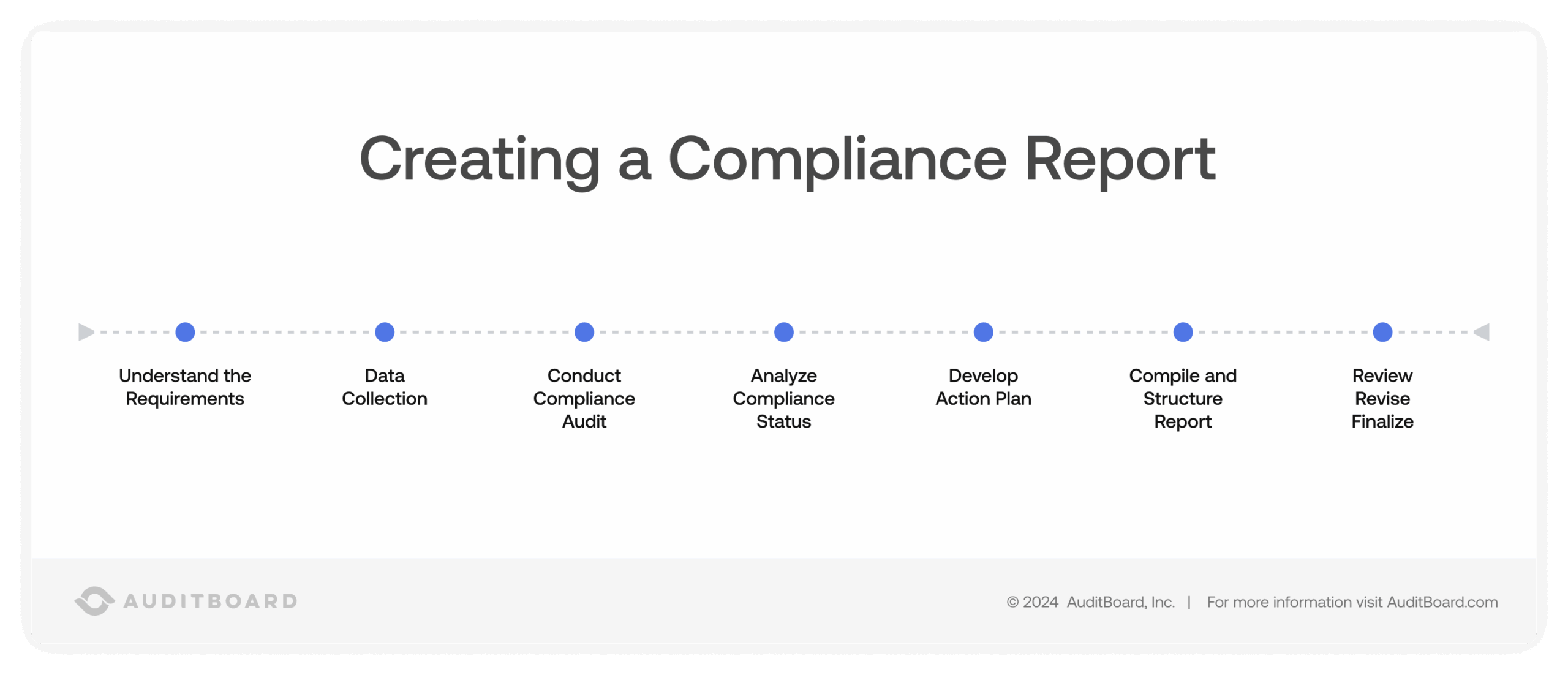
Creating a compliance report requires careful planning and thorough preparation. This stage is pivotal for setting the groundwork for a comprehensive analysis of the compliance landscape, enabling compliance managers and CCOs to approach the reporting process with precision and depth.
To work efficiently, familiarize yourself with the reporting standards, norms, and criteria set forth by the regulatory bodies relevant to your industry. Understanding the context and requirements directs your data collection and shapes the framework of your compliance report.
The next step is a thorough data collection effort: gathering all pertinent documentation, records, and evidence related to the organization's compliance activities. This includes policies and procedures, prior audit reports, training records, incident response logs, and correspondence with regulatory bodies. The objective is to amass information that provides a holistic view of the compliance status, ensuring nothing is overlooked.
Parallel to data collection, identifying and engaging key stakeholders is critical. These stakeholders span various departments and levels, including individuals who directly oversee or contribute to the compliance program. Engaging them early ensures their insights are incorporated, enriching the depth of the compliance report. Case studies reveal that using a connected risk platform to centralize documentation can save valuable time and improve stakeholder communication.
The cornerstone of a compliance report is a comprehensive compliance audit, a process that demands rigor, detail, and strategic planning. This step requires a meticulous evaluation of systems, procedures, and controls to ascertain their alignment with the relevant regulatory mandates and security norms. During this phase, the compliance team — led by seasoned compliance managers and officers — examines the organization's operational facets to surface non-compliance issues, vulnerabilities, and deviations from established standards.
A thorough security and compliance audit goes beyond surface examination. It involves a granular analysis of data handling practices, internal controls, and the compliance program's effectiveness through interviews, document reviews, and on-site observations. The audit also tests the resilience of response mechanisms — for example, by walking through how a material cybersecurity incident would move from detection to an SEC Item 1.05 filing within four business days.
The audit results serve as the factual foundation of the compliance report, identifying deficiencies, classifying risks based on severity, and prioritizing corrective actions. A thorough audit equips the organization with the insights to strengthen its compliance stance — shifting from reactive to proactive management of regulatory obligations and risks.
Once the audit is complete, the focus shifts to critically analyzing the findings to identify non-compliance issues and the root causes contributing to them. This phase demands a nuanced approach: compliance risks are categorized and scrutinized to pinpoint existing gaps and rank them based on their potential impact. Risk prioritization informs the strategic direction and urgency of remediation efforts.
Engagement with relevant stakeholders during this stage is paramount. It ensures a comprehensive understanding of the audit findings and fosters a collaborative atmosphere for addressing the identified gaps. Such collaboration is critical for devising action plans tailored to the root causes of non-compliance, enhancing the organization's overall compliance posture.
This analytical process is also foundational to developing targeted action plans. It enables compliance managers and CCOs to formulate precise corrective measures aligned with risk management objectives and regulatory obligations — transforming compliance challenges into opportunities to strengthen the program.
Crafting actionable plans for compliance improvement is a pivotal phase. Action plans must be detailed: specific remedial actions, designated responsible parties, and clear timelines for execution. This ensures accountability and facilitates progress tracking.
A crucial aspect of action plan design is incorporating both short-term fixes and long-term strategies to address systemic compliance risks. This may involve updating policies and procedures, enhancing internal controls, and implementing training programs to instill a culture of compliance across the organization.
Automation tools and compliance management software play a significant role in modern action plans — improving evidence collection, control-to-framework mapping, and regulatory change tracking. PwC's Global Compliance Survey 2025 found that technology is the top compliance technology priority for executives, and leading practices now include RAG-based regulatory Q&A with citation validation (notably for the EU AI Act) and automated risk classification against Article 6 and Annex III.
Equally important is aligning action plans with the organization's overall risk management framework and regulatory obligations. A practical approach is to build a single control library mapped many-to-many against each applicable framework — NIST CSF 2.0 for cyber, NIST SP 800-171 Rev 3 for CUI, ISO/IEC 42001 for AI governance, DORA for ICT resilience, and ESRS for sustainability — then generate framework-specific report views from that shared evidence base.
Engaging stakeholders throughout development and implementation reinforces a collaborative, transparent approach to compliance improvement.
Completing the reporting process efficiently requires careful planning and meticulous organization. Clarity, coherence, and precision must take priority to meet the expectations of stakeholders and regulatory bodies. The goal is to combine data, audit results, analyses, and action plans into a comprehensive narrative of the organization's compliance status and direction.
The report should be organized logically, with sections arranged to guide the reader through the compliance program overview, detailed findings, and recommendations. Every segment should transition smoothly to the next. Establish a consistent reporting cadence — monthly KRI dashboards, quarterly internal reports to the audit committee, and annual external or regulatory reports — with event-driven reports triggered by incidents, M&A, or regulatory change. A standardized template reduces resource use across cycles.
Attention to detail is paramount: every data point and assertion should be cross-verified for accuracy and relevance. Visual aids such as heatmaps, control coverage charts, and exception trend lines should be used judiciously to break down complex information and highlight trends. This makes the report both a document of record and a tool for strategic decision-making.
Finalizing a compliance report requires a thorough review process to ensure every aspect meets the highest standards of accuracy and professionalism. This stage is not merely about refining the text for clarity but about validating the integrity of the data presented and its alignment with regulatory requirements and internal objectives. It involves a detailed examination of the entire report, from initial assessments and audits to proposed action plans, scrutinizing each for precision, relevance, and impact.
Engaging a diverse group of stakeholders during this phase is critical. Input from various departments can expose overlooked aspects or inaccuracies, providing a well-rounded perspective on compliance efforts and outcomes. This collaborative review reinforces the organization's commitment to transparency and collective responsibility.
When handling revisions, exercise caution and ensure that every change reflects a strategic grasp of compliance obligations and risk management. Modifications to action plans or compliance risk analysis must be thoroughly evaluated to maintain the report's credibility. Risk management software can centralize risk data, increase visibility, and save time.
Before publication, the report should be formally signed off by the CCO and, depending on materiality, upper management and the legal team — particularly for filings tied to regulator-facing disclosures such as SEC Form 8-K Item 1.05. Skipping formal sign-off leaves accountability ambiguous if regulators question the report later.
Beyond the headline challenges, practitioners learn faster from failure patterns than from generic best practices. The most frequent pitfalls include:
The SEC received a record 53,753 tips, complaints, and referrals in fiscal year 2025 — a nearly 19% year-over-year increase — signaling that internal reporting weaknesses increasingly surface externally. Skipping formal sign-off compounds the risk: it leaves accountability ambiguous if regulators later question the report.
Compliance reporting presents challenges that demand strategic foresight: the intricacies of data collection, the dynamic nature of regulatory requirements, organizational resource constraints, and the need for comprehensive stakeholder engagement. To address these issues, organizations are adopting compliance automation tools that offer real-time reporting capabilities and automate complex compliance processes. These tools improve collection and analysis of large data volumes and increase accuracy and timeliness against reporting deadlines.
The agility to adapt to regulatory changes is equally critical. Organizations must foster a proactive culture that anticipates and responds to the evolving regulatory environment, integrating new standards — NIST CSF 2.0, DORA, ISO/IEC 42001, ESRS — into their compliance frameworks with minimal disruption. Engaging stakeholders at every level is essential: a shared understanding of compliance objectives builds collective commitment to reporting quality.
By addressing these challenges with strategic planning, technological innovation, and stakeholder collaboration, organizations can navigate the complexities of compliance reporting and reinforce their dedication to operational integrity and regulatory adherence.
Successfully producing compliance reports requires a thoughtful, strategic approach that prioritizes operational integrity and a deep understanding of the regulatory landscape. The fundamentals laid out above — preparation, audit rigor, findings analysis, action planning, structured compilation, and formal sign-off — produce reports that fulfill regulatory mandates and serve as strategic tools for organizational improvement.
Success hinges on a thorough understanding of regulatory landscapes, meticulous preparation, and adept analysis of compliance data. Adopting technology to improve reporting processes ensures accuracy and efficiency. By fostering a proactive compliance culture, organizations can stay ahead of regulatory changes, mitigate risks, and maintain transparency and accountability. As the regulatory environment continues to evolve in 2026 and beyond — with PCAOB QC 1000 and ISA 240/570 (Revised) taking effect December 15, 2026 — the ability to produce comprehensive, actionable compliance reports will remain a pivotal factor in sustaining an organization's reputation and operational excellence. The right compliance management software can help ease compliance reporting, secure your organization, and accelerate the business.
In larger organizations, the Chief Compliance Officer (CCO) owns the compliance report, supported by compliance managers, internal audit, and cross-functional contributors from legal, IT, finance, and operations. Before issuance, the report should be formally signed off by the CCO and, depending on materiality, upper management or the legal team — particularly for filings tied to regulator-facing disclosures such as SEC Form 8-K Item 1.05.
The five C's — commitment, culture, communication, controls, and continuous monitoring — are the foundational pillars of an effective compliance program and should appear as evidence categories in the report. Use them to organize qualitative narrative (tone from the top, training, escalation channels) alongside quantitative control testing results and monitoring KPIs.
At minimum, include the status of controls (design and operating effectiveness), identified vulnerabilities and open findings, remediation owners and timelines, risk-rated exceptions, KRIs and KPIs with trend data, prior-period comparison, third-party status, and the overall cost of compliance. For regulator-facing reports, add scope, methodology, exclusions, attestation language, and sign-off signatures.
Cadence is driven by regulatory mandate and risk velocity. SEC material cybersecurity incidents require a Form 8-K within four business days; SOC 2 Type II covers a 6–12 month observation window; HIPAA, PCI DSS, and ISO 27001 typically follow annual cycles with quarterly internal reviews. A practical baseline is monthly KRI dashboards, quarterly internal reports to the audit committee, and annual external reports — with event-driven reports for incidents, M&A, or regulatory change.
The most frequent pitfalls are inconsistent or unverified data sources, missed reporting deadlines, lack of version control on findings, over-reliance on manual spreadsheets, failure to map findings to the current regulatory baseline (e.g., NIST CSF 2.0 vs. legacy CSF), weak audit trails, and treating the report as a one-time artifact instead of a living record. Many failures also stem from skipping formal sign-off, which leaves accountability ambiguous if regulators question the report later.
Automation is shifting compliance reporting from periodic manual exercises to continuous control monitoring, with AI-driven tooling handling evidence collection, control-to-framework mapping, regulatory change tracking, and draft narrative generation. Leading practices include RAG-based regulatory Q&A with citation validation (notably for the EU AI Act), automated risk classification against Article 6 and Annex III, and integrated GRC dashboards that pull live data from security, HR, and finance systems.
Public companies must file an Item 1.05 Form 8-K within four business days of determining that a cybersecurity incident is material. The compliance report should document the materiality determination process, an incident timeline, and an evidence trail linking the security incident to the disclosure decision. Build the incident-to-filing workflow into the IR playbook and run quarterly mock-filing drills to validate cycle time and approval chains.

Sean Kenney is a Manager of Product Solutions at Optro, specializing in IT Risk and Compliance. Prior to joining Optro, Sean worked for an Information Security Consulting company where he did GRC advisory services for clients.