



InfoSec
CRX | October 13-15, 2026 | Up to 17 CPEs | In-person & virtual options available | Register Now!
April 1, 2026 • 25 min read

Brett Guzzi
Key Takeaway: COBIT 2019 is ISACA's IT governance framework, built on six principles, seven enablers, and 40 governance and management objectives across five domains (EDM, APO, BAI, DSS, MEA). Practitioners use it to translate overlapping obligations — SOX, ISO 27001:2022, PCI DSS v4.x, DORA, and the NIST Cyber AI Profile — into a single control architecture.
ISACA's February 2026 release of the ITAF 5th edition broadened COBIT's relevance to AI/ML auditing, continuous assurance, and cloud governance, while ISACA research found that 59% of organizations do not know how quickly they could halt a compromised AI system. COBIT 2019's design-factor model is the mechanism most audit and risk teams now use to align IT governance with these new realities without standing up parallel control universes.
COBIT, which stands for Control Objectives for Information and Related Technologies, is an IT governance framework developed by ISACA (Information Systems Audit and Control Association). It provides guidance and best practices for organizations to manage information and technology effectively, aligning IT goals with business goals, improving cybersecurity, and strengthening the overall governance system.
Why practitioners care in 2026. PwC's 2026 Global Digital Trust Insights survey ranks third-party risk management (37%) and AI governance (37%) as the top concerns for digital trust leaders. COBIT is the framework most often used to translate those concerns into testable controls across the EDM, APO, BAI, DSS, and MEA domains.
The COBIT framework establishes a common language for IT auditors, compliance officers, risk managers, and business executives. It helps organizations define clear management objectives and establish a structured approach to achieve them. By implementing COBIT, organizations can manage risks, demonstrate compliance with regulatory requirements, and optimize IT controls.
Six governance principles. COBIT 2019 is built on six principles of governance system and processes: meeting stakeholder needs, covering the enterprise end-to-end, applying a single integrated framework, enabling a holistic approach, separating governance from management, and maintaining a dynamic governance system. These principles guide organizations in designing governance processes that align with specific business goals.
Seven enablers. COBIT also incorporates seven enablers that are essential components for the success of IT processes: principles, policies, and frameworks; processes; organizational structures; culture, ethics, and behavior; information; services, IT infrastructure, and applications; and people, skills, and competencies. Together they give practitioners a structured way to evaluate whether all relevant governance factors are accounted for.
To help organizations operationalize COBIT, ISACA offers webinars, training programs, certifications, and online materials. The most relevant certifications for audit and risk professionals are COBIT 2019 Foundation, COBIT 2019 Design & Implementation, and COBIT 2019 Assessor — the last of which qualifies the holder to conduct formal capability assessments, particularly valuable for DORA, NIS2, and ISO 27001:2022 assurance work.
COBIT was first released in 1996 as a set of IT control objectives and has evolved through five major versions: COBIT 1 (1996) focused on audit; COBIT 2 (1998) added control; COBIT 3 (2000) introduced management guidelines; COBIT 4/4.1 (2005/2007) added IT governance; COBIT 5 (2012) integrated risk and assurance. The current version, COBIT 2019, was released in 2018 and builds on the foundation laid by COBIT 5.
COBIT 5 served as a useful enterprise governance framework, but the rapid advancement of cloud, mobile, and AI technologies made an update necessary. The move from COBIT 5 to COBIT 2019 incorporated new insights from IT and governance experts and aligned the framework with current industry practices, allowing organizations to address modern challenges without rebuilding their governance programs.
Five principles to six. One major difference between COBIT 5 and COBIT 2019 lies in the governance system principles. COBIT 5 had five principles: (1) meeting stakeholder needs, (2) covering the enterprise end-to-end, (3) applying a single integrated framework, (4) enabling a holistic approach, and (5) separating governance from management. COBIT 2019 retains the substance of all five and adds two new system principles — dynamic governance and tailored to enterprise needs — reframing the structure into governance system principles and governance framework principles.
This flexibility allows organizations to tailor their governance system to their unique requirements. COBIT 2019 also introduces a conceptual reference model that promotes consistency and automation, aligning IT governance practices with industry standards and regulations. The new COBIT architecture is based on the CMMI Performance Management Scheme, which focuses on assessing capability and maturity levels rather than scoring isolated controls.
Overall, the evolution from COBIT 5 to COBIT 2019 reflects continuous effort to adapt to the changing needs of organizations. The momentum continues beyond COBIT itself — ISACA's updated framework for IT audit (ITAF 5th edition) reflects the same direction of travel toward AI governance, continuous assurance, and cloud assurance.
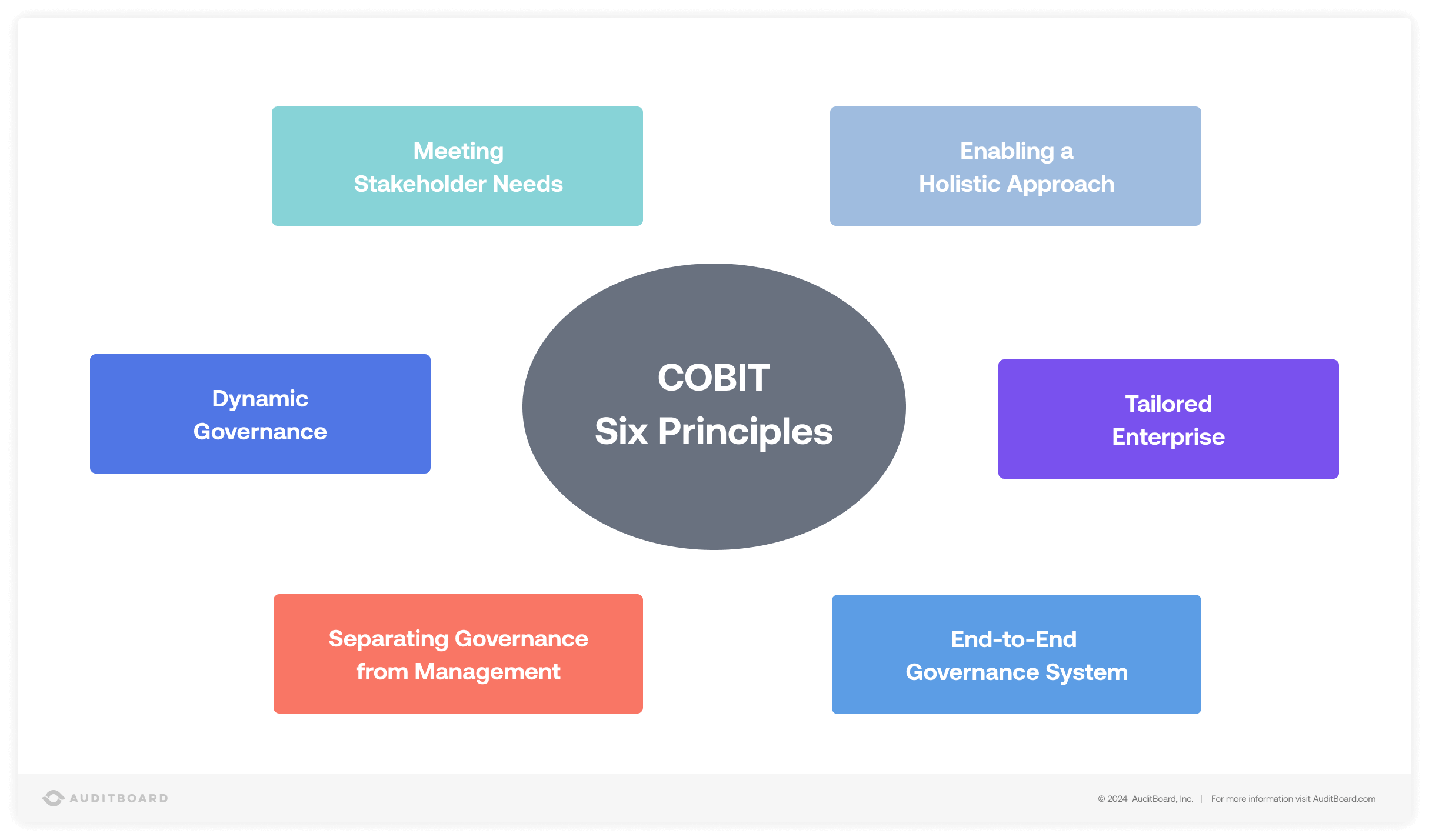
COBIT is widely recognized as a leading management framework for organizations to manage information and technology, thanks to its systematic approach to IT governance and risk management. COBIT 2019 incorporates six principles that are essential for effective IT governance:
By adhering to these principles, organizations can establish a mature IT governance framework. COBIT provides detailed process descriptions, design factors, and performance management practices to support implementation, and individuals can validate their proficiency through COBIT 2019 Foundation, Design & Implementation, and Assessor certifications.
COBIT's seven enablers are the components that make IT governance work in practice. Auditors and risk managers use them to scope reviews and identify where governance gaps sit:
By using these seven enablers, organizations can improve IT governance maturity and meet compliance goals. COBIT provides a CMMI-based maturity model that helps teams assess current capability in each enabler, identify gaps, and build a defensible roadmap for improvement.
COBIT 2019 organizes its content into 40 governance and management objectives spread across five domains. Practitioners use this structure to scope audits, build control libraries, and map COBIT to other frameworks:
Design factors do the tailoring. COBIT 2019 also specifies 11 design factors — including enterprise strategy, risk profile, threat landscape, compliance requirements, sourcing model, and enterprise size — that organizations score to derive a tailored governance system. Practitioners run a design workshop to weight each factor, then use ISACA's design toolkit to identify which of the 40 objectives should be prioritized and at what target capability level. This produces a defensible justification for scope decisions when auditors ask why certain objectives received more attention than others.
COBIT, ITIL, and NIST are distinct but complementary frameworks: COBIT focuses on governance and risk management, ITIL emphasizes IT service management practices, and NIST concentrates on cybersecurity standards. Each plays a different role in an organization's control environment.
COBIT provides comprehensive guidance for managing information and technology end-to-end. It focuses on aligning IT goals with business objectives, strengthening cybersecurity, and improving overall governance. COBIT covers principles, processes, organizational structures, culture, information, services, infrastructure, and people.
ITIL (Information Technology Infrastructure Library) is an IT service management (ITSM) framework. It provides best practices for designing, delivering, and supporting IT services across their lifecycle.
NIST (National Institute of Standards and Technology) publishes guidelines for cybersecurity and risk management. The NIST Cybersecurity Framework 2.0 — released February 2024 — helps organizations of all sizes understand, manage, and reduce cybersecurity risk. NIST also released a preliminary Cyber AI Profile in February 2026 that extends CSF 2.0 with three AI-focused functions: Secure, Defend, and Thwart.
The frameworks differ primarily in scope. COBIT covers the full IT governance landscape, including controls, risk management, and process design. ITIL focuses specifically on IT service management. NIST narrows further to cybersecurity and risk standards. They are not mutually exclusive: practitioners often combine ITIL, NIST, CMMI, ISO 27001:2022, DevOps practices, TOGAF, and COBIT to achieve an integrated approach to IT management and compliance.
Compliance is a core part of running a regulated business, and the 2025–2026 deadline clustering has made multi-framework coordination harder. ISO/IEC 27001:2022 transition deadlines closed October 31, 2025; 51 future-dated PCI DSS v4.x requirements became effective March 31, 2025; and DORA and NIS2 are now in force for EU operations and many extraterritorial entities. COBIT is the framework most often used to manage that complexity.
One control library, many frameworks. COBIT 2019's 40 governance and management objectives function as a central control taxonomy. APO12 (Manage Risk) satisfies ISO 27001:2022 risk assessment requirements; DSS05 (Manage Security Services) maps to PCI DSS v4.x access and vulnerability controls; and the full domain structure aligns to the six functions of NIST CSF 2.0, including the new "Govern" function. Practitioners build a single control library tagged to all applicable frameworks rather than maintaining parallel SOX compliance programs.
Clear roles and accountability. COBIT provides guidance on defining roles and responsibilities for IT governance, which streamlines decision-making during audits and incident response. This is especially relevant for DORA, where named decision authorities and tested escalation paths are explicit requirements.
Culture and behavior. COBIT also emphasizes culture, ethics, and behavior — making compliance a shared expectation rather than a compliance-team-only concern. This includes awareness training, regular education, and visible accountability for control ownership.
COBIT's value in 2026 is most visible in three areas where traditional governance has lagged: AI oversight, continuous delivery, and continuous assurance.
AI incident response is the most material gap. ISACA research released in 2026 found that 59% of organizations do not know how quickly they could halt an AI system during a security incident, and only 21% could do so within 30 minutes. Just 42% are confident they could investigate and explain a serious AI incident to leadership or regulators. Practitioners are mapping AI incident response to DSS02 (Manage Service Requests and Incidents) and DSS04 (Manage Continuity), supported by APO12 for pre-incident risk appetite, with documented target time-to-halt under 30 minutes.
AI agent identity needs hardening. ISACA 2026 research also found that 88% of enterprises reported confirmed or suspected AI agent security incidents in the past year, and 45.6% of teams still use shared API keys for agent authentication. Map AI agent governance to DSS05 (Manage Security Services), APO13 (Manage Security), and APO07 (Manage Human Resources) extended to non-human identities, with dedicated identity assignment and logged actions per agent.
DevOps assurance is now in scope. ISACA's "COBIT Focus Area: DevOps Using COBIT 2019" extends BAI03, BAI06, and DSS06 with practices specific to continuous integration, automated testing, and pipeline-as-code. The companion audit program provides test procedures for segregation of duties in automated pipelines, secrets management, and deployment evidence — areas where traditional change-ticket sampling falls short.
ITAF 5th edition broadens audit scope. Released February 2026, the updated IT Audit Framework explicitly extends to AI/ML auditing, cloud computing, business automation, agile auditing, and continuous assurance. For internal audit functions, this raises the expectation that COBIT-based audit work products incorporate digital trust and AI governance concepts. Teams scaling these expectations across hundreds of objectives typically operationalize them through dedicated IT risk management tooling rather than spreadsheets.
By using COBIT's principles, enablers, and the design-factor methodology, audit, risk, and compliance teams can enhance compliance management, manage risk, and produce defensible evidence across SOX, ISO, PCI, SOC 2, DORA, and NIS2 obligations in parallel.
In audit and compliance practice, COBIT is used to scope IT audits, structure SOX ITGC testing, support HIPAA and GDPR control assessments, and provide the control basis for SOC 2 and ISO 27001:2022 readiness. Risk teams use it to define IT risk appetite, prioritize remediation, and benchmark maturity through CMMI-aligned capability assessments. Boards and CIOs use COBIT to justify IT investment decisions and demonstrate enterprise governance of information and technology (EGIT) to regulators.
Yes. ISACA has actively extended COBIT 2019 to modern delivery models through the "COBIT Focus Area: DevOps Using COBIT 2019" and a companion DevOps audit program, allowing assurance over continuous delivery pipelines without stifling release velocity. The 2019 design-factor model also lets organizations tailor governance to cloud, agile, and AI contexts. Recent regulatory pressure from DORA, NIS2, and the NIST Cyber AI Profile has reinforced COBIT's role as a central translation layer for disparate obligations.
COBIT 5's five principles were meeting stakeholder needs, covering the enterprise end-to-end, applying a single integrated framework, enabling a holistic approach, and separating governance from management. COBIT 2019 retains the substance of all five and adds two new system principles — dynamic governance and tailored to enterprise needs — while reframing the structure into governance system principles and governance framework principles. The practical impact is that COBIT 2019 explicitly requires periodic reassessment of governance design rather than treating it as a one-time implementation.
COBIT 2019 specifies 11 design factors — including enterprise strategy, enterprise goals, risk profile, threat landscape, compliance requirements, sourcing model, and enterprise size — that organizations score to derive a tailored governance system. Practitioners run a design workshop to weight each factor, then use ISACA's design toolkit to identify which of the 40 governance and management objectives to prioritize and at what target capability level. This produces a defensible, evidence-based justification for scope decisions when auditors challenge them.
COBIT 2019's 40 governance and management objectives across EDM, APO, BAI, DSS, and MEA function as a central control taxonomy that other frameworks can be crosswalked into, eliminating duplicate testing. APO12 (Manage Risk) satisfies ISO 27001:2022 risk assessment requirements, DSS05 (Manage Security Services) maps to PCI DSS v4.x access and vulnerability controls, and the full domain structure aligns to NIST CSF 2.0's six functions including the new "Govern" function. Build a single control library tagged to all applicable frameworks rather than running parallel programs.
DSS02 (Manage Service Requests and Incidents) and DSS04 (Manage Continuity) are the primary objectives for AI incident response, supported by APO12 (Manage Risk) for pre-incident risk appetite. Extend DSS02 playbooks with AI-specific containment procedures and a documented target time-to-halt under 30 minutes, since only 21% of organizations currently meet that threshold. Evidence for auditors should include tested runbooks, named decision authorities, and post-incident explainability artifacts, since only 42% of organizations are confident they could explain a serious AI incident to regulators.
DORA's five ICT risk management pillars — risk management, incident reporting, resilience testing, third-party risk, and information sharing — map directly to APO12, DSS02, DSS04, APO10, and APO08, giving non-EU firms a familiar framework to demonstrate compliance. NIS2's governance and accountability requirements align with the EDM domain, particularly EDM03 (Ensured Risk Optimization). Run a DORA/NIS2 applicability assessment first — covering EU customer base, EU operations, and supply-chain relationships — then use COBIT as the translation layer to existing SOX, HIPAA, or SOC 2 controls.
Brett Guzzi, CISA is a Manager of Product Solutions at Optro. Brett’s background includes nearly 13 years of experience in Internal Audit and Risk Transformation, including time spent at EY in Philadelphia, URBN, Inc., and the Eliassen Group. Brett specializes in Internal Audit consulting (IT, Operational, Pre-IPO) and system conversion projects. Connect with Brett on LinkedIn.