
AI
CRX | GRC Intelligence and Agentic AI across audit, risk, and compliance | Read more
October 21, 2026 • 16 min read
Autonomous AI agents are already approving access requests, adjusting controls, triggering workflows, and escalating exceptions without waiting for a human to review the output first. For GRC programs built around manual checkpoints and periodic assessments, this is a structural problem.
Recent research helps explain why. Gartner projects AI governance platform spending will hit $492 million in 2026, reflecting how seriously the market is taking the compliance challenge.
Yet only 34% of organizations describe their governance programs as strategic and continuously improving. The rest are running governance models designed for a slower, more predictable AI landscape.
This brings urgency for IT compliance managers and risk leaders.
By 2027, 74% of enterprises expect to be using AI agents at least moderately, but only 21% have a mature governance model for agentic AI in place. The gap between AI adoption speed and governance readiness is widening, not closing.
This guide breaks down what agentic AI changes for GRC, where governance gaps emerge, which regulatory frameworks now apply, and how to build an oversight program that keeps pace with autonomous systems.
Are your autonomous AI agents scaling faster than the policies meant to govern them?
Optro's connected GRC platform gives compliance and risk teams centralized visibility, automated controls, and real-time oversight across every AI agent in the enterprise.
Agentic AI refers to AI systems that perceive their environment, make decisions, and take actions autonomously — without requiring human approval at each step.
For GRC, this is significant because most governance frameworks assume a human checkpoint between a recommendation and its consequence. When that checkpoint disappears, the control environment changes: accountability structures, audit trails, and risk ownership models all need to account for systems that act on their own.
A chatbot recommends. An agent acts. That distinction sounds simple, but it changes the entire control environment.
Traditional AI assistants, such as chatbots, copilots, and summarization tools, provide recommendations or outputs for people to review before taking action. Existing GRC processes generally assume this kind of human oversight between an AI-generated recommendation and its downstream consequences.
Agentic AI removes that checkpoint. An autonomous agent can query a database, evaluate the result against a policy, approve an exception, and log the action, all before a compliance analyst sees it. Everything happens in a single automated sequence.
This creates new risk vectors that existing controls may struggle to catch. Without a person approving each action, accountability can become unclear, while long chains of automated tool calls make decisions harder to trace. Risks also increase when agents operate across systems and departments without clearly defined boundaries.
The adoption curve is steep. 85% of organizations have already integrated AI into core operations or deployed it across multiple functions. But comprehensive visibility into what AI tools employees are actually using? Only 25% of organizations report having it.
The forward trajectory amplifies the urgency. By 2027, 74% of enterprises expect to be using AI agents at least moderately, according to Deloitte's 2026 State of AI in the Enterprise survey. Yet only 21% report a mature governance model for agentic AI.
The window for proactive governance is narrow. Teams that wait to retrofit controls after embedding agents across workflows will face the same sprawl problem that shadow AI already creates, except with systems that act, not just inform.
Most GRC programs have governance gaps they can work around: a manual evidence collection process here, a quarterly review cadence there. Agentic AI turns those manageable gaps into structural vulnerabilities because autonomous systems don't wait for the next audit cycle to create risk.
Governance ownership for AI is already fragmented. IT holds the largest share of responsibility at 25%, with risk management at 18%, cross-functional committees at 17%,** and dedicated AI governance teams at just 10%. No single function has clear ownership.
Traditional RACI models assume a human decision-maker at each step. Who is accountable when an agent autonomously adjusts a control setting: the team that deployed the agent, the platform team that configured it, or the business unit whose process it modified? In most organizations, the answer is unclear.
The fragmentation extends to incident response. Optro’s research found that ownership, accountability, and the authority to shut down an AI system are distributed across the organization, and recommends agreeing on clear decision rights — including a kill switch — before they are needed.
For agentic AI governance, this ambiguity creates a clear control gap.
Traditional audit approaches rely on sampling. Pull a selection of transactions, review the evidence, and assess whether controls operated effectively. That model assumes decisions happen at a pace and scale where sampling produces a representative picture.
Autonomous agents break that assumption. A single agent can execute hundreds of tool calls in a chain — querying systems, evaluating conditions, triggering actions, spawning sub-tasks — in the time it takes an auditor to open a work paper. Sampling after the fact cannot reconstruct the full decision logic.
To fix this, organizations need real-time behavior logging that captures every agent action as it happens, structured decision trails that connect agent outputs to controls and risk registers, and autonomous control testing capabilities that match the speed of the systems being governed.
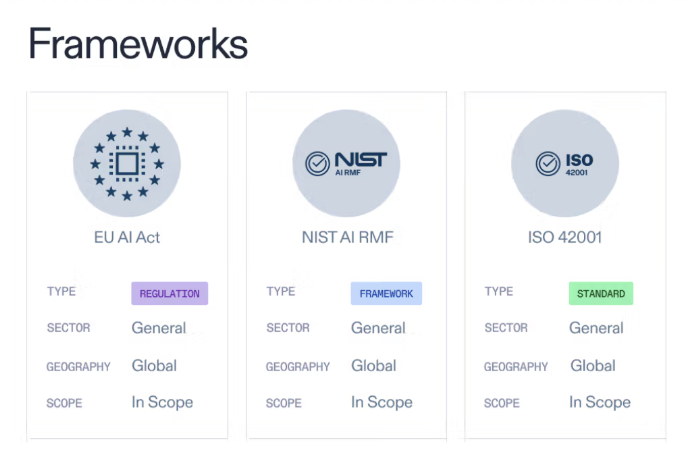
Regulation is catching up to the reality of autonomous AI, and the compliance timeline is shorter than most organizations expect. The frameworks now in play weren't written for chatbots or systems that can act.
Three regulatory frameworks define the governance landscape for autonomous AI systems. Each addresses different dimensions of the compliance challenge, and together they set the baseline that enterprises will be measured against.
The EU AI Act’s transparency obligations applied from 2 August 2026, and its high-risk requirements follow in stages: 2 December 2027 for standalone high-risk systems, and 2 August 2028 for those embedded in regulated products. Organizations deploying autonomous agents in high-risk categories face mandatory risk assessments, human oversight requirements, and transparency obligations, with penalties of up to €15 million or 3% of annual turnover for breaching them.
NIST launched its AI Agent Standards Initiative in February 2026, specifically addressing the governance gap for autonomous systems.
The initiative targets three pillars:
ISO 42001 provides the management system framework for responsible AI. Organizations pursuing certification need documented AI policies, risk assessment processes, and control implementations that now must account for autonomous execution, not just model outputs.
Most enterprise AI policies were designed for a review-and-approve workflow. A model generates an output, a human reviews it, and the organization acts on it. Governance wrapped around that sequence: acceptable use policies, output review checklists, periodic assessments.
Agentic AI bypasses the review step entirely, creating a structural gap: policies that govern what humans do with AI outputs don't apply when agents execute decisions autonomously. Periodic compliance assessments, whether quarterly or annual, cannot catch risks that emerge and compound between assessment cycles.
To fix this, compliance monitoring must become continuous, not periodic. Policies must govern agent behavior and scope, not just human use of AI tools. And evidence collection must happen in real time, because agentic AI is already reshaping how internal audit operates.
Governance programs that scale with autonomous AI share three characteristics: they know what agents exist, they assign clear ownership before agents deploy, and they connect agent oversight to the existing GRC infrastructure.
You cannot govern what you cannot see. Shadow AI, described as pervasive or widespread by 35% of organizations, makes discovery the non-negotiable first step.
An effective inventory captures every AI agent in the environment: what it can access, what decisions it can make, what data it processes, and who deployed it. Classification follows, categorizing agents by risk level, regulatory exposure, and operational scope.
This is not a one-time exercise. Agents proliferate quickly, and new deployments can appear without centralized approval. A living registry with automated discovery mechanisms is what separates governance programs that function from those that exist only on paper.
Every agent needs a named owner before it reaches production. That means defining who is responsible for the agent's behavior, what conditions trigger human review, and how to shut the agent down if needed.
Escalation paths must be explicit and tested. When an agent takes an action outside its defined scope, or when its decision creates an exception, the escalation workflow needs to route to the right person within the right timeframe. Ambiguity in ownership is how minor agent misbehavior becomes a reportable incident.
Standalone AI governance tools create another silo. The value comes from integrating agent oversight into the same platform where risk registers, control frameworks, evidence repositories, and audit workflows already live.
A connected data model links agent actions to controls, controls to frameworks, and frameworks to evidence, so compliance teams can trace from an agent's behavior all the way to the regulatory obligation it touches. This is how governance keeps pace with the speed of autonomous execution.
Humana demonstrated the power of connected risk management across functions. By breaking down silos between risk management and internal audit using Optro's platform, Humana achieved a 30% increase in SOX controls tested, a 50% increase in risk audits completed, and a 20% gain in audit cycle efficiency.
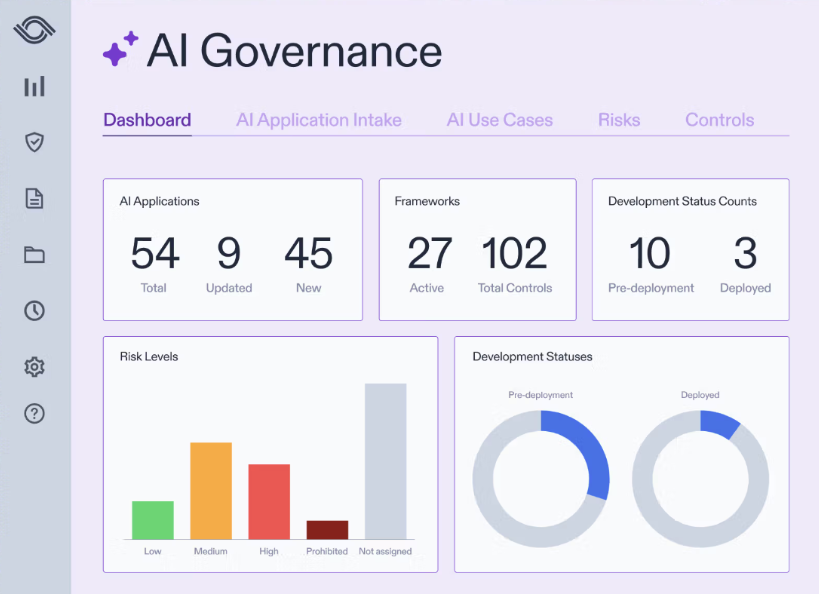
Optro's AI Governance solution delivers centralized AI system inventory and discovery, surfacing unauthorized agents before they create compliance gaps.
Compliance automation spans 25+ frameworks, including ISO 42001, EU AI Act, and NIST AI RMF, with harmonized controls that eliminate duplicate evidence work.
Automated risk scoring evaluates AI systems from intake through production. Dedicated autonomous agent governance frameworks provide the guardrails that agentic deployments require.
And because AI governance sits inside Optro's connected risk platform — integrated with risk management, compliance, IT controls, and audit — organizations get a single source of truth rather than another standalone tool.
AI agents are making decisions across your enterprise right now — do you have real-time visibility into what they're doing?
Optro's connected GRC platform centralizes AI agent discovery, automates compliance across 25+ frameworks, and links every agent action to your existing controls, risks, and audit programs.