



Internal Audit
CRX | GRC Intelligence and Agentic AI across audit, risk, and compliance | Read more
June 3, 2026 • 17 min read

Kara Killingsworth
Manual control testing has hit a structural wall. SOX populations are growing, audit complexity is climbing, and the people pool that does the work isn't expanding to match.
RPA closed part of the gap. It moved repetitive sampling and screenshot collection out of human hands, but didn't change the shape of the work. Practitioners still scoped traditional test cases, performed manual tickmarking, interpreted exceptions, and assembled workpapers by hand.
Agentic AI can now execute control tests against source systems, identify exceptions, and produce audit-ready documentation as a continuous workflow rather than a quarterly sprint. What follows defines the practice, separates it from prior automation, and lays out what audit and compliance leaders should expect.
SOX and SOC 2 control testing still consuming weeks of manual effort every quarter?
Optro's agentic AI executes control tests against your source systems, generates audit-ready workpapers, and runs on the connected GRC data model where your controls and frameworks already live.
Autonomous control testing is the use of AI agents to execute control tests with minimal human direction. It applies principles from AI-driven autonomous software testing and test automation — long used in software development and engineering — to the compliance domain. The end-to-end workflow runs in order:
The work runs continuously rather than as a periodic exercise. Instead of pulling a quarterly sample, an agent can test the full population or selected samples every time the underlying data changes — and produce documentation the auditor can sign off on.
Manual testing gave way to RPA, which gave way to continuous controls monitoring; autonomous testing closes the remaining gap by adding reasoning and documentation.
These three terms get used interchangeably and shouldn’t be. The differences matter when evaluating vendors or scoping a program.
Agentic AI sits across the workflow, not just at the end. Practitioners scope what to test and what tolerance looks like; agents handle data retrieval, test execution, exception identification, and workpaper drafting; humans review and sign off. The split removes work that doesn’t require practitioner judgment, freeing human testers so judgment lands where it adds value.
The economics of manual testing stopped working before AI made an alternative possible. Now both are true at once—rising program costs with a workforce that hasn’t kept pace, and an agentic approach that addresses the test itself, not just the prep work.
SOX costs keep climbing. KPMG’s 2025 SOX Survey put the FY24 average annual program cost at $2.3M, up from $1.6M in FY22, with 45% of organizations reporting a year-over-year increase. Average program hours rose 32% over the same period, from 11,800 to 15,580.
The volume driver is in-scope system count, which more than doubled in two years—from 17 in FY22 to 40 in FY24. Every new system means new controls, new evidence requests, and new test populations.
Internal audit isn’t insulated. Deloitte’s 2025 Internal Audit Hot Topics flagged talent constraints, burnout, and the gap between rising audit complexity and a workforce that hasn’t grown to match. Boards and external auditors are asking for continuous assurance; most teams are still producing it quarterly.
RPA took the obvious work off practitioners' plates. Scripts pull reports, screenshot dashboards, populate templates, and reconcile lists. What it never handled was interpretation: whether an exception is material, whether evidence actually supports the control objective, whether a flagged item is a real finding or a false positive.
Most programs used automation for the prep work, not the test itself, so hours moved around the calendar instead of coming out of it
Agentic AI changes the unit of work. Instead of automating a task, an agent executes an outcome: test this control against this population, document exceptions, and produce a workpaper ready for review. The agent decides which evidence to retrieve, how to apply the test, and how to narrate the result.
The shift depends on connected GRC data across the entire compliance lifecycle underneath. Autonomous agents only produce defensible results when they reason against a unified control library, framework mapping, and evidence repository — not a patchwork of spreadsheets and shared drives.
Manual control testing has hit a structural wall. SOX populations are growing, audit complexity is climbing, and the people pool that does the work isn't expanding to match.
RPA closed part of the gap. It moved repetitive sampling and screenshot collection out of human hands, but didn't change the shape of the work. Practitioners still scoped traditional test cases, performed manual tickmarking, interpreted exceptions, and assembled workpapers by hand.
Agentic AI can now execute control tests against source systems, identify exceptions, and produce audit-ready documentation as a continuous workflow rather than a quarterly sprint. What follows defines the practice, separates it from prior automation, and lays out what audit and compliance leaders should expect.
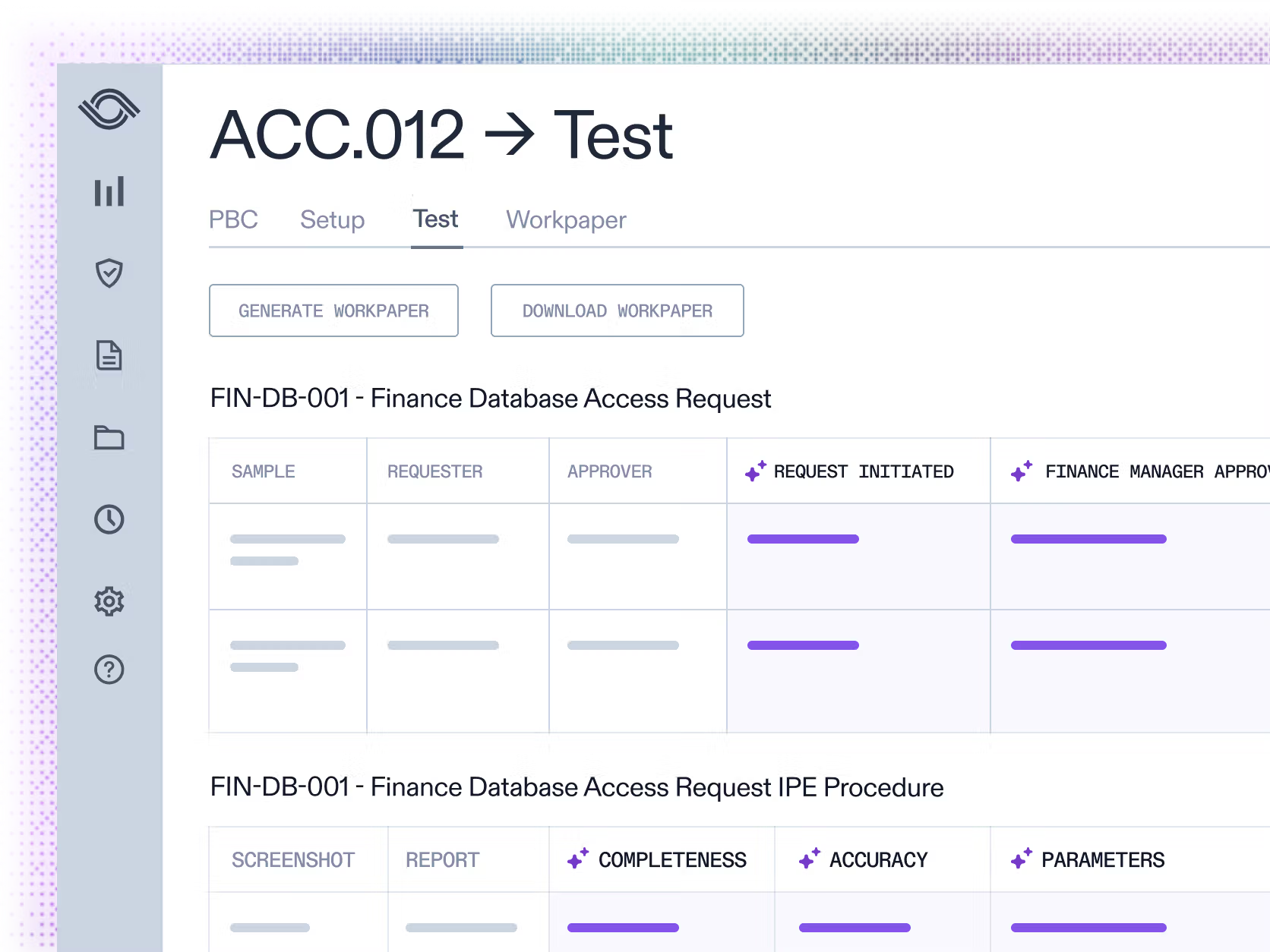
The workflow looks the same across mature implementations, even if the underlying agent architecture varies. The end-to-end loop runs in order: practitioners define parameters, agents collect evidence and execute tests, exceptions get handled and documented, and humans review and sign off.
Practitioners define the control, test cases, test logic, population, tolerance threshold, and what an exception looks like. Agents inherit these parameters. They don’t invent test approaches or redefine the control objective.
Oversight is configurable: teams can set agents to draft workpapers and stop for review, or to run continuously and surface only flagged exceptions. The right setting depends on the control, the risk rating, and the team’s track record with the agent.
Source-system reach is the gating factor. Agents connect via APIs to ERP, cloud platforms, identity providers, SaaS applications, and ticketing tools, then pull the evidence the test calls for—full population, not a sample. Where access constraints exist, the agent surfaces them rather than working around them. Or the SOX team can follow their regular sample-based and evidence collection approach.
Test execution applies the practitioner’s logic: a user-access review compares entitlements against approved access lists; a change-management test traces production changes to approved tickets. The agent runs the comparison and records what it found.
Exceptions get handled the same way every time: recorded against the control, evidence traced back to source, narrative explanation drafted in natural language. The workpaper carries test logic, population, exceptions, evidence, and the agent's reasoning in a single linked record. Audit-grade documentation is the output, not a deliverable assembled after the fact..
Review depth scales with risk. For controls, the agent has tested cleanly over multiple cycles, practitioners can run a lighter review—confirm logic, scan exceptions, sign off. Judgment-intensive controls get deeper review: follow-up questions, additional evidence requests, and direct inspection of the agent’s reasoning.
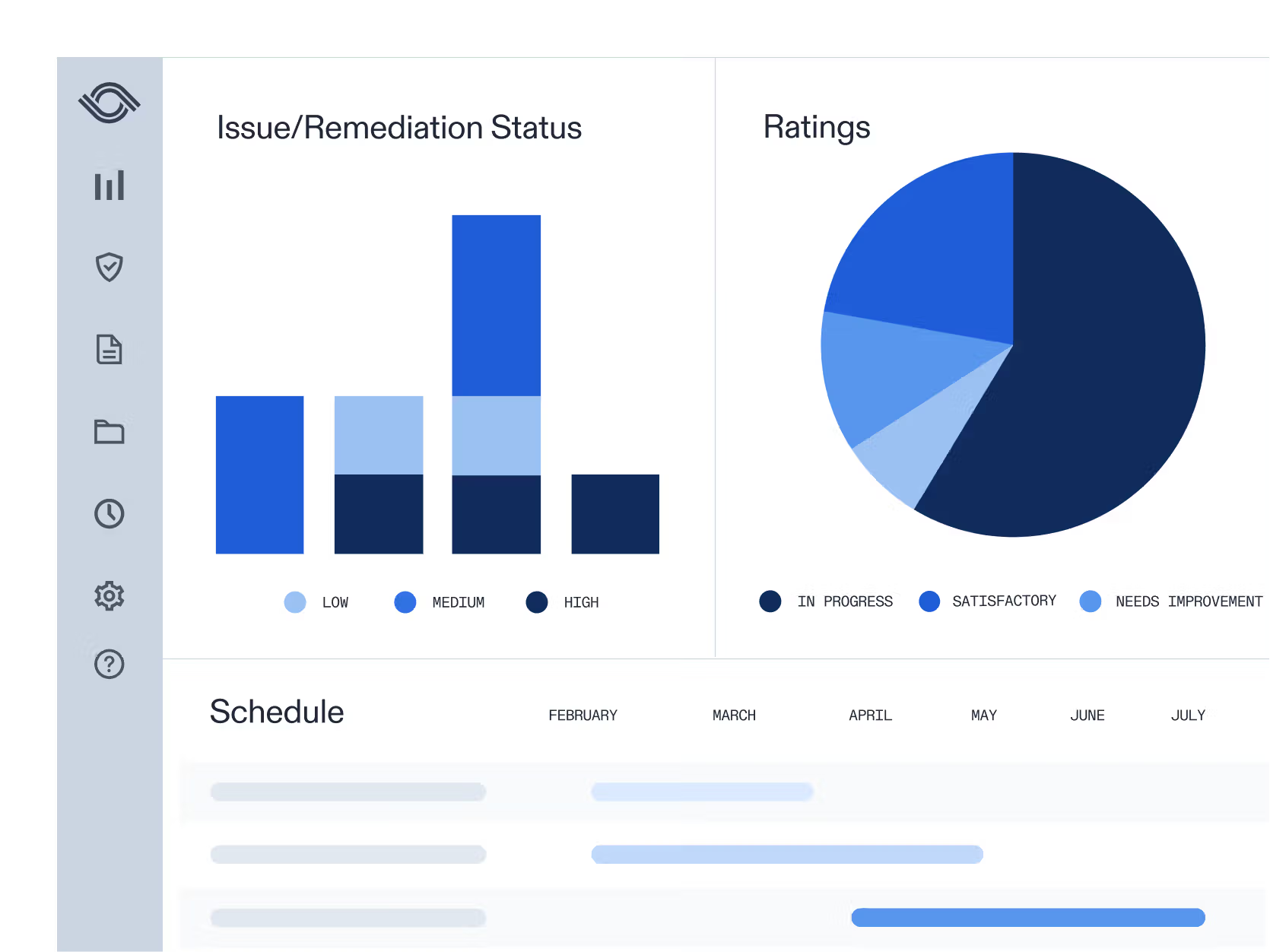
That review-and-sign-off loop is what Optro's Controls Management solution operationalizes. Following the Midship acquisition in May 2026, agents execute SOX control tests, draft workpapers, and route them to practitioners — closing the gap between continuous testing and practitioner oversight inside one platform.
Autonomous testing delivers the biggest gains on rules-based, evidence-heavy controls—SOX, FDICIA, MAR, ITGCs, SOC 2 criteria, and cross-framework IT compliance work. The same adaptability that improves software quality for QA teams translates here: agents handle the patterned work so practitioners can focus on judgment-intensive controls.
SOX IT general controls—user access reviews, change management, backup and recovery, segregation of duties—are the strongest fit. Each has clear test logic, defined evidence, and large populations that benefit from full-population testing. Process controls like journal entry approvals, reconciliations, and three-way matches follow the same pattern.
SOC 2 Trust Services Criteria around security, availability, and confidentiality translate cleanly into autonomous tests—the evidence sits in identity systems, cloud configurations, and ticketing tools that agents can connect to. Internal audit testing across operational and financial controls follows the same logic.
This is where the connected-control-library payoff is largest. The same test of a user access control can produce evidence for SOX ITGCs, SOC 2, NIST CSF, ISO 27001, and HIPAA simultaneously—if the data model maps controls against multiple frameworks. Without that mapping, the agent runs the same test five times with no efficiency gain. The piece on cybersecurity GRC covers the data model implications.
Some controls aren’t autonomous-friendly today. Entity-level controls around tone at the top, control environment assessments, fraud risk evaluations, and any control that turns on management intent still require practitioners. The same goes for novel risks where the test approach itself is being defined. Autonomous testing accelerates the work where the rules are clear—it doesn’t replace the work of figuring out what the rules should be. Expert insights on automating IT controls reinforce the point: the biggest gains come from pairing automation with sharper human focus on judgment-heavy areas.
Autonomous control testing is most credible when it sits on a connected GRC data model — where controls, frameworks, evidence, and risks already share a single record. Without that foundation, "autonomous" reduces to rebranded RPA.
Six questions separate a real agentic platform from a relabeled one: whether the agent reasons about exceptions or just runs a scripted task, how broad the source-system integrations are, whether test logic and evidence trace back to source in a single record, whether oversight is configurable per control, how the security posture holds up, and whether the data model underneath is actually connected.
The teams getting the most out of autonomous testing are the ones whose controls, evidence, and frameworks already live in the same place.
Are SOX and controls testing still consuming weeks every quarter? Optro's agentic AI executes control tests against your source systems, drafts audit-ready workpapers with traced evidence, and runs on the connected GRC data model where your controls, frameworks, and risks already live. Request a demo.

Kara Killingsworth, CPA, is a Product Marketing Manager for SOXHUB at Optro. She has 6 years of experience working in IA consulting, helping financial services clients with SOX compliance, operational audits, and regulatory compliance, most recently as a Manager at Protiviti. Kara has reviewed and performed end-to-end SOX testing for clients, with a special focus on how the right technology can speed and streamline processes.