





Internal Audit
Risk
CRX | October 13-15, 2026 | Up to 17 CPEs | In-person & virtual options available | Register Now!
May 5, 2026 • 11 min read

Richard Chambers
Internal audit resources are in decline. This decline is happening just as risks are expanding exponentially, fueling a risk exposure gap, imperiling internal audit’s ability to fulfill its mission, and creating new risks for internal audit and our organizations.
These concerns are not new. I’ve been sounding the alarm about stagnating resources since 2023. But data from the Internal Audit Foundation’s (IAF’s) 2026 North American Pulse of Internal Audit and recent Optro surveys should create a new sense of urgency.
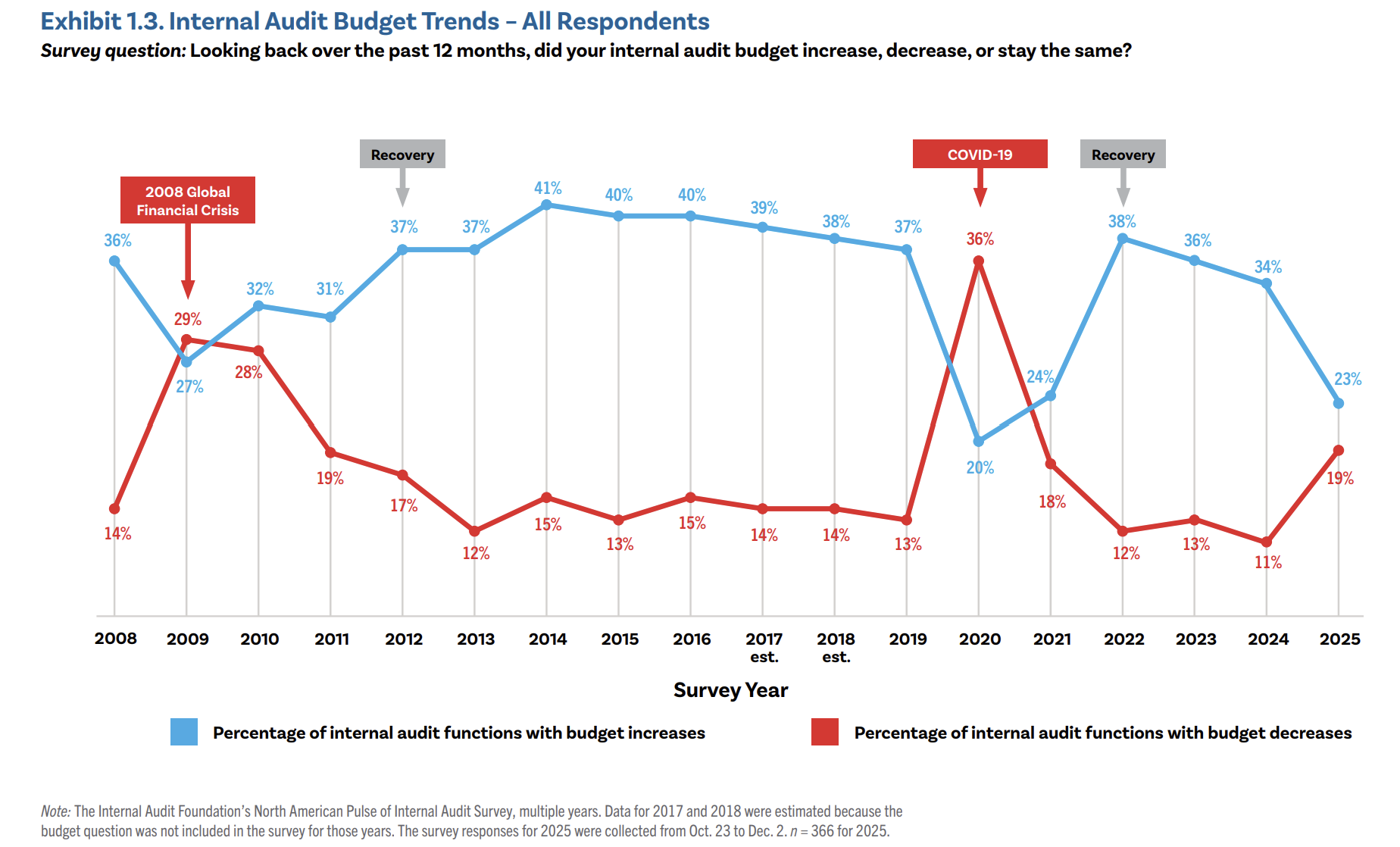
For only the third time since the Pulse began 18 years ago, IAF’s 2026 survey reflected a significant contraction in the number of internal audit functions growing versus those losing resources. More functions reported budget cuts (11% in 2024; 19% in 2025), fewer reported increases (34% in 2024; 23% in 2025), and fewer said funding was “mostly” or “completely” sufficient (53% in 2024; 45% in 2025). As shown, the first two significant budget contractions — 2009 and 2020 — clearly correlated to macroeconomic conditions: the 2008 global financial crisis and COVID-19. But the 2025 decline appears to be an anomaly. What’s going on?
At the same time, survey data suggests that CAEs typically have limited control over their budgets — and that their resource optimism often doesn’t match reality. CAEs can’t mitigate resource risks they don’t see coming. Accordingly, let’s examine the data to better understand the signals, possible explanations, and how CAEs can take action to mitigate the expanding risks of declining resources.
Recent surveys find that most internal audit budgets have either flatlined or declined. Optro’s 2026 Focus on the Future survey reflected this trend, with 61% of 2025 budgets flat (43%) or reduced (18%). An April 2026 Optro poll offered a sneak preview of 2026: 64% of internal audit leaders said current fiscal year budgets had either decreased or remained flat; another 8% said budgets had increased, but less than the widely recognized 3% rate of inflation. In sum, the data suggests that as many as 72% of internal audit functions could be operating with reduced budget capacity in the coming year. That’s a stark figure.
Further, most CAEs aren’t in the driver’s seat on how their budgets are allocated. Optro’s April poll found that only about one-fourth of CAEs have autonomy over how their budgets are used. Specifically, 26% reported having full autonomy; 46% can reallocate small amounts, but major shifts require CFO/Finance approval; and 28% have to obtain individual approval for every significant expense change.
While CFOs take their responsibility to safeguard internal audit independence very seriously, internal audit nonetheless remains a cost element in CFO budgets in many organizations. Broadly speaking, CFOs have significant influence on internal audit functions given:
Despite rising risk volume and complexity, expanding internal audit mandates, and persistent CAE optimism, data shows that internal audit headcounts are often similarly flat or declining.
Optro’s April poll of over 200 internal audit leaders* indicated that, among functions facing budget reductions, staffing took the biggest hit. The most impacted areas included internal audit function staffing (20%) external co-sourcing/SME support (17%). And yet, most internal audit leaders remained reasonably optimistic about headcount: 50% expected headcount budgets to stay the same, 27% expected increases, and 23% expected decreases. However, Optro’s recent Focus on the Future data suggests CAEs often forecast lower headcount decreases than actually occur:
Again, 2009 and 2020’s resource contractions correlated to macroeconomic conditions following the 2008 financial crisis and COVID-19. We can only speculate about 2026’s contraction. However, if this data is reflective of the overall profession, I see three realistic explanations:
Internal audit’s apparent resource decline creates new and urgent risks. Just as internal auditors advise others incurring risks to have mitigation plans in place, CAEs urgently need mitigation plans. Consider these actions:
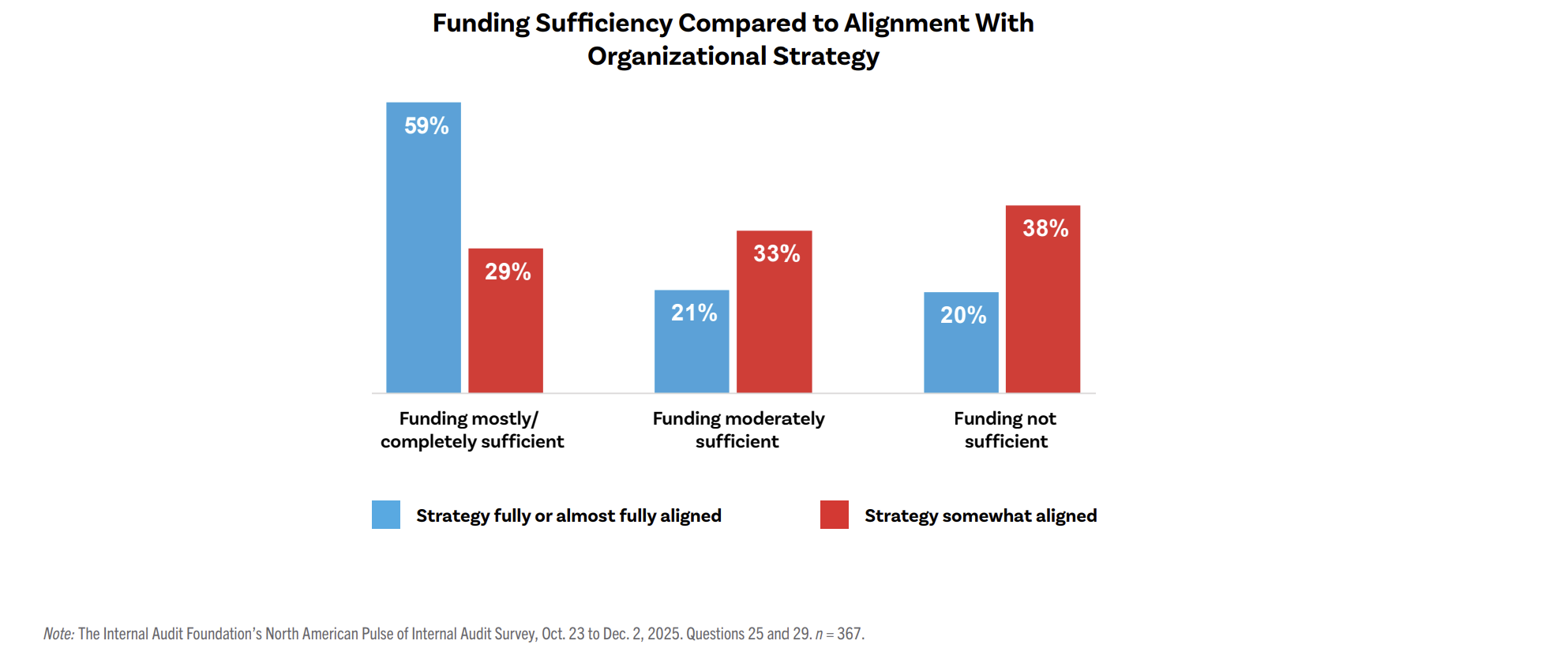
4. Leverage technology use and innovation to audit smarter. My staff was always my priority when I faced budget cuts as a CAE. So I’d first cut discretionary expenses (e.g., travel, training, technology, third-party services), with third-party services and technology typically the first to be reduced. I’d caution today’s CAEs, however, that technology is now integral to solving today’s resource challenges. If we fail to use AI and other technologies to enable our teams to do more with less, we put our own relevance and value — as well as the future of our profession — at risk. Further, Standard 10.3 requires CAEs to regularly evaluate technology use and pursue improvement opportunities.
Whatever your current situation, this data should ring alarm bells. It suggests that 2026 could mark the first time in recent history when internal audit resource contractions were not the result of a major macroeconomic event. It also signals that internal audit may be entering a new resource era in which we must continuously demonstrate our value with fewer resources. Only functions that are proactive in mitigating the risks of declining resources will win the race for relevance.
*The “Internal Audit Budget Pressures” survey was open from April 2, 2026, to April 9, 2026, and distributed to internal audit professionals to gather insights on budget trends, staffing, and the impact of AI on internal audit functions.
Richard Chambers, CIA, CRMA, CFE, CGAP, is the CEO of Richard F. Chambers & Associates, a global advisory firm for internal audit professionals, and also serves as Senior Advisor, Risk and Audit at Optro. Previously, he served for over a decade as the president and CEO of The Institute of Internal Auditors (IIA). Connect with Richard on LinkedIn.