



Internal Audit
CRX | GRC Intelligence and Agentic AI across audit, risk, and compliance | Read more
March 31, 2026 • 25 min read

Vice Vicente
Key Takeaway: Effective audit reports lead with a one-page executive summary, rate findings by severity, and tie every observation to evidence. The IIA's Global Internal Audit Standards (effective January 9, 2025) and PCAOB QC 1000 (effective December 15, 2026) are reshaping what report templates must contain. Success is measured by remediation rates, not pages issued.
An effective audit report cuts through inbox noise and drives action from the people who own the controls. With the IIA's new Global Internal Audit Standards now in force and PCAOB QC 1000, ISSA 5000, and the EU AI Act all landing by December 2026, internal audit, infosec, and compliance teams are rebuilding report templates against a moving regulatory baseline. The bar is no longer a clean opinion — it's a report that an audit committee, a process owner, and an external regulator can each act on without translation.
A poorly written audit report carries real downside: penalties and fines, litigation risk, financial losses, operational disruptions, reputational damage, and patient safety impacts in regulated sectors. Miscommunicating results means stakeholders miss operational deficiencies, data integrity risks, and care-quality issues. Consider an audit committee receiving an incomplete picture of cybersecurity readiness over client medical data, or an internal report mis-categorizing control failures as a significant deficiency instead of a material weakness — leading to a material misstatement in the annual financial report. These scenarios illustrate why the report must clearly communicate findings, purpose, report type, who performed the audit, recommendations, the audit opinion (when required), and other key attributes.
A quality audit report written with the audience in mind, taking a human-centered approach, produces more value for readers and motivates stakeholder action. It saves time across the board by being simple, digestible, and actionable. It's the core deliverable of a mature audit program.
An effective audit report — internal or external — clearly communicates the objectives, scope, and findings of an engagement and motivates readers to act on its recommendations. Length is not the measure of value: in fact, a one-page audit report can be the perfect format for certain initiatives. The right level of detail lets the audience understand context, determine whether the audit objective was met, and act on recommendations.
Different audiences need different views. Executives want a short summary of takeaways. Managers and process owners directly affected by findings need to review results and recommendations in detail. The same underlying evidence supports both.
Different report types also follow designated templates — some set by regulators, some adopted as industry practice.
Financial audits. Public companies (issuers) are required to undergo an annual financial audit from an independent external accounting firm. The audit report is published in the company's Form 10-K. Depending on size, issuers may also be required to undergo an audit of their internal controls over financial reporting (ICFR). The PCAOB oversees public accounting firms and ensures their auditing standards comply with Sarbanes-Oxley (SOX). Language in the 10-K audit report is largely standardized and runs less than two pages. The critical component is whether the auditor issues an unqualified or qualified opinion (two other options are covered below). PCAOB AS 3101 also requires external auditors of most public companies to describe Critical Audit Matters (CAMs) — matters communicated to the audit committee that involved especially challenging, subjective, or complex auditor judgment — in the report, including the relevant accounts and how each matter was addressed.
Healthcare audits. Entities across the healthcare sector undergo mandatory audits to verify regulatory compliance, improve quality of care, and safeguard financial integrity. Organizations must be audited for compliance with the Health Insurance Portability and Accountability Act (HIPAA), which sets national standards for protecting sensitive patient information and mandates safeguards over the confidentiality, integrity, and availability of protected health information (PHI). Laboratories are audited against the Clinical Laboratory Improvement Amendments (CLIA) and related standards. Medicare and Medicaid require audits to confirm compliance with federal and state regulations and proper use of funds.
Criteria for an effective report vary by report type, but the common themes covered below apply across engagements.
The IIA's Global Internal Audit Standards (GAIS), effective January 9, 2025, replaced the 2017 International Standards and reorganized requirements into five domains. For reporting specifically, GAIS Domain V (Performing Internal Audit Services) requires that final engagement communications include objectives, scope, results, conclusions, recommendations or action plans, and — when applicable — the auditor's overall conclusion or opinion, with stronger emphasis on whether engagement objectives were achieved.
Practitioners should remap existing report templates against GAIS in 2026 and update QA/QAIP procedures to test conformance. Functions still citing the prior IIA Standard 2410 in their methodology documents are working from a superseded reference.
An effective audit report delivers a clear message — whether that message is an unqualified opinion or a list of expenditures to eliminate. Reports should be concise and focused. Simplicity and specificity go the distance in business writing. Use plain language over auditor jargon; write for a reader who isn't an auditor. Avoid confidential information that would limit external distribution. Keep the focus on the audience, and keep the report centered on the risks and control environment in the area audited.
We've pulled one of our top resources on how to write a good audit report from our Audit Management Playbook — 10 best practices for writing a digestible audit report. The full playbook is available for download below.
Our Audit Management Playbook recommends 10 best practices for writing a digestible audit report:
Good writing leaves room to break the rules. If your audience needs a shorter report and you can't incorporate every practice into your deliverable, that's fine. As long as you've tailored the report to your audience and have detailed findings in your back pocket to support it, you should be able to present your findings with confidence.
Citations matter. Avoid unverifiable claims and bridge information gaps by referencing where you obtained key facts and figures. Give stakeholders the tools to research findings themselves. Demonstrate domain command by referencing authoritative documents, calling out audit evidence, and providing insightful data.
To keep the report from getting congested with citations — whether from local government, an official .gov publication, or another organization — include a reference section and use appendices. Even the report for a single audit benefits from a well-structured references section.
Use visuals to convey your message. Reports don't have to be drab. Circle or highlight key points, and use font styling and color to draw attention to critical facts and figures. Use tables or graphs to summarize key trends or important data wherever possible.
Report key statistics and contextual details to give relevance to audit findings and keep stakeholders invested. Presenting financial information — like a company's liabilities balance — in a vacuum means very little. Showing how that value relates to the company's overall financial position gives stakeholders a basis to decide whether to reduce liabilities or take on more debt.
Audits and auditors get a bad rap for only ever bringing bad news. Break the stereotype and give stakeholders something to acknowledge by including positive findings alongside gaps. It may seem trite, but highlighting the positives reinforces habits, processes, and teams worth keeping.
Issues and accompanying recommendations make up much of the report. Use the five C's as a guide for what each finding should document: criteria, condition, cause, consequence, and corrective action plan (or recommendation).
Pair the 5 C's with a documented severity rating. Most internal audit functions use either a three-tier (high/medium/low) or four-tier (critical/significant/moderate/minor) model, with rating criteria defined by likelihood and impact on objectives, controls, or compliance. Apply the rating consistently, document the rationale in the workpapers, and order findings in the report from highest to lowest severity so readers see what needs immediate action first. For SOX and ICFR work, align severity language with the PCAOB definitions of control deficiency, significant deficiency, and material weakness to avoid downstream misclassification.
A good audit report stays short, sweet, and on target — but some findings call for zooming in. Not every finding needs deeper treatment. When observations are complex, require additional resources to remedy, or need to be elevated for another reason, a Detailed Observations section that includes additional facts and figures draws reader attention to higher-priority items.
Multiple reviews of a management-facing audit report are recommended. Find a reviewer without a direct connection to the audit so they can provide fresh eyes. If possible, ask someone from the department or function audited to review the report and provide feedback. Reports should only be finalized and delivered once the last review is complete and open comments are addressed.
Preserve the relationship with audit clients, especially when performing an independent audit as part of a CPA firm, by remaining objective and avoiding blame. State issues, opinions, and recommended actions.
Avoid soft, indirect statements. Use solid recommendations and clear calls to action. Use plain language over technical jargon; write for a reader who isn't an auditor. The reader will appreciate it.
The most damaging audit report mistakes are predictable. Run a pre-issuance review specifically against this list:
An audit report should include objectives, scope, methodology, findings with supporting evidence, conclusions, recommendations, and — when applicable — the auditor's opinion. One useful framing comes from the IIA Global Standards, now organized under GAIS Domain V. Working from common standards, most internal auditors follow a similar baseline structure:
The full report structure should include a title page, table of contents, and executive summary. The introduction should explain the audit objectives, scope, and methodology. This establishes what the audit was about, why the audit risk areas mattered to management, and what the team covered.
Key Point: For certain audits, it is best practice to communicate with key stakeholders prior to fieldwork to understand their concerns and expectations.
Next, the report presents findings in a clear, structured manner, categorized by area or process audited. Evidence to support each finding — data, documents, observations — needs to be documented, along with any benchmarking criteria and the impact of each finding on the organization.
After findings, recommendations follow. Actionable suggestions that provide practical, specific recommendations are most useful. Prioritize recommendations by urgency and importance, and quantify the financial benefit of implementation where possible.
The conclusion section gives the audit team a chance to make comments beyond the individual issues in the results section. It's also where most reports include the internal auditor's opinion. The end of the report is a good opportunity to acknowledge areas where management did well.
The executive summary fits on one page and answers five questions in order: why the audit was performed (purpose/scope in one to two sentences), what was tested (methodology in one line), what was found (finding counts broken down by severity rating), the overall conclusion or opinion, and what management is expected to do next. Write it last but place it first. Make sure an executive who reads only this page can take action without reading the rest of the report. Don't restate the scope memo — the summary exists to drive decisions, not document procedures.
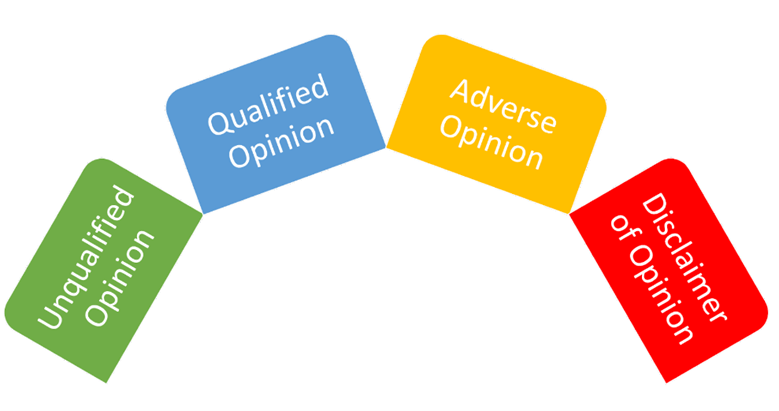
While not all audit reports involve issuing an audit opinion, many do — financial statements and annual reports among them. There are four possible audit opinions.
Image: Types of audit opinions
The written report is the artifact; the delivery model is what drives remediation. Effective audit functions layer the communication: informal interim communication during fieldwork, a draft-finding review meeting with each process owner, a formal closing meeting with management to validate findings and agree action owners and dates, and a concise verbal walkthrough or one-page deck for the audit committee. Verbal delivery surfaces objections you'd otherwise discover post-issuance and lets you adjust phrasing for accuracy without diluting the message. Track action-plan closure rates as the success metric, not report-issued counts.
To improve your next audit report, follow our audit checklist on how to write a good audit report. A successful audit report is measured by its ability to inform stakeholders and initiate necessary change — clear objectives, clear scope, clear findings, and an actionable path forward.
An effective audit report executive summary fits on one page and answers five questions in order: why the audit was performed, what was tested, what was found (with finding counts by severity), the overall conclusion or opinion, and what management is expected to do next. Write it last but place it first. An executive who reads only this page should be able to take action without reading the rest of the report.
Findings should be rated using a documented severity scale — most internal audit functions use either a three-tier (high/medium/low) or four-tier (critical/significant/moderate/minor) model, with rating criteria defined by likelihood and impact. Apply the rating consistently across engagements, document the rationale in the workpapers, and order findings from highest to lowest severity. For SOX and ICFR work, align severity language with the PCAOB definitions of control deficiency, significant deficiency, and material weakness.
Critical Audit Matters are matters communicated to the audit committee that relate to material accounts or disclosures and involved especially challenging, subjective, or complex auditor judgment. PCAOB AS 3101 requires external auditors of most public companies to describe each CAM in the auditor's report, identify the relevant financial statement accounts, and explain how the matter was addressed. CAMs do not change the overall audit opinion; they give investors transparency into the auditor's most judgmental work.
The IIA's Global Internal Audit Standards (GAIS), effective January 9, 2025, replaced the 2017 International Standards and reorganize requirements into five domains. For reporting, GAIS Domain V requires final engagement communications to include objectives, scope, results, conclusions, recommendations or action plans, and — when applicable — the overall conclusion or opinion, with stronger emphasis on whether engagement objectives were achieved. Practitioners should remap existing report templates against GAIS and update QA/QAIP procedures to test conformance.
ISSA 5000 is the IAASB's stand-alone sustainability assurance standard, applicable to engagements over sustainability information regardless of framework (ESRS, GRI, ISSB) and effective for periods beginning on or after December 15, 2026, with early adoption permitted. The report must explicitly state the assurance level (limited vs. reasonable), the subject matter and applicable criteria, the materiality approach (including double materiality where the framework requires it), and the practitioner's conclusion calibrated to that assurance level. Pilot ISSA 5000 on a 2026 engagement to build templates ahead of the deadline.
The most effective delivery model is layered: informal interim communication during fieldwork, a draft-finding review meeting with each process owner, a formal closing meeting with management to validate findings and agree action owners and dates, and a concise verbal walkthrough or one-page deck for the audit committee. Verbal delivery surfaces objections you'd otherwise discover post-issuance and lets you adjust phrasing without diluting the message. Track action-plan closure rates as the success metric, not report-issued counts.
AI is currently used in audit reporting for three tasks: summarizing workpapers and observations into draft findings, standardizing tone and reading level across reviewers, and full-population analytics that feed evidence sections. The risks are that AI-generated language may overstate or soften findings, may invent citations, and — under ISO/IEC 42001 — must be governed through a documented AI management system covering data inputs, human review, and explainability. Treat AI output as a first draft requiring auditor sign-off, log prompts and model versions in the workpapers, and never let AI write the final opinion or rating.
Vice Vicente started their career at EY and has spent the past 10 years in the IT compliance, risk management, and cybersecurity space. Vice has served, audited, or consulted for over 120 clients, implementing security and compliance programs and technologies, performing engagements around SOX 404, SOC 1, SOC 2, PCI DSS, and HIPAA, and guiding companies through security and compliance readiness. Connect with Vice on LinkedIn.